





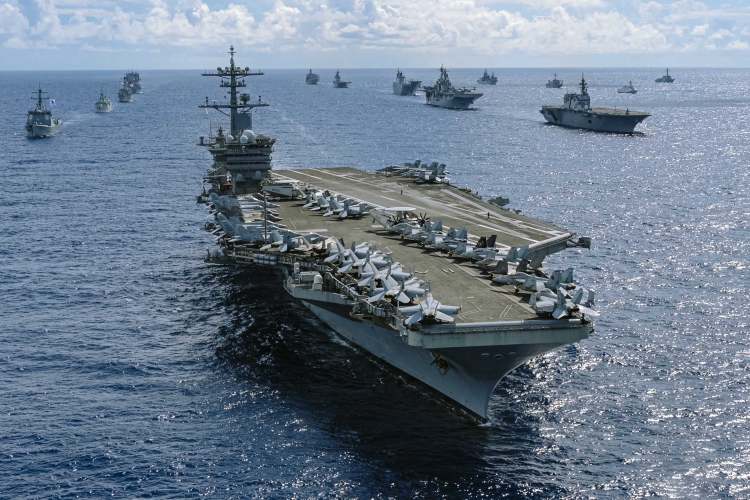
US naval supremacy under threat: The United States once ruled the Pacific because no rival could match its ability to build, move, and sustain fleets across oceans. That assumption now rests on memory, not evidence. Classified Pentagon war games examining a Taiwan conflict have produced an uncomfortable conclusion: the United States loses with disturbing regularity.
This is not the view of critics on the fringe. It is the judgment of the Pentagon’s Office of Net Assessment, conveyed to successive administrations through a classified review known as the Overmatch brief. When senior officials were briefed, one reportedly turned pale. Another admitted that every American advantage had been met by Chinese redundancy.
The timing matters too. President Xi Jinping has instructed the People’s Liberation Army to be ready to take Taiwan by 2027. Washington continues to speak the language of strategic ambiguity, but presidents of both parties have stated openly that Taiwan would be defended. Deterrence, therefore, now depends on whether American power at sea still intimidates.
The evidence suggests it does not. China has built a navy designed not to win parades, but to deny access. The Pacific is becoming less an arena of dominance and more a test of endurance. On that test, the United States and its allies are no longer certain of passing.
READ I Erosion of US hegemony speeds up under incoherent policy
China’s navy is built for war, not display
China’s naval expansion is often described as rapid but that understates the intent. It has been systematic, planned, and industrial. According to publicly available figures from the US Department of Defence, China now operates more than 370 warships. The United States fields roughly 296. More important than numbers is replacement speed. Chinese state-owned shipyards produce more than three warships for every one built in American yards.
Beijing has not chased prestige. It has chased denial. Long-range anti-ship ballistic missiles, hypersonic glide vehicles, quiet diesel-electric submarines, and land-based missile batteries are designed to make American carriers liabilities rather than assets. In Pentagon war games, those carriers do not linger. They sink early.
There is a blunt reality here that Washington has resisted acknowledging. A $13-billion aircraft carrier is not ten times more useful than a $1.3-billion alternative if it can be neutralised by a missile costing a fraction of that sum. China understands this arithmetic. The United States prefers not to. US naval supremacy is no longer about the biggest ship. It is about whether the ship can survive the first week of war.
READ I Harsh migration policies chipping away at American hegemony
US naval supremacy and its shipyards
The decline of US naval supremacy is not happening at sea. It is happening on land.
Over the past three decades, the United States has hollowed out its shipbuilding base. The Navy has spent roughly $700 billion on shipbuilding since the early 1990s. During that period, the fleet shrank by nearly half. This is not a budget problem. It is an industrial failure.
The collapse of the Constellation-class frigate programme illustrates the dysfunction. Conceived as a low-risk adaptation of a proven European design, it was derailed by endless modifications, labour shortages, and supply-chain fragility. The Navy eventually cancelled the programme after billions had been spent and years lost.
Workforce data is even starker. US shipyards employ about 150,000 workers. The Navy itself estimates it will need nearly 140,000 more over the next decade just to meet submarine orders. Welders, pipefitters, and machinists are in short supply, and pay often struggles to compete with service-sector jobs.
Here is the uncomfortable judgment: a country that cannot pay skilled workers to build ships cannot credibly threaten to fight a long naval war. China can. The United States currently cannot.
READ I Dollar hegemony: Trump’s economic policies risk weakening of greenback
Expensive platforms losing to cheap weapons
The wars in Ukraine and the Black Sea should have settled a debate Washington continues to postpone.
Ukraine did not neutralise Russia’s Black Sea Fleet with aircraft carriers or destroyers. It did so with small, unmanned boats packed with explosives. Drones costing hundreds of dollars forced capital ships to retreat. Prestige did not matter. Vulnerability did.
The same logic applies in the Pacific. China’s strategy is not to match American platforms one-for-one. It is to overwhelm them economically and logistically. Hypersonic missiles and mass-produced drones aim to exhaust US defences faster than they can be replenished.
The United States has responded hesitantly. Despite years of research, it has yet to deploy hypersonic missiles at scale. Attempts to procure cheap drones have repeatedly collapsed under the Pentagon’s instinct to over-engineer. Systems that should cost hundreds end up costing tens of thousands.
There is irony here. During the Cold War, the United States outproduced and out-innovated its rivals. Today, it risks becoming the Maginot Line navy of the 21st century—impressive, expensive, and designed for the last war.
Allies cannot offset US structural weakness
Washington often points to alliances as the answer. Japan, Australia, South Korea, and NATO partners are cited as force multipliers. Politically, this is correct. Industrially, it is insufficient.
Most US allies lack large-scale naval shipbuilding capacity. Japan is the partial exception, but even Japanese yards cannot match China’s output. European allies face similar constraints. Alliances add legitimacy. They do not manufacture hulls or missiles.
Supply chains introduce new vulnerabilities. Undersea cables, fuel depots, and port infrastructure are exposed to cyber and kinetic attack. US officials have confirmed that Chinese state-backed hackers have implanted malware in systems linked to American bases, potentially disrupting mobilisation.
Stockpile data is sobering. US missile inventories were significantly depleted during recent conflicts lasting weeks, not months. A Pacific war would demand sustained production over years.
The restrained but necessary judgment is this: alliances amplify strength, but they cannot substitute for it. Deterrence erodes when replenishment is slow and losses cannot be replaced.
A visible gap in capabilities
The loss of US naval supremacy in the Pacific is not sudden, nor is it mysterious. It is the cumulative result of industrial neglect, procurement inertia, and conceptual comfort with outdated assumptions.
China has aligned strategy, manufacturing, and doctrine toward a single objective: denying access to the Western Pacific. The United States has relied on legacy platforms and past reputation. That gap is now visible.
Reversal is still possible, but it requires discipline rather than drama. Investment must prioritise shipyards, skilled labour, and scalable weapons. Procurement rules must open space for new manufacturers. Allies must contribute industrial capacity, not only diplomatic statements.
Naval power in the 21st century will belong to those who can endure, replace, and adapt. The Pacific will not be decided by the most expensive fleet, but by the one that can still fight after the first losses are taken.