





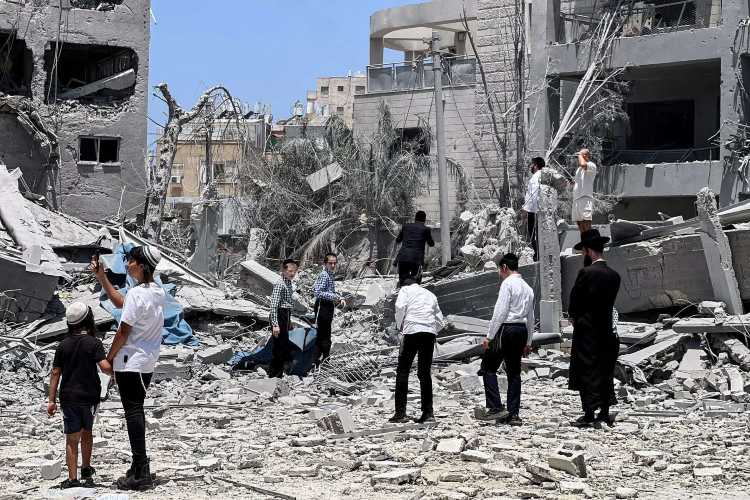
Europe’s silence on the Iran war: Europe has not merely failed to stop the US-Israel war on Iran. It has failed to defend the one claim that gave the European project moral and diplomatic weight after 1945: that power must remain tethered to law. That failure now carries a cost. It weakens Europe’s case for a rules-based order, erodes its credibility with the global south, deepens its dependence on Washington, and leaves its own economies exposed to a new energy shock that it neither caused nor can control. European leaders may call this realism. It is, in fact, abdication.
The revealing fact is that Europe is not truly divided on the legal question. The European Council has condemned Iran’s attacks and expressed solidarity with states in the region, but the record of European statements also shows a studied reluctance to apply the same clarity to the US-Israel use of force. That gap matters. When law is invoked against adversaries but suspended for allies, it ceases to be a principle and becomes an instrument. Europe has lived with charges of double standards before. This time, the charge is harder to rebut because the dissonance is written into its own diplomacy.
The contrast with 2003 is instructive. The Iraq war split Europe. France and Germany opposed Washington openly, Britain and others aligned with it, and the Union looked geopolitically incoherent. Yet that division produced a serious argument about Europe’s vocation in the world. It strengthened the case for multilateralism and eventually helped create the diplomatic setting in which the E3 and the EU became central to negotiations that culminated in the 2015 nuclear agreement with Iran. Europe turned disagreement into agency. On Iran war, it has done the opposite: it has converted broad unease into strategic muteness.
READ I Iran war is becoming a losing game for every player
Strategic autonomy without legal autonomy
This is where the rhetoric of European sovereignty begins to collapse. Brussels, Paris, Berlin and London have spent years speaking of “strategic autonomy”, “European defence”, and a more geopolitical Union. But autonomy that cannot survive American pressure is not autonomy. It is a slogan with a procurement budget attached. The Trump administration has openly pressed allies to help manage the Strait of Hormuz crisis and tied future alliance politics to their response. Europe’s answer has been to avoid direct military entanglement while refusing a frontal political break with Washington. That may reduce immediate friction. It does not establish sovereignty. It demonstrates its absence.
Europe’s caution on Iran war is not entirely irrational. The continent remains dependent on the United States for core security functions, above all in relation to Russia and Ukraine. That dependence distorts every other theatre. Governments that might otherwise denounce the war more clearly fear antagonising a White House that could retaliate by weakening intelligence support, military backing, or sanctions enforcement against Moscow. In other words, Europe’s inability to take a principled line on Iran is also evidence that it has still not solved its own primary strategic problem: it cannot yet secure itself without the patron it increasingly mistrusts.
That is why Spain’s Pedro Sánchez has stood out. Spain has been more willing than the E3 to articulate opposition in principled terms. But Spain’s room for manoeuvre also reflects geography and threat perception. For countries closer to Russia, the war in Ukraine remains existential in a way the Gulf crisis does not. The result is an uncomfortable hierarchy of principles. International law is defended with greater energy when its violation is linked to Russian conduct. When the violator is Washington or Israel, the language softens into concern, restraint, or silence. Europe’s normative architecture is thereby not defended selectively; it is hollowed out selectively.
READ I India gas supply: Why the Iran conflict may not choke urban kitchens
The cost of Europe’s Iran war response
The most immediate price is economic. The Iran war has triggered a fresh energy shock. The G7 and EU foreign ministers have already warned about global energy supplies and the security of maritime routes, especially the Strait of Hormuz. EU officials are discussing lower gas-storage targets and greater flexibility because the surge in prices has become a macroeconomic problem, not just a foreign-policy concern.
The ECB has held rates steady but explicitly flagged the uncertainty and inflation risk created by the war, while Bundesbank president Joachim Nagel has warned against second-round inflation effects taking hold. Europe is again learning that geopolitical dependency is not an abstract vulnerability. It appears on household energy bills, industrial input costs, inflation forecasts and growth downgrades.
This comes at a particularly bad moment for Europe. Germany’s industrial model was already weakened by high energy costs after Russia’s invasion of Ukraine. A renewed oil and gas shock now hits a continent that is still struggling with anaemic growth, shaky public finances, and politically fragile governments. Reuters reports that European gas prices have jumped sharply after damage to regional gas infrastructure, while investor sentiment in Germany has deteriorated markedly under the weight of renewed energy inflation fears. Europe did not choose this war. But by failing to oppose it with clarity at the outset, it has improved neither its security position nor its economic resilience.
The energy shock also exposes a second contradiction. Some EU governments now want relief through a softer climate stance, including changes to the emissions trading framework, while others resist any dilution of decarbonisation commitments. War-driven fossil dependence is thus beginning to distort Europe’s internal climate politics as well. A Union that once argued that climate policy, energy security and strategic autonomy reinforce one another is now being pulled back into short-term fossil vulnerability by a conflict it lacked the courage to contest.
READ I India’s metals policy must adapt to the Iran conflict
Europe’s diplomatic capital is being spent down
The larger cost is reputational. Europe’s claim to be a distinctive pole in world politics has rested less on raw force than on credibility: treaty-making, mediation, institutional patience, and a preference for law over unilateral coercion. That capital was always finite. It has already been damaged by Gaza. Iran risks depleting it further. Many countries in Asia, Africa and Latin America no longer see Europe as an impartial defender of rules. They see a bloc that invokes sovereignty, civilian protection and multilateral procedure when convenient, then retreats into alliance management when the United States is the transgressor. Europe may dislike that judgment. Its own conduct is making it easier to sustain.
That reputational decline has consequences beyond moral standing. It reduces Europe’s ability to build coalitions with middle powers, to shape UN outcomes, to persuade energy producers, and to broker future settlements in West Asia. The 2015 Iran nuclear deal was possible because Europe was seen, however imperfectly, as a serious diplomatic actor distinct from Washington. That distinction is fading. Once lost, it will not be restored by summit communiqués about multipolarity. It will require visible political acts of independence.
Law abandoned abroad returns as weakness
There is also an internal European consequence that is less discussed. The European Union is itself a legal order before it is a military order. Its single market, courts, treaties and enlargement logic all presuppose that rules are not decorative. When leading European figures imply that international legality is secondary to geopolitical necessity, they weaken more than foreign policy doctrine. They weaken the intellectual habit on which the Union rests. One cannot spend years arguing that Europe is a community of law and then, at a major test of external principle, declare that legality “misses the point.” That is not pragmatism. It is corrosion.
That is why the present moment is more serious than routine hypocrisy. Hypocrisy leaves the norm intact while violating it. Europe’s current posture risks something worse: treating the norm itself as dispensable when power politics becomes inconvenient. If that view hardens, Europe will not become a harder geopolitical actor. It will become a less coherent one, more dependent on the US, more vulnerable to Russian opportunism, and less persuasive everywhere else.
A principled position now would not require Europe to endorse Tehran, ignore Iran’s repression, or minimise the threat posed by its nuclear and missile programmes. It would require three simpler acts. First, state clearly that preventive war without imminent threat does not become lawful because it is conducted by allies. Second, insist that maritime security and energy stabilisation cannot be converted into retrospective legitimacy for the war itself. Third, revive diplomacy in a format that restores Europe’s distinct role rather than subordinating it to Washington’s battlefield timetable.
Recent European calls for protection of infrastructure, freedom of navigation and de-escalation are useful, but they remain managerial responses to a crisis whose legal and political origins Europe still hesitates to name.
The cost of that hesitation on Iran conflict is already visible. Europe has not prevented escalation. It has not insulated itself from energy turmoil. It has not increased its leverage over Washington. And it has not strengthened the legal order on which its own international identity depends. In trying to avoid a confrontation with the United States, European leaders may have chosen the more comfortable course. They have not chosen the wiser one.