





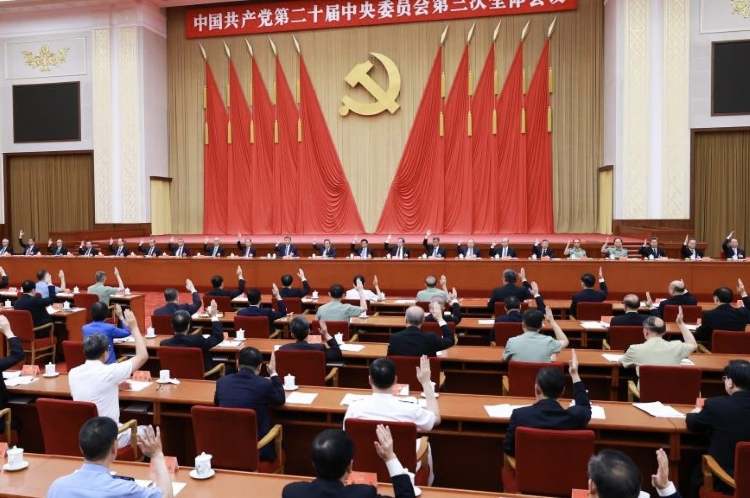
China’s 15th Five-Year Plan should not be read as a routine planning document. It is a state blueprint for the next phase of global competition. Beijing is entering what it calls the final decade of its drive to “basically achieve socialist modernisation” by 2035. The plan’s significance lies there. It is less about posting a respectable growth number than about deciding which country will shape the technologies, supply chains, standards and political language of the next international order.
The headline growth target of the 15th Five-Year Plan tells its own story. China has set a lower 2026 growth target of 4.5% to 5%, the weakest in decades, while keeping the focus on “high-quality development”. That is not an admission of retreat. It is a choice to accept slower expansion in return for a stronger industrial base, greater technological autonomy and deeper resilience against US pressure. The plan makes clear that Beijing now treats technological dominance not as an economic aspiration but as a national-security objective.
READ I AI regulation: China gets it right with hard rules
Technology leadership as state strategy
The 15th Five-Year Plan’s centre of gravity is unmistakable. Artificial intelligence appears throughout the document. Beijing wants AI embedded across manufacturing, logistics, education, healthcare and public administration. It is not pursuing a narrow laboratory race alone. It wants deployment at scale. That is a more formidable ambition. Countries can sometimes catch up in invention. They struggle far more to match a system that can diffuse new technology across industry, infrastructure and the state. Reuters reports that the plan mentions AI more than 50 times and ties it to quantum computing, humanoid robotics, 6G, brain-machine interfaces, advanced chips, nuclear fusion and space systems.
That matters because global leadership will increasingly rest on who controls applied ecosystems, not just frontier patents. China is trying to build the full stack: research, talent, computing power, manufacturing capacity, domestic scale, and exportable platforms. The official target to raise the value added of core digital-economy industries to 12.5% of GDP by 2030 is therefore not a side metric. It is a marker of a deliberate shift in the structure of power.
A recent analysis by the Tony Blair Institute captures the shift well. The emphasis is moving from developing scientific capability to diffusing it across the productive economy. Beijing’s wager is that AI-enabled industrial upgrading can offset demographic decline, preserve manufacturing dominance and export a Chinese model of techno-industrial governance. That is a blueprint for leadership, not merely for growth.
READ I Record trade surplus masks weakness of China’s economy
Supply chains, minerals and the politics of leverage
The second pillar is control over chokepoints. Beijing has for the first time highlighted its competitive edge in rare earths inside a five-year plan and pledged to maintain that lead while improving its export-control system. This is not a technical detail. Rare earths, critical minerals, batteries, power equipment and industrial inputs are becoming instruments of statecraft. China has understood earlier than most that future influence will come not only from markets but from bottlenecks.
The same logic runs through energy, food and materials. China wants more domestic mining, steady oil production, larger strategic stockpiles, more gas, higher grain output and secure overseas supplies of foodstuffs. It is preparing for a world in which interdependence is selective, weaponised and unstable. A country that controls industrial inputs, secures food and energy, and dominates midstream processing can set terms for others even without firing a shot.
READ I India-China trade: Structural imbalance, not a one-year problem
Domestic demand still lags the rhetoric
The 15th Five-Year Plan is not without contradiction. Beijing says household consumption will play a larger role, and the IMF has welcomed that direction. But the substance remains limited. China’s core problem is still the imbalance between strong supply and weak demand. The property slump, local-government debt and persistent deflationary pressures continue to depress household confidence. The IMF has warned that prolonged weak domestic demand and continued reliance on exports are generating mounting internal and external imbalances. Rhodium Group is blunter: China’s financial system is increasingly channelling credit into local governments and state firms simply to prevent collapse, while private investment remains weak.
This is the central weakness in China’s leadership bid. A nation that wants to lead the world cannot indefinitely depend on external markets to absorb domestic overcapacity. Reuters notes that Beijing again promised to tackle overcapacity in sectors such as steel, petrochemicals and copper smelting, but without hard output cuts. That suggests the political economy of industrial policy remains intact. China still prefers managed excess to market-led adjustment.
And yet this weakness may not derail the larger strategy. Leadership does not always require a perfectly balanced domestic economy. It requires state coherence, control over key technologies, command over supply chains, and the ability to convert economic weight into international bargaining power. On those counts, China is still advancing.
Green ambition of the 15th Five-Year Plan
The climate section also deserves a harder reading. The plan aims for a 17% cut in carbon intensity and a 25% non-fossil share in energy consumption by 2030. But it stops short of a firm coal phase-down, speaks only of coal consumption peaking, and continues to back oil, gas and coal-to-liquids. Beijing is not abandoning decarbonisation. It is subordinating it to energy security, industrial competitiveness and system stability.
That too is part of the world-leadership blueprint. China wants to dominate the green transition without allowing climate policy to weaken its geopolitical position. It will build solar, EV, grid and storage capacity at scale, but on terms that preserve industrial sovereignty. Others may talk more elegantly about the energy transition. China is building the machinery.
Culture, welfare and the making of a durable state
The 15th Five-Year Plan also extends beyond factories and export controls. It includes targets on employment, life expectancy, education, healthcare and childcare, and Beijing has separately detailed measures to respond to population decline and ageing. These are not merely welfare promises. They are attempts to stabilise the social base of a long strategic contest. A state that expects prolonged rivalry with the United States cannot afford social drift at home.
There is also a softer ambition. Chinese official commentary around the plan places clear emphasis on culture, communication and national cohesion. Outside China, such language is often dismissed as propaganda. That is too casual. Great-power competition is also about narrative legitimacy. Beijing wants not only to manufacture more than the West, but to persuade more of the world that its order is competent, stable and worthy of emulation.
A blueprint shaped by American volatility
Much of this plan is plainly a response to the United States. Analysts quoted by Reuters and other institutions are right to say the strategic level is “about the US”. Export controls, tariff wars and supply-chain pressure have not moderated Beijing. They have deepened its conviction that dependence is dangerous and self-reliance must be built fast.
This is where the wider geopolitical context matters. China’s plan arrives at a time when Washington has become more erratic in trade, alliance management and industrial policy. Beijing is offering the world something different: not openness in the liberal sense, but predictability, scale, financing, infrastructure and strategic patience. Many countries may resist Chinese dominance; quite a few will still adapt to it.
The 15th Five-Year Plan therefore deserves to be seen for what it is. It is not a promise that China will inevitably lead the world by 2030. Its domestic economy remains burdened by debt, weak consumption and overinvestment. But it is a coherent attempt to ensure that if world leadership in the next decade is defined by control over advanced industry, data systems, green infrastructure, critical minerals, applied AI and the institutions of interdependence, China will be better placed than any rival to claim it.