





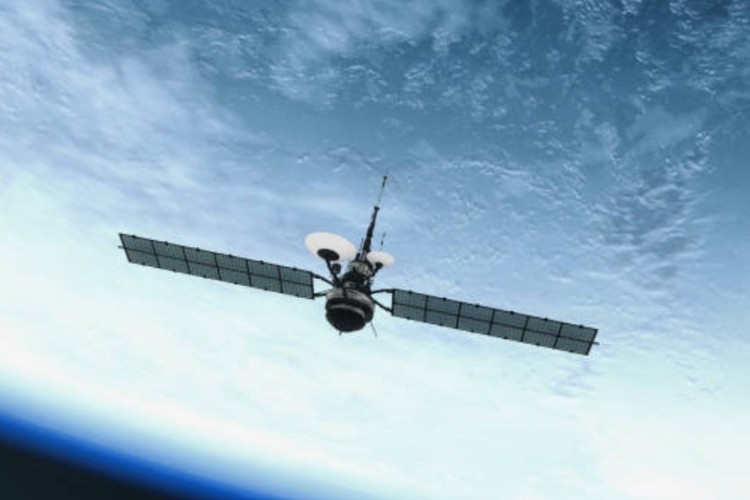
India’s space security shift: India may be trailing the US, China and Europe in the race for space dominance, but it is trying to catch up. For decades, its space programme was a story of quiet competence, with scientists doing more with less. That is changing. The government is now in discussions with private startups on developing “bodyguard satellites”, rethinking India’s presence in orbit. As space becomes more crowded and more contested, India has recognised that it is a domain that must also be secured. Reports on these discussions have gained urgency alongside India’s wider push to expand its space-based surveillance architecture.
In 2024, a spacecraft from a neighbouring country reportedly passed within a kilometre of an Indian satellite in low-Earth orbit. In space terms, that is uncomfortably close. It is against this backdrop that the government’s talks with startups on “bodyguard satellites” acquire significance. India has already approved the third phase of its space-based surveillance programme, involving 52 satellites at an estimated cost of about Rs 27,000 crore.
READ | Aerospace manufacturing: India eyes foothold in global market
Sentinel satellites are not offensive weapons. They are protective systems designed to monitor nearby activity, detect anomalies and respond to potential threats. Their role is simple: stay close to high-value assets such as communication, navigation or surveillance satellites and help secure them. But the larger shift is institutional as much as technological. India already has a space situational awareness architecture within ISRO. IS4OM compiles the Indian Space Situational Assessment Report, while ISRO’s space situational awareness and management set-up tracks close approaches, re-entry risks and the broader orbital environment.

Why India’s space assets need protection
India’s dependence on space-based services has grown sharply. Satellites now support logistics, communications, disaster management, navigation and military operations. Damage to this infrastructure, whether through deliberate interference or accidental collision, would carry cascading consequences. A dedicated protection mechanism is no longer optional.
The threat is also wider than physical collision or hostile proximity. In February 2026, CERT-In issued a cyber security framework for the space and satellite communication sector that applies to government agencies, operators, manufacturers, service providers and private space firms. It calls for security-by-design across the full satellite lifecycle, from design and launch to in-orbit management and decommissioning. That matters because satellite protection now includes guarding against jamming, spoofing, unauthorised access and other forms of cyber compromise, not just against kinetic attack.
India is not alone in moving in this direction. Several countries are building systems to patrol, monitor or protect valuable space assets. The direction of travel is clear: major powers increasingly see satellites not merely as scientific instruments, but as critical infrastructure that must be actively protected.
READ | India’s space industry: From Chandrayaan glory to startup reality
Private space startups central to India’s space security
Indian startups such as Agnikul Cosmos and OrbitAID Aerospace are being seen as potential contributors to this effort. That matters beyond the immediate security context. It shows that private firms are being drawn into a domain once dominated by ISRO and the state. Reports on the proposed bodyguard-satellite effort suggest that security agencies are already in advanced discussions with startups.
The larger point is that the state cannot remain the sole actor if the sector is to scale. India’s policy framework now reflects that shift. The Indian Space Policy 2023 assigns IN-SPACe the role of authorising and supervising non-government entities. The 2024 norms issued under that policy make clear that private space activity will be allowed, but within a framework shaped by safety, security and sustainability requirements.

Agnikul’s work on repurposing rocket upper stages points to what such a model can produce. Upper stages usually become inert debris after a mission. Turning them into functional platforms addresses orbital clutter while also opening the possibility of proximity-based support systems in orbit.
OrbitAID is working on in-orbit refuelling. Satellites are often retired not because their instruments fail, but because they run out of fuel. Extending their operational life improves both economic efficiency and strategic resilience. In a security context, it could also keep protective satellites functional for longer.
READ | Space economy: India joins the trillion-dollar global pursuit
Orbital threats, deterrence and rules
Some countries are investing not only in defence, but in attack. China has been associated with increasingly sophisticated manoeuvrable satellites. The United States and China have both developed counter-space capabilities. That makes protection more urgent for countries such as India, which still have smaller satellite fleets.
India’s own satellite inventory remains modest compared with the leading space powers. In that context, the loss or impairment of even one important satellite would be a serious setback. The asymmetry makes protection more important, not less.
India’s own record shows that it is not new to the logic of deterrence in space. In March 2019, DRDO conducted Mission Shakti, an anti-satellite test that successfully struck an Indian target satellite in low-Earth orbit. The government has maintained that it opposes the weaponisation of space. But capabilities shape perceptions, whatever the declared intent.
For now, bodyguard satellites are about prevention, not destruction. Even so, the underlying question will not go away: where does protection end and militarisation begin? That question cannot be answered by technology alone. It requires rules, norms and supervision. The United Nations process on the long-term sustainability of outer space activities has already pushed states towards better registration, conjunction assessment, orbital data-sharing, debris mitigation and national regulatory oversight. Those are no longer peripheral issues. The more satellites India places in orbit, and the closer they operate to one another, the more important those norms become.
A broader international dialogue on responsible behaviour in space is overdue. India has now entered the phase where space security is no longer only about launch capability or prestige. It is about governance, resilience and the ability to protect critical infrastructure without helping turn orbit into another unstable frontier.