





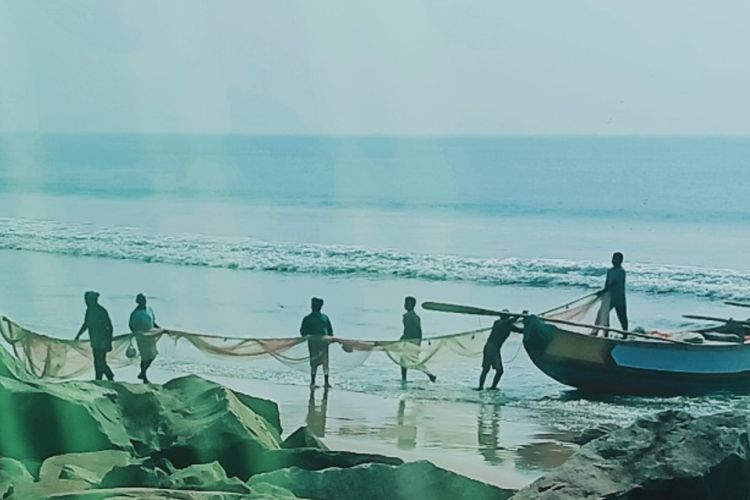
Uppada coastal protection needs an economic strategy: Uppada, the coastal village in Andhra Pradesh known for its Jamdani sarees and fishing community, is about to see substantial public investment. IIT Madras began surveying the coast in September to prepare the design and Detailed Project Report for a proposed ₹323-crore coastal protection project. Its fishing harbour, another long-awaited investment, is nearing completion.
The two projects could change the physical and economic conditions of the village. Whether they do will depend on what follows the construction.
Uppada already has the foundations of a local economy in fisheries, handloom and women’s collective enterprise. What is missing is a stronger connection between them. The coastal protection project can reduce the threat from erosion and the harbour can improve fishing infrastructure. Neither, on its own, addresses the question that matters to a village whose younger residents will have to make their livelihoods in the years ahead: what economic opportunities will remain in Uppada?
READ | Devaraja Market: Mysuru must restore living heritage
The coastal survey by IIT Madras began on September 7, 2026, as part of the preparation of the coastal protection project. For a village that has faced serious erosion, protecting homes, roads and other infrastructure is an immediate necessity. But the scale of the proposed investment also makes it worth asking what else can be protected and developed around it.
The answer lies partly in the economy that already exists.
The harbour can anchor a larger fisheries economy
During a village immersion exercise, students of IIFT Kakinada observed how closely fisheries were tied to household livelihoods. They also saw the constraints faced by the community, including coastal erosion, fluctuations in fish markets and inadequate infrastructure.
The fishing harbour was still an unfulfilled promise when the fieldwork took place. That has begun to change. The Andhra Pradesh government reported that ₹282.43 crore had been spent on the harbour by January 2026, and the project was subsequently reported to be more than 86% complete.
The proposed coastal protection project and the harbour therefore represent more than ₹600 crore of completed or proposed public investment in the same local economy. The value of that spending should not be judged only by whether the wall is built or boats can use the harbour.
A functioning harbour can support an ecosystem of businesses around fishing. Cold storage, ice plants, grading, processing, packaging and transport can create employment and retain more of the value generated by the catch within the local economy. Small businesses can also develop around equipment, maintenance and services for fishing households.
That requires planning beyond the harbour itself. Fisheries infrastructure, credit, producer organisations and access to markets have to work together if the investment is to generate more than a better landing facility.
For Uppada, the opportunity is to use the harbour as an economic anchor for the fishing community rather than treating it as an isolated piece of infrastructure.
The Uppada saree has a market. The weaver needs a stronger position in it.
The second major economic asset is the handloom industry.
Uppada Jamdani has a Geographical Indication and is the One District One Product of Kakinada district. The saree has a market well beyond the village. During the fieldwork, students found that finished sarees were being sold in cities including Bengaluru, Chennai, Mumbai and Hyderabad, while retailers and intermediaries often supplied designs and raw material to weavers and purchased the finished products.
This arrangement serves a purpose. Intermediaries can provide working capital, raw materials, designs, market access and distribution. Removing them without replacing those functions would create new problems.
The more useful question is whether weavers have enough alternatives.
A saree may take weeks to produce, yet the person who makes it may have little influence over its branding, pricing or relationship with the final customer. The market has built recognition for the Uppada saree without necessarily giving equal recognition to the person who produces it.
There are signs that this relationship can change. In 2026, D2C handloom platform Shobitam acquired Kalaneca, a brand working with 135 Uppada weaver families. Reporting after the acquisition said sales had increased fivefold, while the weavers continued to receive work.
The development does not make the case for eliminating intermediaries. It makes the case for giving producers more choices.
A producer-owned organisation could help weavers pool procurement, develop designs, maintain quality standards, negotiate with retailers and digital platforms, and build a common Uppada identity. Such an institution would not have to replace existing traders. It could give weavers another route to the market and greater bargaining power within it.
That distinction is important. Raising production without improving the producer’s position in the value chain would leave much of the underlying problem untouched.
READ | Pink tax hurts women’s income and Indian economy
Mahila Mart offers a model for local ownership
The most useful example may come from within Uppada itself.
Mahila Mart was established as a collective of Self-Help Groups. According to the village field study, members contributed ₹200 each and raised about ₹42 lakh, while the government provided the building. The enterprise created employment, and members’ contributions were treated as investments linked to the income generated by the business.
Its significance lies less in the size of the enterprise than in the relationship between the members and the activity they have created. They are participating as economic stakeholders rather than only as recipients of a government programme.
That experience could inform other parts of Uppada’s economy.
Women’s groups could participate in fish processing and packaging, food businesses, local retail and tourism services. Collective institutions could also provide services to weavers and fishing households that would be difficult for individual families to organise on their own.
The fisheries sector provides another opportunity. Andhra Pradesh has been developing women-led initiatives around fisheries and allied activities, including marine processing and seaweed cultivation. The state and the Union government could use such programmes to connect women’s collective enterprise with the investments being made in Uppada’s coastal economy.
The Pradhan Mantri Matsya Sampada Yojana also includes an Integrated Modern Coastal Villages component covering infrastructure, disaster-resilient housing, shelters and post-harvest facilities. The Union fisheries ministry said in 2026 that Andhra Pradesh had not availed itself of this particular component. Uppada could offer a practical setting for examining whether such an integrated approach can complement the investments already under way.
READ | Women entrepreneurs grow, but labour gaps persist
Uppada coastal protection: Public investment should connect the pieces
Uppada does not need a new economic identity. Its assets are already visible. The policy challenge is to connect them.
The coastal protection project can safeguard the physical base on which households and businesses depend. The harbour can support fishing and the businesses that grow around it. The handloom sector can build stronger producer institutions and direct market connections. Women’s collectives can operate across these activities.
Tourism provides another possible link.
Uppada’s beach and handloom tradition could be connected with travel to nearby destinations such as Annavaram and Pithapuram. Visitors need not come only to see the coast or buy a saree. Local food, craft experiences, small retail businesses and other services can allow more of the money spent by visitors to remain in the village.
That requires a different approach to tourism from simply counting visitors. The relevant question is how much economic activity a visitor generates locally and who receives it.
The same principle applies to the larger public investments. The ₹323-crore coastal protection project will have an obvious physical output. The harbour will have a measurable infrastructure output. Their wider economic value will be harder to calculate, but it is ultimately more important to the people who live there.
For Uppada, the test of coastal resilience should therefore extend beyond the reduction of erosion risk. A village is better placed to absorb economic and environmental shocks when households have more than one source of income, producers have greater access to markets and local enterprises can capture a larger share of the value created by visitors and natural resources.
The village already has the ingredients for such an economy. Fisheries provide an established livelihood and a new harbour. Uppada Jamdani has a recognised identity and a national market. Women’s groups have demonstrated that collective enterprise can create income and employment.
The opportunity now is to make these parts reinforce one another.
A seawall can protect Uppada from erosion. A harbour can strengthen its fishing economy. Better market institutions can improve the position of its weavers. Women’s enterprises can create another layer of local economic activity.
The larger measure of success will be whether these investments change the choices available to a young person growing up in Uppada. If that person can find work as a fisher, weaver, designer, entrepreneur, technician or hospitality worker without having to leave the village for lack of opportunity, the investment in physical protection will have acquired a much larger economic meaning.
That is the point at which protecting Uppada’s coast becomes part of securing its future.
Dr Oly Mishra is Assistant Professor, Indian Institute of Foreign Trade, Kakinada.