





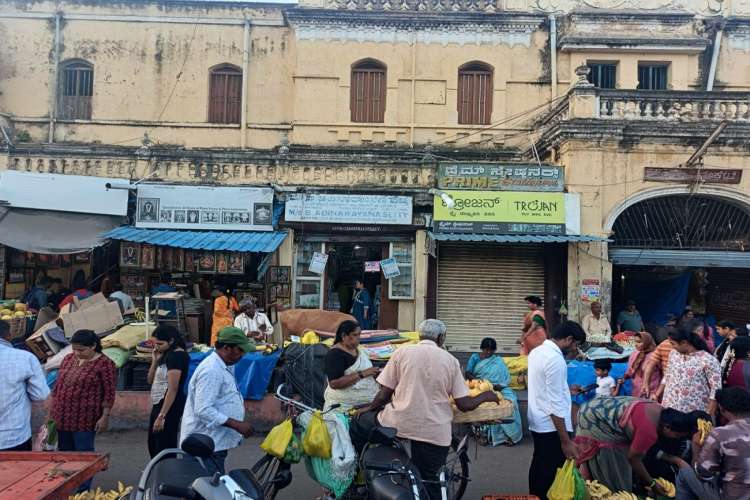
Walking through Devaraja Market is like walking through a geography of smell. The scalloped arches come later. First come damp lime-mortar walls, Mysuru Mallige, incense, fruit, spices and the slow burn of sandalwood. This is not nostalgia. It is a working market, a civic memory and an old economy still doing its daily business.
For more than 135 years, Devaraja Market has been one of Mysuru’s most recognisable institutions. It is not merely a place to buy flowers and fruit. It is part of the city’s identity, as visible as the palace road and as familiar as the Dasara season.
READ | Sandalwood revival hinges on farmer ownership
That is why the recent legal turn matters. In September 2025, the Supreme Court halted Karnataka’s move to demolish Devaraja Market and the Lansdowne Building, and asked IIT Roorkee to assess whether preservation was feasible. In May 2026, after considering the IIT Roorkee report, the Court ordered preservation and restoration. It directed the Mysuru City Corporation and the Mysore Urban Development Authority to prepare a comprehensive conservation plan.
Devaraja Market and Mysuru heritage
Devaraja Market was built during the rule of Maharaja Chamaraja Wadiyar IX. It grew from a weekly market laid over the old Dewan Poornaiah Canal, which once supplied water to the Mysore Palace. Its location near the palace made it part of the Wadiyar capital’s administrative and commercial centre.
Its architecture was not ornamental alone. Lime-mortar walls, high roofs, shaded corridors and open courtyards helped air circulation and crowd movement. The building housed an economy suited to Mysuru’s climate and social habits. Flowers, fruits, puja articles, spices and everyday goods turned it into a dense network of small vendors and regular customers.
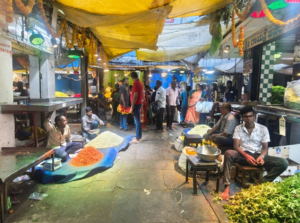
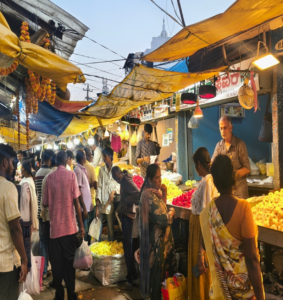
Source: Local vendors displaying fresh produce along one of the market’s three main aisles. Photo by Kavya Sanjaya.
The Supreme Court record notes that Devaraja Market has cultural, historic and architectural value, and is designated as a Group A heritage structure in the Master Plan 2031 for the Mysore-Nanjangud Local Planning Area. It is subject to stringent development controls comparable to those applicable to the Mysore Palace precinct.
READ | Crowd safety at places of worship: Why India needs a resilience-first shift
This is the core point. Devaraja Market is not a dilapidated municipal asset to be monetised or cleared. It is public capital. Article 49 of the Constitution places a duty on the state to protect places and objects of historic interest. Article 51A(f) asks citizens to preserve India’s composite culture. These provisions do not settle engineering questions. But they do set the presumption: preserve first, demolish only when preservation is impossible.
Heritage cannot be replaced by replica
The proposal to build a “replica” rests on a common Indian fallacy: that heritage means external appearance. It does not. A replica can reproduce arches, colours and shopfronts. It cannot reproduce use, memory or trust.
No new building can recreate the thresholds worn down by generations, the vendor who inherited his stall, the jasmine seller who has held the same corner for decades, or the informal credit and supply networks between rural producers and city buyers. A concrete version of Devaraja Market would be new real estate with old styling.
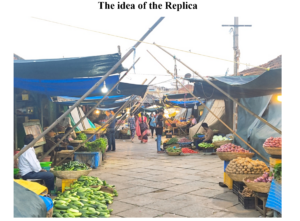
That is not conservation. It is replacement.
The difference matters economically. Mysuru’s appeal to tourists lies in the original city: its palace, markets, streets, smells and continuity. A “heritage-style” structure may look tidy in a brochure. It will not carry the value of a living market. Demolition would not be development. It would be the liquidation of irreplaceable cultural capital.
Neglect caused the crisis
The market’s present condition did not arise overnight. It followed years of weak maintenance, delayed repairs and ad hoc alterations. Public authorities often allow heritage buildings to decay and then present decay as proof that demolition is unavoidable. That argument should not pass without scrutiny.
The IIT Roorkee committee found that about 70% of the vertical load-bearing elements in Devaraja Market and the Lansdowne Building were in mild-to-moderate distress and repairable. More serious deterioration was found in horizontal elements such as roofs and slabs. The committee also flagged insensitive and non-engineered alterations.
This is not an argument for complacency. Safety is non-negotiable. Weak sections must be repaired, roofs strengthened, unsafe portions isolated, and restoration carried out under technical supervision. But the evidence weakens the case for total demolition. If repair is feasible, demolition becomes a failure of imagination, not a necessity.
A public authority cannot neglect a heritage asset for years and then invoke its own neglect as justification for destruction. That is poor administration and poor economics.
Devaraja Market livelihoods need protection
The strongest case for restoration is not sentimental. It is about livelihoods.
Devaraja Market supports thousands of small traders, workers, suppliers and transporters. Many operate on daily cash flows. They do not have the savings to survive a long closure, uncertain relocation or a multi-year construction gap. For them, displacement is not a temporary inconvenience. It can be the end of a business.
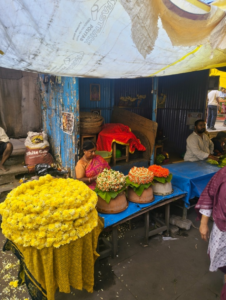
A rebuilt market would almost certainly bring new rents, new stall rules, new lease terms and new commercial incentives. Such changes often displace original vendors without formally saying so. The market may return as a building, but not as the same economy.
This is where Article 21 becomes relevant. The Supreme Court recognised in Olga Tellis v Bombay Municipal Corporation that livelihood is part of the right to life. Any conservation plan must therefore protect both structure and occupation. The vendors are not encroachers on heritage. They are part of it.
The rural-urban supply chain is equally important. Devaraja Market links farmers, flower growers, small traders and households through long-standing relationships. Once such networks are broken, they rarely reassemble in the same form.
READ | What holds back India tourism despite its natural riches
Restoration is climate-smart economics
Demolition is also bad environmental policy. Old buildings contain embodied carbon in stone, lime mortar, timber and masonry. Demolishing them wastes that stored value and creates new emissions through debris transport, disposal and fresh construction.
Restoration is closer to a circular economy approach. It repairs, strengthens and reuses. It creates work for conservation engineers, lime workers, carpenters, masons and heritage architects. It also avoids the carbon cost of replacing a historic structure with cement-heavy construction.
Every rupee spent on careful restoration preserves public value. Every rupee spent on demolition writes off what Mysuru already owns.
Devaraja Market is not a liability to be cleared. It is a trust fund that pays daily dividends in tourism, trade, employment and civic identity. The Supreme Court has now pushed Mysuru towards the right test: public safety through disciplined restoration, not destruction dressed up as modernisation.
The market has survived more than 135 years. Mysuru should now prove that it knows how to maintain what it claims to value.
Kavya Sanjaya is an Assistant Professor in Economics at Christ University, Bengaluru, and Karun Sanjaya is an Assistant Professor in Law at Symbiosis University, Nagpur.