





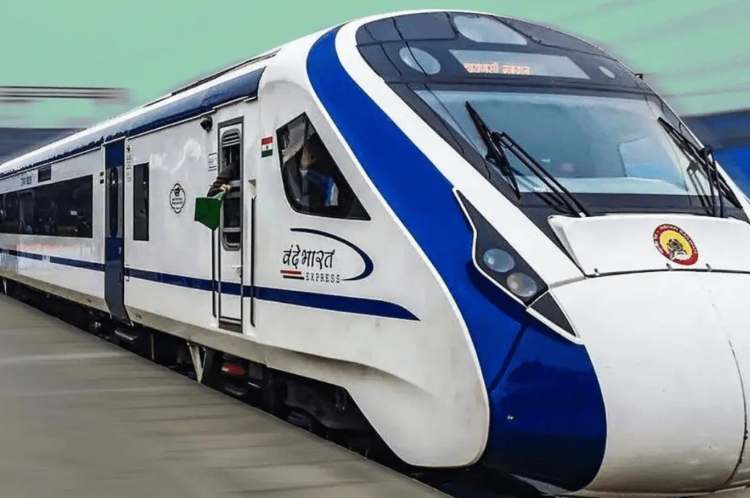
Railway expansion and sustainable transport: India wants faster growth and cleaner growth. The railway budget suggests it can have both. Indian Railways, after all, is central to the country’s economic life. It moves more than 23 million passengers a day and remains the backbone of long-distance connectivity. In the Budget 2026-27, it received its highest-ever support: a total outlay of Rs 2.78 lakh crore and capital expenditure of Rs 2.93 lakh crore, up 5.4% from the previous year.
The budget sets aside Rs 36,721.55 crore for new lines, Rs 37,750 crore for track doubling, and Rs 5,000 crore for electrification. It also announces seven new high-speed rail corridors, presented as part of an environmentally sustainable passenger system.
That claim needs closer scrutiny. Electrification will reduce diesel use over time. But the act of building new rail infrastructure carries its own ecological cost. The question is not whether India should build railways or protect nature. It is whether railway expansion is being designed in a way that limits irreversible environmental damage. Once forests are fragmented, wetlands filled, or drainage channels altered, electrification cannot undo the loss. Budget targets and political deadlines do not change that.
READ I India’s high-speed rail ambitions face tough funding test
Railway electrification and green claims
The case for railway expansion rests heavily on electrification. In principle, that is sound. Electric trains can cut emissions sharply on a per-passenger basis, especially on dense routes. If powered by clean electricity, high-speed rail can emit far less than road or air transport over time.
But this is not an automatic outcome. Construction generates a large upfront carbon and material burden through steel, cement, earthwork, tunnelling, embankments, and power systems. That burden is recovered only over years of operation. The payback period depends on passenger volumes, route design, and, above all, the source of electricity.
That is where the Indian claim weakens. Coal still dominates power generation. So railway electrification can end up moving emissions from diesel locomotives to coal-fired plants rather than cutting them decisively. International experience is clear on this point. Electrified rail delivers major climate gains only when backed by a cleaner grid and high network utilisation. Without that alignment, the environmental dividend comes slowly.
READ I Indian Railways asset monetisation: Govt plans sale without loss of control
Indian Railways: Expansion and ecosystem damage
The sharper environmental cost lies in land use. Big rail projects do not merely occupy land; they cut across ecological systems. New lines, high-speed corridors, doubling works and associated facilities can divide forests, disturb wetlands, alter drainage, and reduce habitat continuity.
That matters in India because several of the regions targeted for rail expansion are ecologically sensitive. Parts of the Western Ghats, Eastern Ghats and the Northeast are rich in biodiversity but already under pressure from roads, mining, urbanisation and transmission infrastructure. Assam and the wider northeastern region have also received substantial rail investment. In such landscapes, railway expansion is not neutral infrastructure. It is an intervention into fragile ecological terrain.
Fragmentation is often more damaging than outright land loss. Large mammals such as elephants, tigers and leopards depend on connected habitats. Break those corridors and the ecological cost persists long after construction ends. High-speed rail adds another layer of risk. Faster trains leave animals less time to respond. India has spoken often of mitigation, through underpasses, overpasses and wildlife crossings. The record of design, upkeep and monitoring is far less reassuring.
READ I High-speed rail plan to test India’s capacity, governance
Land acquisition and rural losses
Environmental damage is only one side of the ledger. Land acquisition shifts the cost to rural communities. Farmers lose not just plots of land but income streams built over decades. Compensation disputes are common because official valuations often lag market realities and rarely account for the future value of agricultural output.
The Mumbai-Ahmedabad high-speed rail project has already shown how such conflicts unfold, with resistance from landowners over compensation and delays. This is not a procedural irritant. It is part of the economics of railway expansion. Agricultural land acquired for infrastructure ceases to produce food, support household incomes, or anchor local economies. When such trade-offs are ignored, the language of sustainability becomes too narrow.
Freight corridors and railway sustainability
The strongest environmental case in the budget lies not in passenger rail but in freight. Investment in Dedicated Freight Corridors has continued at scale. By October 2025, 2,741 km of the planned 2,843 km network had been commissioned. The Eastern corridor was operational across its full length, while the Western corridor was close to completion. The proposed Dankuni-Surat extension shows that freight capacity is now central to railway planning.
This matters because freight accounts for a large share of transport emissions, largely due to the dominance of diesel-based road haulage. Shifting long-distance bulk cargo to electrified rail can reduce emissions, congestion and logistics costs at the same time. Estimates for the first phase of the DFCs suggest significant long-term carbon savings if freight actually migrates from road to rail.
That “if” matters. India’s freight mix has been stubborn. Roads still carry about 65% of total freight volumes, while rail carries roughly 30%. That pattern has not shifted decisively even as freight infrastructure has improved. The budget speaks the language of capacity creation. It says much less about measurable modal shift. Without clear targets, timelines or benchmarks, freight corridor expansion risks being treated as an environmental result rather than a means to one.
Freight and the coal dependence problem
There is a second problem. Rail freight in India still depends heavily on coal. Roughly half of total rail freight tonnage is linked to coal movement. That improves railway revenues and keeps the system busy. It also complicates the sustainability narrative.
A more efficient rail system moving coal is still moving coal. Freight efficiency is useful, but it does not settle the larger environmental question. As India’s energy system changes, railway freight priorities will have to change with it. The budget does not explain how that transition will be managed. So the current climate claim rests on a contradiction: better transport efficiency tied to a cargo basket still dominated by a high-emissions fuel.
Railway expansion needs environmental tests
The budget frames railway expansion as a green transition. That is too generous. Rail can cut emissions. It can reduce road congestion. It can make freight movement cleaner and more efficient. But those gains depend on how the infrastructure is powered, what traffic it displaces, and what ecological damage is locked in during construction.
More railway spending does not, by itself, prove environmental progress. New lines impose immediate environmental costs through land conversion, material use and habitat disruption. Electrification helps only if the power system gets cleaner. Freight corridors help only if they pull cargo off highways at scale. Until those conditions are met, railway expansion should be seen not as evidence of sustainability, but as infrastructure with environmental potential and environmental risk in equal measure.
Anju Reddy and Vidyali Reddy are students and Dr Barun Kumar Thakur teaches economics at FLAME University, Pune.
READ I Indian Railways need accountability, not slogans

Barun Kumar Thakur is Associate Professor - Economics at Flame University, Pune. His areas of specialisation include neuro-economics, economics of water pollution, environmental economics and non-market environmental valuation.