





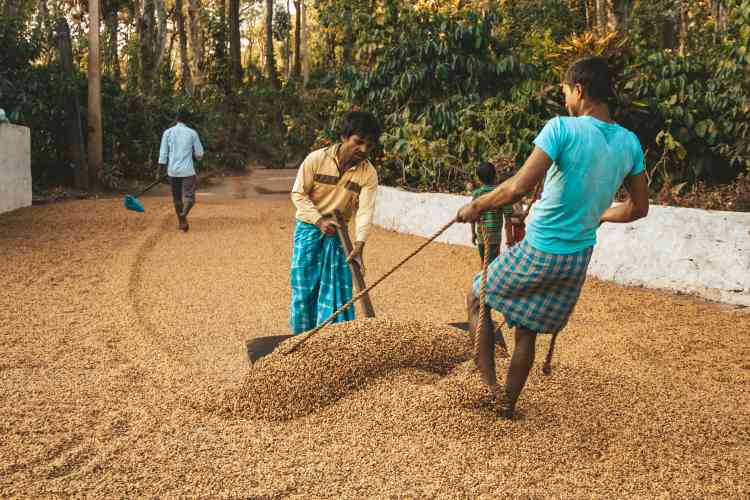
India’s farm crisis: Agriculture provides only about a third of the average agricultural household’s monthly income. Government and private-sector jobs, wage labour and small enterprises supply the rest. Farming still employs the household, but no longer pays its bills.
NABARD’s All India Rural Financial Inclusion Survey 2021-22 puts the average monthly income of an agricultural household at ₹13,661 and its consumption expenditure at ₹11,710. Cultivation accounted for about a third of that income. A quarter came from salaried jobs, 16 per cent from wage labour and 15 per cent from small enterprises. The numbers describe households that farm but cannot live by farming alone.
READ | Food subsidy squeeze calls for procurement reform
Landholdings have meanwhile been divided into smaller plots. Families with too little land to support themselves turn to wage work, often on other farms. The distinction between cultivator and labourer has consequently acquired greater significance.
Farm labourers bear the agrarian crisis
The National Crime Records Bureau recorded 10,546 suicides among cultivators and agricultural labourers in 2024. Of them, 5,913, or 56 per cent, were agricultural labourers; 4,633 were cultivators. Farm-sector suicides fell marginally from 10,786 in 2023, but the share of agricultural labourers has exceeded that of cultivators since 2021. The NCRB data record a death in the farm sector roughly every hour.
An agricultural labourer usually has fewer protections than a cultivator. Crop insurance is tied to cultivation and insurable interest, not to the wages lost when a crop fails. A bad monsoon, pest attack or fall in prices cuts employment as well as farm income.
NABARD found that about 30 per cent of agricultural households had suffered crop losses during the five years preceding its survey. Weather and pest attacks were the main causes. Another 12 per cent reported losses from unexpected falls in output prices. More than half of rural households had outstanding debt. Among indebted households, the average amount owed was about ₹90,000.
These numbers require some care. Debt is not, by itself, evidence of distress: a loan used for an irrigation pump or dairy animal may raise income. The problem arises when volatile farm earnings must service debt taken for consumption, medical treatment or a failed crop. Small landholders and labourers have little margin for a second bad season.
That risk has risen this year. The World Meteorological Organisation puts the probability of El Niño conditions during June-August 2026 at 80 per cent, rising to about 90 per cent in subsequent three-month periods. It expects the event to be at least moderate and possibly strong. The WMO’s July-September outlook points to a higher probability of below-normal rainfall over parts of the Indian subcontinent, though El Niño does not produce the same result in every region or every year. Its forecast is a warning, not a certain monsoon failure.
READ | India’s food safety gap: Why enforcement alone cannot fix it
Healthy diet costs India more
Farm distress has another side: the price paid by the consumer bears little relation to the income received by the producer. This is especially true of perishable foods such as vegetables, fruit, milk and eggs.
The UN’s State of Food Security and Nutrition in the World 2026 estimates that a healthy diet in India cost $4.11 per person per day in purchasing-power-parity terms in 2025. The comparable figure was $2.77 in 2017. That is an increase of more than 48 per cent in eight years.
PPP dollars allow food costs to be compared across countries after adjusting for differences in local prices. They are not amounts that an Indian household pays after converting dollars into rupees. The series nevertheless captures the increase in the cost of meeting basic dietary requirements.
India remains below Bhutan, where a healthy diet costs $6.17 per person per day, and Sri Lanka, at $5.21. Bangladesh is at $4.59 and Nepal at $4.19. Pakistan, at $3.94, is below India. The comparison is less important than the domestic burden. A modest daily increase becomes substantial when multiplied across a household and a month.
The number of Indians unable to afford a healthy diet has fallen, but remains high. The UN report estimates that 520.1 million people in India could not afford one in 2025. Falling deprivation and rising diet costs can coexist: incomes may improve enough to lift some households above the affordability threshold even as food becomes dearer.
Poor households adjust first by cutting foods that cost more per calorie. Rice and wheat can be obtained through the public distribution system. Fruit, vegetables, pulses, milk and eggs must largely be bought at market prices. A household may therefore have enough grain while remaining short of protein and micronutrients.
This is where India’s food policy retains an old bias. Procurement, stocking and distribution were built around cereals. They have helped prevent widespread calorie deprivation. They are less suited to a nutrition problem involving anaemia, poor dietary diversity and inadequate consumption of fresh foods.
READ | Grain surplus shows why food procurement policy must change
India’s farm crisis: Food supply chains fail farmers and consumers
Perishable produce passes through collection, sorting, transport, storage and wholesale markets before reaching the consumer. Each stage entails a cost. Poor roads, interrupted cold chains, electricity failures and local market restrictions raise it further. Spoilage is ultimately recovered through higher retail prices or lower payments to farmers.
The policy response cannot be reduced to building more warehouses. Different crops require different arrangements. Milk needs reliable chilling and daily collection. Fruit and vegetables need grading, cold storage and fast transport. Pulses need improvements in seed, yields and procurement. Local conditions determine whether a farmer needs irrigation, a producer organisation, a processing unit or better access to a nearby market.
The Finance Ministry and agriculture ministries also need to distinguish between cultivators and labourers when designing relief. Income support paid to landholders does not compensate a worker who loses employment after a crop failure. Crop insurance does not cover lost wages. The group that now accounts for most farm-sector suicides remains largely outside farm support built around land ownership.
Nutrition programmes face a related problem. The National Food Security Act secures cereal entitlements, while schemes such as school meals and anganwadi services have a wider nutrition mandate. Their performance depends on state budgets, procurement and the regular supply of eggs, pulses, vegetables and other foods. Grain availability alone cannot deliver a balanced diet.
A 2026 study in BMJ Global Health, based on 1,248 dietary surveys covering 185 countries, found low consumption of fruit, vegetables, pulses, nuts and seeds among children and adolescents. South Asia recorded the lowest intake across age groups. The study does not establish that prices are the sole cause, but its findings fit India’s larger problem: the foods missing from children’s diets are often those that poor households find hardest to buy regularly.
India has treated farm income and nutrition as separate policy questions. The first is assigned to agriculture departments and the second to food, health and women and child development ministries. The household encounters them together. The farmer receives too little for perishable produce; the consumer pays too much for it; the child eats less of it.
The cereal economy has institutions, procurement and fiscal backing. Nutritious food does not yet have an equivalent system. Until that changes, India may continue to provide enough grain while leaving both farm workers and poor consumers exposed.
Vikas Parashram Meshram is an independent journalist and development communication professional with experience in documenting grassroots development, rural governance, tribal livelihoods, climate resilience, agriculture, and social justice.