





For decades, trade agreements were treated as technical instruments. They lived in annexures, negotiated by officials, interpreted by exporters, and noticed by citizens only when something went wrong. That world no longer exists.
India’s trade negotiations with the United States, the United Kingdom, the European Union, Australia, and through multilateral frameworks such as QUAD and the Indo-Pacific Economic Framework marks a structural shift. These agreements are not about lowering tariffs. They are about trust, technology, supply chains, and economic security. In other words, trade policy has become statecraft.
READ I India-US trade deal: A pact with promise and plenty of fine print
From market access to strategic alignment
The older trade model prioritised efficiency. Production had gravitated to the cheapest location, supply chains had lengthened, and risk was treated as an externality. The approach delivered lower prices at the cost of resilience. The pandemic, the Ukraine war, sanctions regimes, and climate disruptions exposed the fragility of that system. Governments responded not by abandoning trade, but by redefining it.
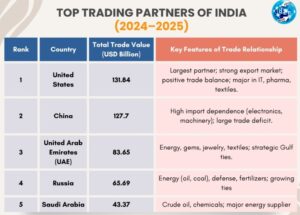
India’s negotiations reflect this recalibration. The US–India Bilateral Trade Agreement is not a conventional free trade pact. It combines tariff discussions with technology access, digital trade rules, energy cooperation, and supply-chain resilience. The UK and EU negotiations go deeper into services mobility, regulatory alignment, and standards. The Australia agreement, already operational, functions as an early-harvest pact—limited in scope but fast and pragmatic.
QUAD and IPEF, though not trade agreements, matter just as much. They align policy on critical minerals, clean energy, semiconductors, logistics, and trusted technologies. Together, these platforms form the scaffolding of a new trade architecture.
READ I India-US trade deal: Tariff relief and trust deficit
Supply chains are the real prize
The central question in modern trade is no longer who exports what. It is who can be relied upon when systems are under stress.
India’s trade agreements embed this logic. Rules of origin are tighter. Standards harmonisation is explicit. Investment screening and technology safeguards are increasingly part of the conversation. The objective is diversification away from single-country dependence without sliding into protectionism. This is friend-shoring by design, not slogan.
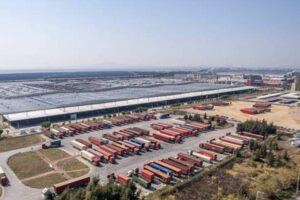
For India, the strategic bet is clear. It is positioning itself as a reliable manufacturing and services base—governed by predictable rules, capable institutions, and political continuity. That positioning matters less for price competition and more for credibility.
READ I India-EU FTA explained: Strategy, gains, and risks
Why trade agreements matter to households
Trade agreements have long suffered from a credibility gap. They were seen as instruments that benefited large firms while offering little to citizens; that gap is narrowing.
Lower tariffs and smoother logistics reduce costs for electronics, pharmaceuticals, and clean-energy equipment. Supply-chain relocation into electronics, semiconductors, defence manufacturing, pharmaceuticals, and green energy creates manufacturing and high-skill jobs, while pulling MSMEs into global value chains. Energy and mineral access clauses reduce exposure to price shocks that feed directly into household inflation.
Digital trade provisions are equally consequential. Cross-border services, data flows, and professional mobility affect access to healthcare, education, and financial services. These outcomes are not theoretical. They shape everyday economic security.
India’s leverage in this moment
India enters this phase with advantages that most negotiating partners recognise. A large domestic market provides leverage. A skilled workforce supports services and technology integration. Digital public infrastructure has established credibility. Geopolitically, India is neither aligned nor adversarial, but broadly trusted.
This allows India to negotiate for trade agreements from a position of confidence. Its agreements are not defensive retreats. They are selective integrations—open where it matters, guarded where it must be.
Trade as social contract
The deeper shift is philosophical, though it rarely announces itself as such.
Trade agreements are no longer judged only by export growth. They are assessed by whether they deliver stability, resilience, and predictable prosperity. The emphasis has moved from volume to durability.
When trade works this way, it becomes a social contract across borders. It aligns economic openness with national interest and global engagement with domestic legitimacy. India is not trying to dominate the emerging order. Nor is it withdrawing from it. Its trade strategy reflects a quieter ambition: to shape systems rather than chase markets.
Trade, once a technical domain, has become personal. That is not a slogan. It is a description of how global economics now works.
READ I Gender statistics and the limits of labour data

Shailesh Haribhakti is a Chartered and Cost Accountant, an internal auditor and a certified financial planner. He is a board chairman, audit committee chair and independent director at some of the country's most preeminent organisations. He is a thought leader on the Indian economy and public policy.