





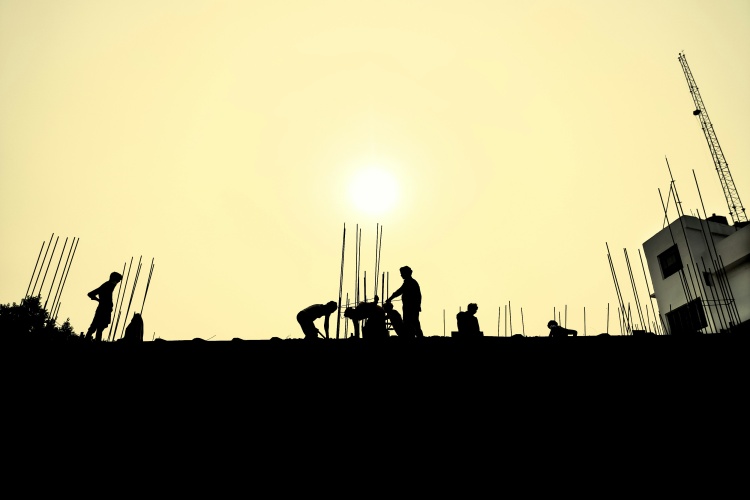
At two in the afternoon in Delhi, a construction worker pouring cement in 43°C heat has few choices. Dizziness should send him into the shade. A day away from work can cost him a day’s pay, so he works on. The employer decides the hours, pace of work and access to drinking water. The worker bears the health risk and the loss of income if he stops. Extreme heat at a worksite is therefore a question of labour protection.
Heatwaves can be characterised as natural catastrophes. Climate change, global warming, and extreme weather conditions are often raised in this context. While these are important factors, the scope of this discussion fails to capture the full extent of the problem. Once workers have to choose between their health and income, extreme heat becomes a labour rights issue. The danger that comes is influenced by decisions made by humans—where people work, what the layout of their cities is like, and what kind of protections are provided by the authorities.
READ | Care economy jobs can solve two labour failures
This transformation is rapidly becoming too hard to ignore. India is presently facing what is believed to be one of its toughest climatic periods in recent times, with concerns over a weak monsoon and repeated occurrences of intense heat waves sweeping through vast parts of the country. As stated in a recent Reuters’ report, the rising temperatures are making life economically challenging for workers, farmers, and even those who are most susceptible to the effects of climate change.
The resultant human toll is shocking. In one study that has been reported by various media outlets, including Reuters estimated that one day of intense heat wave would cause approximately 3,400 additional deaths in India. Five such days could push the figure up to 30,000 additional deaths in the country. These values show how heat-related deaths need to be counted in the official statistics so the extent of the situation is understood better.
Nevertheless, this burden does not fall equally. The problem has become more challenging. As per the India Meteorological Department (IMD) Annual Report 2025, 2025 was the eighth hottest year recorded, with the mean land surface temperature being 0.28°C above the 1991-2020 average in India. The IMD has issued warnings about the increasing probability of above-normal heatwave days in many regions of east, central and north-west India.
There is a huge difference between how this burden will affect the office employee, who works at a place where he has access to air conditioning and is able to control his time, and how it will impact the farmer working in the field, the delivery person moving through the urban areas in the city, and the construction worker carrying the load of materials under the open sky.
READ | Labour codes rollout now depends on state capacity
Think about a construction worker in Delhi or Ahmedabad. Unlike office employees, they are unable to just retreat to a safer workplace. Their work demands that they stay at physical locations within a specific timeframe. This year, in reports from Delhi, there were accounts of construction workers saying that feeling dizzy from heat, dehydration and exhaustion was part of the job. Such statements suggest a disturbing acceptance of heat exposure as inevitable for employment.
This problem is not only confined to India. The International Labor Organisation (ILO) considers heat stress one of the biggest problems of worker’s safety of the twenty-first century. It was estimated by ILO that in 2020 around 231 million people across the world were affected by heat waves. This is an increase of 66 per cent compared to 2000 figures. Also, ILO estimated global mortality related to heat waves at about 4,200 deaths in 2020 alone. These statistics point to the developing trend on an international level with an increase in the crisis if the temperatures continue to rise.
Impact of heatwaves
Heat can affect not only human health but economic efficiency too. For instance, it was predicted by the ILO that in 2030 more than 2 percent of the entire working hours would be lost because of the effects of heat stress, which equals 80 million full-time job losses across the globe. These losses will be unequally distributed. Developing countries like India, where lots of people work outdoors and have a warmer climate, are expected to suffer greatly from this problem.
There is already scientific proof of such a relationship between heat and productivity in India. A study done in the city of Chennai established that workers in different industries were subjected to unsafe amounts of heat, resulting in a reduction in productivity and ability to do work. Such findings show that apart from being a public health issue, heat poses a major limitation to the economic life of workers. Once temperatures rise to unsafe limits, workers end up slowing down, taking many breaks, falling sick, and getting injured.
Even the Indian government recognises this problem. In April 2026, the Ministry of Labour and Employment of India came up with a nationwide heatwave safety advisory which required employers to ensure the supply of drinking water, provision of shady resting places, installation of coolants, rest periods, and work schedule modification for workers in extreme heat conditions.
The significance of such an announcement is that the government has recognised that heat influences workplace safety. However, it should be noted that advisories cannot create enforceable rights.
This is the key element of the labour rights approach. Workers’ rights exist because workers do not always have sufficient bargaining power. Minimum wages, work hour restrictions, safety measures, and protection from harmful environments did not become law because employers chose to voluntarily implement them. They became law because governments understood that certain things should not be left up to the discretion of individual workers.
READ | Migrant labour welfare needs portable benefits
The problem of extreme heat needs to be approached in the same way. Workers should not be forced to choose between dehydration/heat stroke and losing a day’s income. Workers should not have to rely on employers’ kindness for basic things like access to water, shade, and medical services.
The time has come for policies to go from advisories to enforceable measures. Although the Ministry of Labour and Employment’s 2026 heat wave advisory necessitates the availability of drinking water, cooling systems, flexible work times, and adequate breaks, they are still just advisories. These measures need to become a part of the Indian labour laws in the form of national standards for workplace heat. These would include measures such as setting maximum permissible heat levels, mandatory rest periods, provision of drinking water, emergency health care and employer responsibility.
State governments should further mandate that employers in industries that pose higher risks of occupational hazards, like construction, farming, mining, etc develop Heat Action Plans aligned with local heat-response strategies. These Plans should include scheduling physically strenuous activities at cool times of the day, providing breaks for employees, and emergency protocols in case of heat-related illnesses. Heat stroke and other related hazards should be officially recognised to receive compensation.
Reducing exposure of workers also requires efforts beyond the workplace. Increasing urban greenery, protecting water bodies, and incorporating heat-resistant urban design principles are part of the heat mitigation strategy in the National Disaster Management Authority’s Heatwave Guidelines and have received backing from the India Meteorological Department. There is a need to improve tracking of heat-related illnesses. Underreported cases make it hard to gauge the extent of the problem and formulate proper interventions.
India spent years developing legislation to protect workers against unsafe machinery and industrial accidents because the issue of workplace safety was understood. The same should apply to extreme heat. With the intensification of climate change, it isn’t an environmental problem, but a labour rights issue.
Sritirupa Dey is an Intern at Centre for studies in population and Development (CSPD). Dr Deepa Palathingal is a Fellow, Centre for studies in population and Development, and Assistant Professor, Department of Economics, CHRIST University, Delhi NCR Campus.