





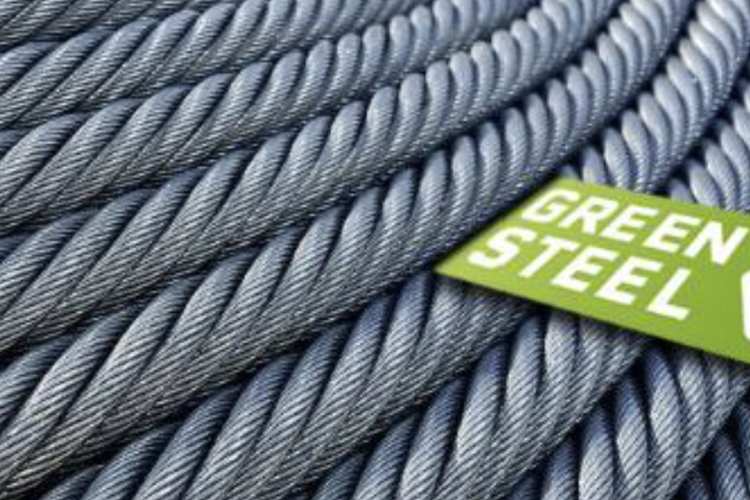
Green steel needs a renewable energy-style policy push: India’s steel industry is concentrating on cleaner technologies, and with good reason. Producers face mounting pressure to cut emissions while remaining competitive in export markets where carbon is increasingly priced. The experience of renewable energy (RE), however, suggests that technological advances alone will achieve little without institutions capable of supporting their commercial adoption. India’s RE expansion depended as much on procurement rules, investment incentives and risk-sharing arrangements as on improvements in photovoltaic technology.
Solar modules, wind turbines, transmission lines and green energy corridors were essential to this expansion. But the market grew because public policy gave developers a reasonably predictable environment in which to invest. Targets created expectations of future demand, competitive auctions helped discover prices, and government agencies assumed some of the risks that private investors were unwilling to bear.
READ | New environmental accounts must change how growth is measured
India’s solar capacity grew from roughly 3 GW in 2014 to 171 GW by September 2026, according to the Ministry of New and Renewable Energy. By March 31, 2026, the country had installed 283.46 GW of non-fossil fuel capacity, including 150.26 GW of solar power, 56.09 GW of wind power, 51.41 GW of large hydropower, 11.75 GW of bioenergy, 5.17 GW of small hydropower and 8.78 GW of nuclear power. Falling equipment costs contributed significantly to this growth, but institutional arrangements helped translate technological improvements into investment on a national scale.
So far, a total of 283.46 GW of capacity from non-fossil fuel sources has been installed in the country as on 31.03.2026. This includes 274.68 GW Renewable Energy (150.26 GW Solar Power, 56.09 GW Wind Power, 11.75 GW Bio Energy, 5.17 GW Small Hydro Power, 51.41 GW Large Hydro Power) and 8.78 GW Nuclear Power capacity.
The Solar Energy Corporation of India (SECI) became an important government-backed intermediary, acting as a critical instrument of policy aggregating demand and signing long-term power purchase agreements with developers. Reverse auctions implemented by SECI and state agencies brought price competition into renewable energy procurement. Renewable purchase obligations, payment security arrangements and centralised bidding helped expand the market and attract domestic and international finance.
Green steel presents a more complicated challenge. Electricity is a relatively uniform commodity, whereas steel comes in numerous grades and serves industries with different technical requirements. Construction companies, automobile manufacturers, engineering firms and defence suppliers cannot necessarily substitute one product for another. Investments in steelmaking are also capital-intensive and difficult to reverse.
The institutional arrangements that supported renewable energy therefore cannot simply be transplanted into steel. They can, however, guide the creation of a market in which producers have sufficient confidence to invest in lower-emission processes.
Public procurement can create demand for green steel
The immediate problem is demand. In renewable energy, government agencies acted as early buyers and demand aggregators. Green steel has yet to acquire a comparable procurement framework across public agencies.
India has already taken an important first step. In December 2024, the Ministry of Steel introduced its Green Steel Taxonomy, establishing emissions-based classifications. Steel produced with an emissions intensity below 2.2 tonnes of carbon dioxide equivalent per tonne of finished steel qualifies for a green rating, with lower-emission products receiving higher ratings.
But classification alone cannot create buyers. Government procurement could provide the demand needed to encourage investment, provided departments, public sector companies and infrastructure agencies adopt compatible specifications. A highway authority, railway organisation and port operator may purchase steel under different technical and contractual conditions. Unless the treatment of carbon intensity is reasonably consistent, suppliers will receive conflicting signals about what buyers require.
The lowest-price tendering system presents another complication. In renewable energy auctions, developers competed to supply electricity at the lowest tariff. In steel procurement, however, the cheapest product may have a substantially higher carbon footprint than a cleaner alternative.
Procurement rules must therefore specify how emissions will be measured and verified, and how the additional cost of cleaner steel will be assessed. Public agencies cannot be expected to pay any premium demanded by producers. Equally, they should not select higher-emission products simply because tender conditions ignore carbon intensity.
A workable framework would combine credible certification with common tender provisions and transparent methods for evaluating the additional cost. It would also recognise differences between steel grades and their intended uses. Without these arrangements, green procurement risks remaining a policy aspiration with limited commercial effect.
READ | India’s tree finance must go beyond plantations
Green steel targets need a functioning market
India’s renewable energy targets gave investors a visible expansion programme. The 175 GW renewable energy target announced in 2015 helped establish expectations about future procurement and created opportunities for developers to compete on cost and performance, while leaving technology choices largely to the market.
The green steel taxonomy is an important starting point, but classification and certification cannot establish how much buyers are willing to pay for lower emissions. India needs mechanisms to discover that price.
Pilot tenders, procurement commitments for selected steel products and auctions incorporating carbon-intensity requirements could establish benchmarks for different grades. Government purchasing agencies could begin with products for which certification and technical specifications are relatively straightforward, expanding procurement as the market develops.
Such measures would give producers more dependable information when deciding whether to invest in cleaner production. The uncertainty is particularly significant for mid-sized manufacturers, which may lack the financial capacity to absorb higher costs without a corresponding improvement in selling prices.
There is also a legitimate concern about increasing the cost of public infrastructure. Green steel procurement should therefore begin with carefully designed commitments that reveal the cost of emissions reduction. This would allow policymakers to assess the public expenditure required for a given reduction in carbon intensity before extending procurement obligations across the economy.
Trade policy makes this exercise more urgent. The European Union’s Carbon Border Adjustment Mechanism entered its definitive phase on January 1, 2026, bringing iron and steel imports within a system that accounts for embedded emissions. Indian exporters must contend with carbon accounting and verification requirements that may differ from domestic certification arrangements.
India’s taxonomy must therefore be sufficiently compatible with international measurement and verification practices to serve exporters, while retaining the flexibility required by domestic producers. India should also participate actively in developing international standards rather than merely adapting to rules established elsewhere.
READ | Smart grid is the next climate-tech frontier
Public pilots can reduce technology risks
The third lesson from renewable energy concerns experimentation. A prime example of this is the Rewa Ultra Mega Solar Park, which pioneered a de-risked framework that became the blueprint for nationwide scaling. Following this model arrangement, India’s ultra-mega solar parks demonstrated how coordinated public intervention could, in principle, reduce the risks faced by individual developers. While execution varied significantly across states, government agencies sought to facilitate land acquisition, transmission access, and common infrastructure, leaving developers better positioned to concentrate on building and operating projects.
The steel industry needs comparable experiments, adapted to its technological and commercial circumstances.
India has already begun this process. Under the National Green Hydrogen Mission, the Ministry of Steel awarded pilot projects involving hydrogen-based direct reduced iron production and the use of hydrogen in existing blast furnaces. These initiatives can generate evidence about technologies whose commercial viability remains uncertain.
Corporate experimentation will also be important, particularly among large integrated producers with the resources to test alternative processes. But privately funded projects may provide limited information to competitors, smaller manufacturers and public agencies. Questions about who funds these projects, who evaluates them and how the findings are disseminated will influence whether the benefits extend beyond the companies directly involved. Smaller producers, in particular, need access to evidence about achievable emissions reductions and the investments required.
That is why publicly supported pilots are the need of the hour that can generate knowledge for use across the industry. They should test the cost and performance of different production technologies under Indian conditions, alongside procurement and financing arrangements that could permit wider adoption.
Government-led experimentation can also address a further complication that India’s steel industry cannot rely on a single technological pathway. Hydrogen-based reduction, greater use of scrap, electric furnaces and carbon capture offer different possibilities depending on plant configuration, access to electricity, raw materials and available capital. Public policy can allow competition between these approaches while ensuring that emissions reductions are measured consistently.
Renewable energy policies did not always succeed in managing risks emanating from the larger sectoral governance landscape. Delayed payments by distribution companies, tariff renegotiations and uneven compliance with purchase obligations created problems for developers and lenders even as installed capacity expanded.
This experience demonstrates why ambitious targets must be supported by enforceable contracts and institutions capable of honouring them. Without these safeguards, investors may demand higher returns or postpone commitments.
For steel, the financial consequences of policy uncertainty could be greater. New furnaces and associated infrastructure operate over decades. Producers making investment decisions today must assess future energy costs, carbon requirements and the prospect of recovering the additional expense of cleaner production.
There is a temptation to settle on particular technologies before commercial and regulatory conditions become clear. Some investments will inevitably be made under uncertainty, and delaying every decision until a perfect policy framework emerges would carry its own costs. The government can nevertheless reduce avoidable risks by providing greater clarity on standards, procurement and the treatment of carbon emissions.
The priority should be to establish common procurement rules, develop credible mechanisms for discovering the green premium and use public pilots to identify technologies that can operate competitively under Indian conditions.
India’s renewable energy success proves that government coordination can successfully de-risk major projects. Yet, that progress wasn’t smooth on account of a parallel reality of patchy implementation by other agencies in the ecosystem, which at times reneged on contractual terms or caused delays in clearances, creating unforeseen costs for developers. Steel decarbonisation will require larger investments and a wider range of technological solutions. Luckily, the government has a timely opportunity to take a leaf from the RE experience and establish market rules and the associated institutional support before producers commit substantial capital to processes that may be difficult or expensive to change.
Anindya Upadhyay researches climate and energy policies in Asia and is a PhD candidate at the Lee Kuan Yew School of Public Policy, National University of Singapore.