






Global public debt is narrowing India’s fiscal choices: The IMF’s October 2026 World Economic Outlook, released on October 13, projects global growth of 3.1% in 2026 and 3.4% in 2027. Yet the recovery faces rising sovereign bond yields and renewed trade tensions. For India, the concern is that mounting government debt in major economies could raise financing costs even as it seeks to fund its own development.
The pressure predates the latest forecast. In its April 2026 Fiscal Monitor, the IMF estimated that global public debt had risen to nearly 94% of GDP in 2025 and would reach 100% by 2029. That projection should not be confused with a universal threshold for fiscal distress. Countries differ in their capacity to raise revenue and service borrowing; the currency and maturity of their debt also affect their vulnerability.
READ | Global bond sell-off exposes the cost of high debt
Higher interest costs squeeze government budgets
Public debt is the stock of outstanding government borrowing. A fiscal deficit is an annual financing requirement that generally adds to that stock. Borrowing can finance investment that increases productive capacity and future revenue. Fiscal vulnerability grows when debt and its servicing costs rise faster than the government’s capacity to pay.
Higher borrowing rates need not immediately increase interest payments on all outstanding debt. Their effect builds as governments issue new debt and refinance maturing obligations. The IMF’s April assessment estimated that global government interest payments had risen from about 2% to nearly 3% of GDP over four years. More revenue committed to interest leaves less available for public services or investment unless governments raise taxes or borrow further.
READ | RBI swap window opens cheaper debt route for PSUs
Growth alone cannot guarantee debt sustainability
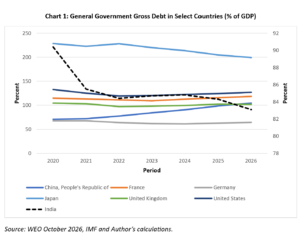
Debt sustainability depends partly on the primary balance, which excludes interest payments, and the gap between the effective interest rate on outstanding debt and nominal GDP growth. The existing debt burden determines how strongly that gap affects the debt-to-GDP ratio.
When nominal growth exceeds the effective interest rate, a government may run a primary deficit while keeping its debt ratio stable. The permissible deficit is limited, however: a favourable growth-interest differential cannot accommodate borrowing of any size. When the interest rate exceeds nominal growth, stabilising the ratio generally requires a primary surplus, before allowing for exchange-rate movements and other changes to the debt stock.
The distinction between rates on new borrowing and the average cost of outstanding debt is also essential. A government with long-maturity, fixed-rate obligations has more time to adjust than one facing substantial near-term refinancing. A worsening growth-interest relationship can therefore take time to appear fully in its budget.
READ | India debt-to-GDP ratio faces a harder FY27 test
How global debt pressures reach India
Higher yields abroad can make overseas borrowing more expensive for Indian companies and alter the returns investors demand from Indian assets. Capital outflows could put pressure on the rupee, increasing the domestic cost of servicing unhedged foreign-currency debt. These are possible transmission channels, rather than an automatic sequence; domestic monetary conditions and investors’ assessment of India will influence the outcome.
Oil prices create a separate exposure. Geopolitical disruptions that raise energy costs can add to India’s import bill and inflation pressures, complicating the response to tighter global financing. Rising public debt should not itself be presented as the cause of every adverse movement in currencies or commodity prices.
India’s fiscal choices consequently require care. Cutting productive investment to meet near-term deficit targets could weaken the growth needed to sustain debt. But assuming that rapid growth will indefinitely offset borrowing costs would leave budgets exposed to a change in financial conditions. The task is to preserve development spending while keeping interest obligations from progressively absorbing the revenue needed to finance it.
Chinmay Joshi is a Research Associate at the Economics and Policy Department at Bhavans’ SP Jain Institute of Management and Research (SPJIMR), Mumbai and a Research Scholar at Gokhale Institute of Politics and Economics (GIPE), Pune.