





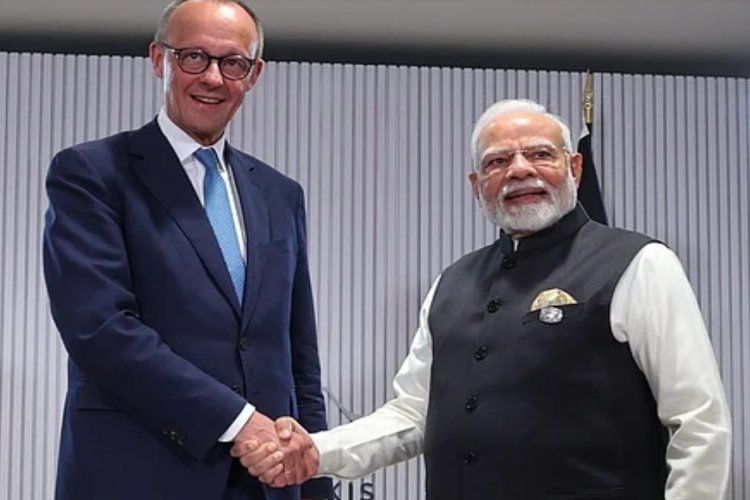
When German Chancellor Friedrich Merz arrives in New Delhi in the third week of January 2026, the visit will not be read in isolation. It follows Russian President Vladimir Putin’s trip to India and precedes the India–EU Summit scheduled for January 27. In today’s fractured geopolitics, the order of arrivals matters. New Delhi is signalling that it engages major powers not episodically, but through deliberate sequencing.
This marks a contrast with Berlin’s recent past. Under Olaf Scholz, Germany’s coalition politics often diluted strategic clarity. Merz’s conservative government, elected in May 2025, has indicated a sharper focus on security, trade, and industrial competitiveness. His New Delhi visit reflects that shift—and India’s confidence that it can deal with a more assertive Europe without narrowing its own options.
READ | US intervention in Venezuela and the Monroe Doctrine
Strategic autonomy as active statecraft
India’s strategic autonomy is often misread as indecision. In practice, it has evolved into an active form of statecraft. Rather than aligning with fixed blocs, New Delhi has expanded its diplomatic bandwidth across competing power centres. As Prime Minister Narendra Modi has repeatedly emphasised, India’s foreign policy is anchored in national interest, not ideological camps.
This posture is increasingly visible in how India structures its engagements. Hosting leaders from Moscow and Berlin within weeks is not about balancing optics. It is about demonstrating that India no longer reacts to global power shifts. It manages them.
Friedrich Merz visit: What the public conversation reveals
The digital conversation surrounding Merz’s visit offers a useful proxy for how India’s diplomacy is being read. Commentary from former diplomats and strategic analysts has focused less on symbolism and more on sequencing. The Moscow–Berlin–Brussels arc is being interpreted as evidence that India is comfortable engaging rival geopolitical camps in parallel.
Equally notable is what is missing. Unlike earlier phases of the Ukraine war, there has been little domestic polarisation around India’s engagement with Russia and Europe. Online discourse reflects a broad acceptance that ties with Moscow are transactional and historical, while engagement with Europe is strategic and forward-looking. This convergence between elite analysis and popular narrative strengthens India’s external credibility.
READ | India-US ties: Partnership under pressure
Germany’s economic weight in India’s calculus
Germany’s importance to India is not abstract. It is India’s largest trading partner in the European Union. Bilateral trade crossed $26 billion in 2024, according to official data. German foreign direct investment stock in India exceeds $14 billion, spanning automobiles, engineering, chemicals, and clean technology. More than 1,800 German companies operate in India today, employing hundreds of thousands directly and indirectly.
Merz’s visit is therefore widely seen as a preparatory step ahead of the India–EU Summit, where the long-stalled India–EU Free Trade Agreement will again be on the table. Berlin is well placed to act as a bridge within the EU at a time when Europe is reassessing supply-chain resilience and industrial policy. European diplomats increasingly describe India as a “partner of choice” rather than a situational hedge.
Trade, technology, and defence converge
From India’s perspective, deeper alignment with Germany offers tangible gains. These include access to advanced manufacturing systems, green hydrogen technologies, and Industry 4.0 capabilities—areas central to India’s industrial transformation agenda.
Security cooperation, though less visible, is emerging as a parallel pillar. Discussions on defence manufacturing, maritime security, and cyber resilience are expected to gather pace. A key marker is the proposed $8-billion submarine project involving ThyssenKrupp and Mazagon Dock, which would deepen co-production in India’s maritime sector. Germany’s growing Indo-Pacific engagement aligns with India’s regional priorities, even as the two countries retain distinct threat perceptions.
READ | Indian Americans and the limits of American nativism
Russia, Europe, and the acceptance of duality
India’s position on the Russia–Ukraine conflict continues to draw scrutiny, but the tone in Europe has shifted. Official messaging and policy commentary now reflect pragmatism rather than pressure. The focus has moved from demanding alignment to keeping India engaged as a stabilising actor with reach across camps.
Former foreign secretary Shivshankar Menon once described Indian diplomacy as “keeping options open, not sitting on the fence.” That logic is now better understood. India’s discounted energy imports from Russia helped cushion domestic inflation during a period of global volatility. At the same time, expanding strategic cooperation with Europe reveals that engagement with Moscow does not preclude deeper Western ties. This duality is increasingly accepted as a feature of India’s foreign policy, not a flaw.
A signal to multiple audiences
The Merz visit carries different messages for different audiences. For Europe, it signals that India is a dependable long-term partner in trade and security. For Russia, it conveys continuity without dependency. For China, it reflects India’s widening strategic options. And for the Global South, it reinforces the idea that strategic autonomy remains viable even as global politics hardens into blocs.
There is also a multilateral subtext. Germany’s support strengthens India’s case for UN Security Council reform, aligning with broader G4 efforts at a moment when global governance reform remains stalled.
India’s diplomatic movement from Moscow to Berlin is therefore less about geography than posture. Strategic autonomy today is no longer passive non-alignment. It is the capacity to host, negotiate, and cooperate with competing powers from a position of confidence. In a world growing more binary by the day, India is making a quieter but consequential argument: influence lies not in choosing sides, but in retaining the freedom to engage all.
Priya Gupta is Associate Professor, Atal Bihari Vajpayee School of Management and Entrepreneurship, Jawaharlal Nehru University, New Delhi.
READ | Global value chains are not breaking — they are being rebuilt