





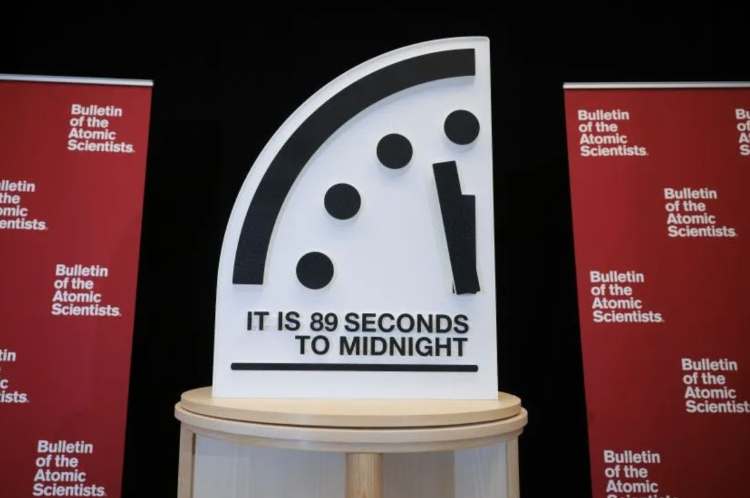
On January 27, 2026, the Bulletin of the Atomic Scientists moved the Doomsday Clock to 85 seconds to midnight, from 89 seconds the previous year. The Clock is not a timetable. It is a judgement about the world’s shrinking safety margin: the distance between a crisis and irreversible escalation.
The Bulletin emerged in 1945, built by scientists who had worked on the Manhattan Project and then chose to speak publicly about the implications of what they had helped create. In the Bulletin’s own phrasing, its purpose is to equip the public and policymakers with information needed to reduce man-made threats to human existence.
Its best-known public instrument- the Doomsday Clock- followed in 1947. It began as a magazine cover, designed by Martyl Langsdorf, and then acquired its second life as a global metaphor.
READ I World order in flux: Testing US power and limits
How the Doomsday Clock is set
In its early decades, the Clock’s movement reflected a small circle of editors and scientific advisers responding to major nuclear milestones. Today, the decision sits with the Science and Security Board (SASB), which evaluates the strategic environment and issues an annual statement.
The frame is no longer purely nuclear. The Bulletin’s own methodology explicitly treats catastrophe risk as a combined problem—nuclear danger, climate stress, and disruptive technologies that can compress decision time and amplify miscalculation.
READ I Data, chips and sovereignty: Towards a new world order
When the Clock last felt this tight
The Clock’s Cold War warning came into focus after Ivy Mike—the first full-scale thermonuclear test—detonated on November 1, 1952. In January 1953, the Clock was set to two minutes to midnight, signalling a world entering an arms race with fewer brakes and more momentum.
That earlier moment matters because it provides a baseline. The Cold War featured a stark binary rivalry, but it also produced habits of caution and, eventually, negotiated constraints. Deterrence, grim as it was, came with a shared understanding that a nuclear exchange would not generate winners.
READ I Regime change in Venezuela and the crisis of global order
Treaties created breathing room
After the Soviet collapse, the Clock moved away from midnight, reflecting a period when arms control and verification made strategy more legible and crises somewhat more manageable. The Bulletin’s timeline records the Clock sitting much farther from midnight in the early 1990s than it does today.
That shift was not about optimism. It was about architecture: negotiated limits, monitoring, and a political climate that treated restraint as a strategic asset.
Arms control: The New START cliff
The present setting is anchored in a harder fact than metaphor: New START, the last major US–Russia strategic arms control treaty, has now expired (February 5, 2026).
The US State Department had earlier described New START’s extension as keeping it in force through February 4, 2026—a formulation that captures the legal edge of what has now passed.

With expiry, the two largest nuclear arsenals no longer sit under a living, binding framework of caps and verification. Even where informal restraint is signalled, the loss is institutional: fewer routine transparency measures, fewer enforced limits, and more room for worst-case assumptions on both sides. Recent reporting notes that Russia has indicated it will stick to the treaty’s limits only as long as the United States does the same—a posture that underlines how quickly “rules” become conditional once the treaty framework disappears.
A less predictable nuclear future
During the Cold War, the central fear was a direct US–Soviet conflict. Today, the nuclear map is broader, with more states inside the club or near the threshold, and more plausible pathways from regional conflict to strategic crisis.
The Bulletin’s 2026 statement points to major powers becoming “increasingly aggressive, adversarial, and nationalistic,” and treats this political drift as a driver of the Clock’s movement.
This is where the Clock’s choice of seconds matters. The argument is not that one actor intends catastrophe. It is that the system has become less buffered: rivalry is sharper, guardrails are weaker, and the time available to correct an error is shorter.
The Doomsday Clock is a communications device with a policy purpose: it tells audiences that risk is not abstract, and that institutions built to manage risk can decay.
At 85 seconds, the Bulletin is effectively describing a world where crisis management depends more on improvisation than on structure. The Clock does not claim certainty. It claims fragility—and that, in 2026, fragility is the relevant fact.

Dr Ravindranathan P teaches at the department of geopolitics and international relations of Manipal Academy of Higher Education.