





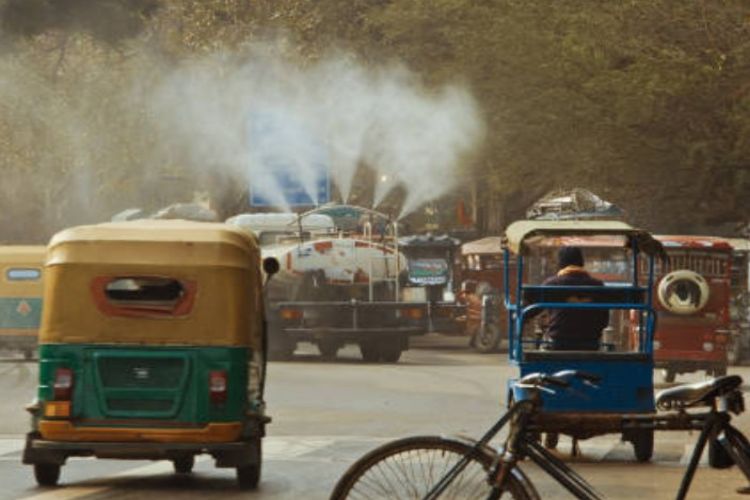
Delhi moves into emergency mode every winter. Schools close, flights are delayed, outdoor work slows, and hospitals see a rise in respiratory cases. Authorities impose restrictions and issue advisories as the Graded Response Action Plan is activated in stages. The routine is familiar because the trigger is known. Delhi’s smog is not an unforeseen shock. What remains unresolved is why a predictable problem continues to be managed as an annual crisis rather than as a year-round governance task.
Delhi’s smog is a predictable event with predictable triggers. The failure lies not in anticipation, but in how policy continues to behave as if the crisis is sudden.
READ | Air pollution, inequality, and collapse of accountability
In an earlier article, Delhi air pollution crisis points to governance failure, this author argued that toxic air in the capital is not merely an environmental problem but a failure of coordination and enforcement. Delhi smog is no longer an atmospheric event; it is a governance crisis, sustained by institutional fragmentation where multiple agencies pursue overlapping mandates.
If governance failure is the diagnosis, there must be solution. Delhi does not need another winter of emergency responses. It needs a year-round anti-smog system that works before the air turns poisonous.
GRAP cannot be the centrepiece
GRAP is designed as an emergency response mechanism. Its logic is straightforward. As air quality crosses danger limits, restrictions are imposed. Construction work stops, diesel generators are banned, vehicle restrictions are imposed, and schools shut down. This is necessary during extreme episodes. It is not sufficient.
GRAP is activated after pollution has already surged. By the time it escalates to severe stages, residents have already been exposed for days. The deeper problem is not GRAP’s existence, but the way it has come to dominate Delhi’s air policy.
A reactive cycle has been normalised: wait for air quality to collapse, impose short-term controls, then relax as soon as winds improve. Governance settles into crisis management rather than prevention.
A preventive model would treat October and November as forecastable risk periods. It would plan months ahead, deploy enforcement early, and reduce emissions at source instead of trying to suppress them after damage has been done.
READ | Delhi air pollution crisis exposes institutional breakdown
Delhi pollution crisis calls for year-round planning
In the earlier article, I mapped the interaction of major pollution sources. Road and construction dust account for roughly 30–40 percent of particulate pollution. Vehicles contribute 15–30 percent. Industry and power add 10–15 percent. Biomass and household fuels contribute about 10 percent, while stubble burning and regional inflows account for 15–25 percent during October and November.
The implications are obvious. The crisis calls for a year-round system that targets each major source with timed interventions and credible enforcement. Pollution is seasonal. Preparation cannot be.
Dust control: The missed opportunity
Dust control is the most neglected aspect of Delhi’s anti-pollution strategy. In summer, roads dry up, construction activity peaks, and open plots turn into dust reservoirs. In winter, this dust becomes part of the pollution load. Municipal bodies must treat dust as a governance target. This requires daily mechanised sweeping on priority corridors, penalties for uncovered construction sites, mandatory site barriers, and continuous monitoring.
Most importantly, dust control must be embedded in contracts, procurement rules, and ward-level accountability. Repeated violations should attract work stoppages and escalating penalties. Compliance must be cheaper than violation. This is where Delhi can cut down winter risk without imposing hardship on citizens. It is also where agencies should build operational readiness.
Enforcement must precede the crisis
First, emissions monitoring needs tightening well before winter. The CAG has flagged gaps in vehicle emission testing and compliance. Weak enforcement during normal months turns emergency restrictions into theatre.
Second, industrial clusters and brick kilns around the National Capital Region require continuous oversight. Crackdowns launched only after air quality collapses merely teach polluters to wait out enforcement.
Third, public transport planning must be treated as pollution policy. The most effective way to reduce winter emissions is to make buses and metro feeder services reliable during peak months. Asking citizens to reduce car use without offering alternatives is not policy. It is abdication.
READ | Breaking Delhi air pollution cycle with a solar revolution
October is the key month for war on pollution
Delhi’s pollution spike in autumn is driven by stubble burning, inversion, low wind speeds, firecrackers, congestion, and construction. The failure is that the system considers this as something unexpected. Prevention calls for action before the peak, on two parallel tracks.
The first is regional coordination on stubble burning. Delhi should stop treating it as a seasonal blame game. The Commission for Air Quality Management can coordinate across states. There should be measurable commitments for October: deploy machines, cover villages, make payments on time, and take enforcement actions.
The second track is local enforcement within Delhi. Construction rules should tighten automatically in October, not after AQI breaches emergency thresholds. Heavy vehicles should face stricter entry restrictions backed by technology, not sporadic checks. Waste burning must be treated as a municipal and policing failure, not an unavoidable habit.
The objective is not to shut the city down. It is to reduce emissions early enough to keep the winter spike out of the emergency zone.
Managing exposure, not just emissions
Between December and February, meteorology traps pollutants. Even moderate emissions become dangerous. At this stage, prevention shifts toward exposure reduction alongside strict enforcement.
GRAP still has a role, but it should operate within a larger framework rather than as the sole instrument. Emergency measures, when needed, must be applied with clarity and fairness. Blanket bans that punish informal workers while powerful violators escape enforcement erode public trust.
Health protection must also be explicit. Schools, hospitals, and workplaces need guidance based on real-time risk, not vague advisories. Outdoor workers require adjusted work timings and basic safety measures. This is not welfare. It is a public-health response to a known hazard.
Fixing accountability in air governance
Delhi’s air governance is marked by too many agencies and too little ownership. As noted earlier, the crisis persists because no institution bears full responsibility, while political theatre substitutes for cooperation.
A year-round system requires a single operational command structure for prevention. This does not mean creating another institution on paper. It means assigning accountability for outcomes.
The Commission for Air Quality Management must function as a performance-driven coordinator with authority to demand compliance and publish results. The Delhi Pollution Control Committee needs manpower and resources, not token status. Municipal bodies must be held accountable for dust and waste burning rather than passing responsibility upward.
Most importantly, performance must be visible. Real-time data should extend beyond pollution levels. Compliance data must be public: construction sites inspected, violations penalised, vehicles failing emission tests, hotspots resolved. Transparency is not an add-on. It is enforcement.
Accountability also fails when capacity is thin. Municipal corporations carry the burden of dust control, waste burning enforcement, and local monitoring, yet they remain understaffed, financially stretched, and dependent on short-term contracts. Penalties and blacklisting mean little if inspection teams are too few, adjudication is slow, and procurement cycles delay equipment deployment.
Prevention requires upfront spending on mechanised sweeping, monitoring technology, transport augmentation, and trained manpower, but clean air rarely appears as a protected budget line. Without treating air quality as a routine public service with stable funding and staffing norms, preventive policy risks collapsing into the same seasonal enforcement theatre it seeks to replace.
READ | Delhi pollution crisis: Why bans won’t clean the air
From emergency response to public service
A preventive model is built on routine, not slogans. Dust control must be enforced in May, not debated in November. Transport improvements must be delivered in September, not promised in January. Stubble-mitigation funds must reach farmers before burning begins, not after smoke reaches Delhi.
Enforcement agencies need staffing, equipment, and authority, not seasonal instructions to “be strict”. The difference between GRAP and prevention is timing. GRAP manages the peak. Prevention reduces the peak.
Delhi will still face difficult winter days. It does not need to accept annual collapse as inevitable.
Clean air is part of the right to life under Article 21. A right matters only when institutions can deliver it. That delivery will not come from panic measures alone. If Delhi wants to break the cycle, it must stop treating smog as a seasonal emergency and start treating clean air as a year-round public service.
Shariq Us Sabah is an economist and author.