





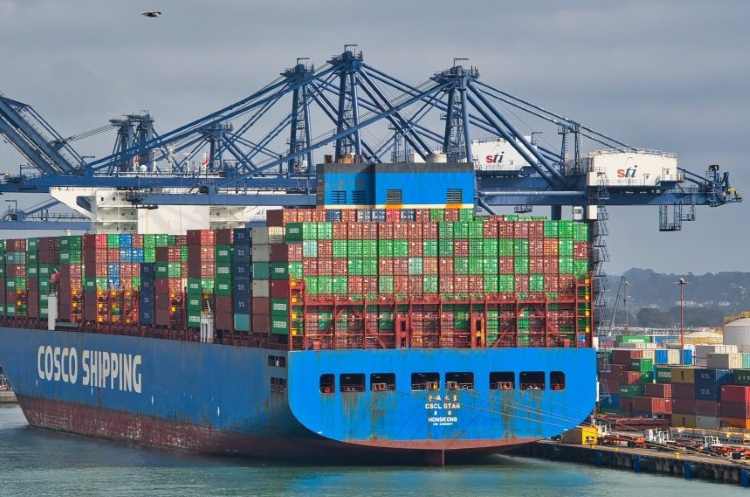
China’s economy: China says its economy grew by 5 percent in 2025, meeting Beijing’s official target as a world record trade surplus of US$ 1.19 trillion boosted economic growth. The trade surplus is 20 percent higher than in 2024, according to data reported by Reuters.
This surplus reflects China’s remarkable dominance as an exporter of manufactured goods. The trade surplus increase was driven by a rise in exports to Europe, Latin America and Southeast Asia, despite a 20 percent decline in exports to the US.
However, analysts have for long been sceptical regarding the economic growth figures provided by the Chinese government. Analysts have again questioned the veracity of the official economic data released by Beijing due to weak investment and consumer spending in China. Economists at Capital Economics in the UK aver that their own calculations suggest China’s official growth figures “overstate the pace of economic expansion” by at least 1.5 percent.
READ | India-China trade: Structural imbalance, not a one-year problem
China’s economy growing at steady pace
Although China achieved its 5 percent growth target, Chinese government figures also showed economic growth slowed to 4.5 percent in the final quarter or Q4 of 2025, compared to growth in Q4 in 2024. Retail sales rose just 0.9 percent in December 2025, the slowest pace in three years, reflecting the negative consumer sentiment. China is facing stagnant prices with employers cutting wages because workers face a choice of accepting lower pay in a highly competitive job market. This is also contributing to lower consumption rates.
Analysts have also questioned China’s policy of export driven growth. This policy is not sustainable because exports are being pushed at a loss to boost economic growth. Price cuts can increase the volume of exports, but this will reduce profits and will hinder growth in the near future.
The Chinese currency is already undervalued. In April 2025, US President Donald Trump labelled China as a currency manipulator. Attempts to further devalue the currency to boost exports will put Beijing in Trump’s cross hairs and is likely to lead to tariffs being imposed on Chinese exports by the Trump administration, further reducing economic growth.
For 2026 and beyond, China’s economy will slow down further. This lower growth will be accompanied by increasing resources provided by Beijing for technology-intensive growth sectors such as artificial intelligence, robotics, quantum computing and other sectors. These sectors are not labour intensive and have contributed to rising youth unemployment.
The focus will predominantly be on national security including domestic and public security. Technology will be used as a tool to prevent and arrest both small- and large-scale protests which may undermine legitimacy and survival of the Communist Party of China.
READ | AI regulation: China gets it right with hard rules
Why it’s happening
There are multiple explanations for lower economic growth rates in China. First, exports cannot be relied upon as a source of economic growth in 2026 and beyond. Trump’s tariffs are a huge cause for concern and it is unclear whether the trade truce between the two largest economies in the world will hold in 2026. Trump has also announced tariffs on countries which buy oil from Iran and oppose US plans to take control of Greenland.
It is likely that Washington’s focus on economic rivalry with China will re-emerge once the US is able to sufficiently de-risk from China and get access to rare earth and critical minerals. This will reduce China’s leverage over the US. It is also likely that most European countries will enhance their de-risking from China due to Beijing employing economic statecraft to achieve political goals, especially regarding Taiwan and the South China Sea. European countries are also increasingly wary of their economic reliance on China and Beijing’s interference in domestic affairs, particularly democratic and electoral processes. Rising global protectionism is also going to dampen exports in the future.
Domestic consumption is also not expected to increase significantly to lead to higher economic growth despite repeated government attempts. In the proposed new five-year plan set to come out in March 2026, Beijing has put renewed focus on increasing domestic consumption. Although domestic consumption in China (at 39 percent of GDP) has increased in the third decade of the new millennium relative to the first two decades, it remains well below the roughly 60 percent typical of developed economies.
READ | US-China rivalry: Too entangled to decouple
This is predominantly due to lack of faith in Chinese government policies and negative sentiment regarding the future of the economy, high youth unemployment at around 20 percent, lack of social safety nets such as unemployment allowances and free medical care, and demographic challenges due to lower birth rates and a declining population.
People are willing to wait longer to get a better deal, but the longer they wait, the more companies are likely to cut prices, leading to even longer delays. China may fall into a deflationary trap, forcing firms to close and further lowering economic growth.
The real estate sector, which contributes approximately 15 percent of the economy, is in the doldrums. Data released in January 2026 highlighted that housing prices continued to fall in December 2025 as the government struggled to stabilise the property market. Prices dropped 2.7 percent year-on-year, the sharpest decline in five months, while property investment fell 17.2 percent over the year. Fixed-asset investment declined by 3.8 percent , the first annual decline since records began in 1996, as debt-strapped local governments pulled back from infrastructure spending. Private investment fell by 6.4 percent.
The slump in the real estate sector has negatively affected construction activity, household wealth and local government finances. Millions of households have been left with unfinished homes or properties that have lost significant value, undermining confidence in what was once seen as the safest place to store savings. Falling land sales have squeezed local government revenues and increased local government debt. Consequently, businesses are more hesitant to invest and consumers more cautious about spending.
Beijing is expected to target 5 percent economic growth in 2026, but its challenge is to ensure this rate is achieved. There is a growing realisation in Beijing that China’s reliance on manufacturing investment and exports is politically and economically unsustainable. The Chinese government has pledged “proactive” policies for 2026 to shore up confidence among consumers and businesses, but the underlying economy remains fragile.
Beijing’s dilemma is that growth can be boosted through stimulus, but this will lead to rising debt. At the same time, China must reduce reliance on exports in an increasingly uncertain trade environment. Domestic demand is unlikely to rise significantly due to higher precautionary savings, weak confidence, absence of social safety nets, and demographic decline. These structural challenges are likely to result in lower growth rates in the years ahead.
Dr Raj Verma is a Non-resident scholar at the Sigur Center for Asian Studies, Elliott School of International Affairs, George Washington University. Originally published under Creative Commons by 360info