





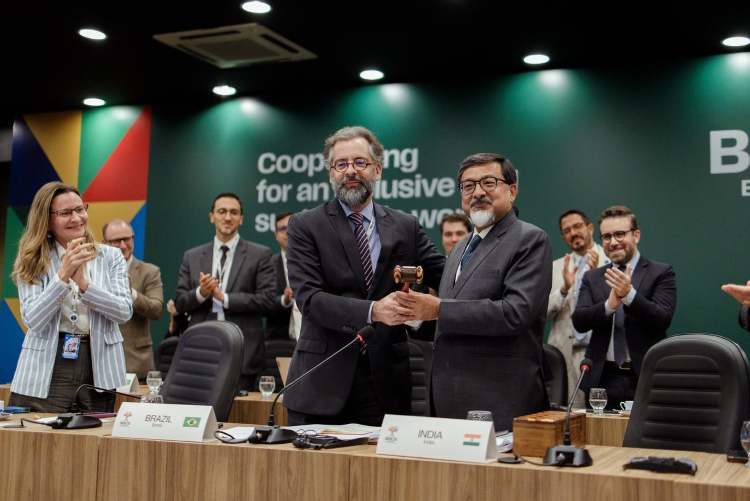
As India prepares to chair the BRICS Summit in 2026, external affairs minister S Jaishankar has launched the BRICS 2026 logo and website in New Delhi, marking India’s assumption of leadership. The launch will inevitably revive the familiar claim: BRICS is building a non-dollar monetary order. A data-led reading supports a narrower proposition. BRICS de-dollarisation is real where it is forced, bilateral, or corridor-specific. It is weaker where it requires deep capital markets, open capital accounts, or shared institutional design.
BRICS and “BRICS+” are often conflated. The numbers cited for “BRICS+ scale” depend on which expanded members are counted and over what base year. The operational evidence in this draft is overwhelmingly about BRICS-5 corridors, led by Russia–China, not a uniform bloc-wide shift.
BRICS economies have scale—population, output (PPP), reserves, and intra-group trade—to reduce transactional reliance on the US dollar. But scale is not the same as reserve-currency capacity. That requires liquid bond markets, deep derivatives, credible rule of law, and capital-account openness—conditions that remain uneven across BRICS.
READ I Gold prices reflect global distrust in dollar, US policy
BRICS de-dollarisation after 2022
The most advanced case is Russia, and it is not an ideal template. Post-2022 sanctions and payment restrictions triggered rapid re-routing of trade settlement into local currencies. Russia’s BRICS trade is now predominantly settled outside the dollar, and China–Russia settlement has shifted heavily into yuan and rubles.
This provides BRICS with a large, visible corridor where non-dollar settlement works at scale. It does not establish that BRICS has found a generalisable path to displacing the dollar in global finance.
READ I BRICS+ meets in Rio amid global shifts and internal fractures
New Development Bank and local-currency finance
The New Development Bank (NDB) is the most concrete BRICS instrument for reducing dollar dependence in development finance. A growing share of its lending and bond issuance is in member currencies, with stated targets to raise the share of local-currency financing over time.
This matters because it substitutes away from dollar borrowing in a defined channel—development lending—without requiring a new global reserve asset. It also shows the practical ceiling: even when local-currency lending rises, the overall scale is small relative to global capital markets dominated by dollar assets.
READ I Venezuela crisis adds new risks to India’s energy security
BRICS currencies in global banking and debt
On the finance side, the data are consistent with incremental internationalisation from a low base. Between 2019 and 2024, the share of BRICS currencies in cross-border bank claims and international debt securities rose, signalling broader use in lending and debt markets. The direction is clear; the pace is modest.
Two distinctions need to be kept explicit.
First, trade settlement can shift faster than trade invoicing. Firms may pay in local currencies while still pricing and hedging against dollar benchmarks, especially in commodities. That preserves the dollar’s role even when the payment leg is de-dollarised.
Second, “non-dollar” in BRICS practice often means “more yuan”. If the adjustment substitutes dollar dependence with yuan dependence, it creates a different concentration risk—particularly for members that are wary of China-centric financial leverage.
Digital payment rails and CBDCs
Digital and alternative payment infrastructure is the most discussed “de-dollarisation enabler”. China-led platforms and experiments show that cross-border payments can be executed outside the traditional SWIFT–dollar pathway for specific corridors.
That is operationally important, but the inference should be restrained. Payment rails reduce settlement friction; they do not, by themselves, create a reserve currency. A reserve asset needs depth, convertibility, and a market large enough to absorb global savings.
Academic work pointing to currency pluralism reinforces this: the plausible path is interoperability and basket arrangements, not a single unified BRICS currency. The draft’s own evidence supports pluralism, not unification.
Diversification within a dollar-centric system
IMF COFER data show the dollar’s share of global reserves has declined over the long run, with a non-linear profile: a gradual fall, a temporary rebound in risk-off phases, and renewed decline thereafter. The implication is not collapse but persistence amid diversification.
This reserve story also needs a second constraint stated plainly. A meaningful share of diversification is into other established currencies and assets, not into BRICS currencies. That does not weaken the case for gradual pluralism; it does limit claims that BRICS is the primary driver of reserve change.
Trade settlement in BRICS
The draft’s settlement figures point to a structural decline in the dollar’s share in BRICS trade settlements, with an inflection after 2022 in Russia-linked corridors and some growth in yuan settlement in China’s trade with partners.
This is consistent with a policy-driven shift towards bilateral local-currency settlement mechanisms. It is not evidence that commodity trade has detached from dollar benchmarks. Oil, gas, and metals contracts—even when settled in non-dollar currencies—often reference Brent/WTI and other dollar-linked price markers. That keeps the dollar central to invoicing and hedging even as settlement diversifies.
Limits of BRICS de-dollarisation
The dollar still dominates global finance because of network effects and switching costs. It is central to FX trading, reserve composition, and trade invoicing. This is not mere inertia; it is a function of market depth, transparency, and legal predictability.
The decisive structural advantage is the scale and liquidity of US Treasury markets and the wider ecosystem around them—repo, derivatives, and safe collateral. Most BRICS currencies face constraints here: limited convertibility, thinner secondary markets, and higher political risk premia. Without capital-account liberalisation and market deepening, BRICS currencies cannot serve as global reserve assets at scale.
Within BRICS, political fragmentation compounds the market limits. China–India rivalry on security and strategic alignment constrains any move towards unified monetary governance. Disagreements over geopolitical conflicts and relationships with the US and EU reduce the scope for a shared reserve asset or common currency design. BRICS functions as a coordination platform, not a monetary union.
Alternatives to SWIFT and dollar clearing exist—CIPS, SPFS, CBDC platforms—but participation remains limited and interoperability unresolved. Sanctions create incentives to experiment, but also deter third-party adoption through the threat of secondary sanctions. That paradox holds: sanctions push experimentation, yet often raise global risk aversion and safe-haven demand for the dollar.
What BRICS de-dollarisation is, and what it is not
BRICS de-dollarisation reduces exposure to dollar-based settlement and improves resilience to financial coercion. It expands options at the margin: more bilateral settlement, more local-currency development lending, and more experimentation with payment rails.
It does not yet supplant the dollar as the primary global reserve currency. It does not create a unified BRICS monetary system. It does not detach commodity pricing from dollar benchmarks. A common BRICS currency remains political rather than operational. The more realistic direction is fragmented, corridor-based pluralism within a still dollar-centric system.
Satyendra Singh is final year law student and Dr Tanya Narula Chaudhury is Assistant Professor at Amity Law School, Noida.