





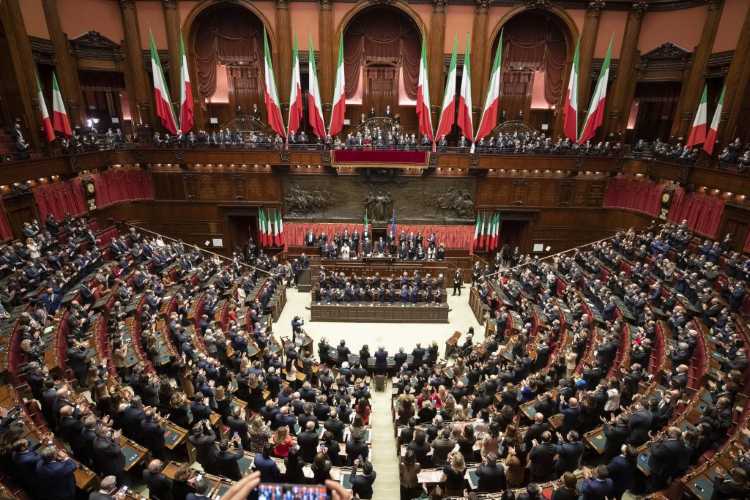
Artificial intelligence is reshaping how we live and how we make collective decisions. As Luciano Floridi – philosopher and Professor of Philosophy and Ethics of Information at the University of Oxford – argues, the key challenge is no longer whether AI will continue to develop, which is largely unavoidable, but how to steer it towards the public good.
This ethical question also arises in parliamentary settings, when parliamentary administrations introduce AI systems to support internal work. Alongside the promise of greater efficiency lies a core issue: the effect these technologies may have on the democratic functions of elected assemblies.
If AI begins to influence, or potentially displace, aspects of the traditional law-making process, the central question becomes whether responsibility for the final vote on a law — or any parliamentary act — remains firmly with elected representatives or shifts, even indirectly, towards artificial intelligence systems. Against this backdrop of opportunities and risks, this article maps the main AI tools being developed in parliaments and reflects on how Italy’s Chamber of Deputies and Senate are responding.
READ I Can India power the artificial intelligence dream?
A fragmented global landscape
To understand Italy’s approach to this issue, it is useful to look beyond the national context. So far, the adoption of artificial intelligence in parliaments has been concentrated mainly in highly developed countries and has not been accompanied by a shared regulatory framework. The result is a fragmented landscape in which technological development and regulation are largely shaped by individual parliaments or EU institutions.
In practice, each parliament is adopting one or more artificial intelligence tools according to internal priorities, with potentially significant implications for institutional organisation and the conduct of democratic deliberation.
Some applications are designed for internal use, supporting parliamentary staff, MPs and legislative committees. Others are outward-facing, aiming to enhance transparency, accessibility and citizen participation.
Some tools affect the legislative process directly; others primarily reshape the relationship between parliament and citizens. Current examples range from AI-assisted transcription and automated classification of debates and parliamentary activities, to automated sequencing of votes on amendments, drafting support and admissibility checks, natural-language search of parliamentary documents, and tools intended to synthesise public sentiment around bills under discussion.
READ I What hypnosis can teach us about artificial intelligence
Strategic choices in artificial intelligence adoption
These examples suggest that artificial intelligence is not merely a neutral administrative upgrade. It can reshape parliamentary power and practice, particularly when adoption concentrates on a specific class of tools. International cases illustrate how AI deployment may reflect strategic choices about parliament’s institutional role.
The Chilean Congress, for example, through its Caminar platform, has prioritised simplifying legislative activity by supporting the drafting of bills and amendments. By contrast, Brazil’s experience with initiatives such as Brasil Participativo has focused on strengthening popular participation, developing participatory AI solutions.
It is therefore unsurprising that the Inter-Parliamentary Union (IPU), which represents parliaments worldwide, has recently stressed that before adopting AI tools, parliaments should clarify the institutional role they intend to play in the future, particularly in relation to deliberation and the balance between parliament and government.
The IPU outlines three possible trajectories for representative assemblies:
- AI-Augmented Assembly: AI enhances human judgement while democratic primacy is preserved; AI acts as a “co-pilot” rather than replacing human decision-making.
- Data-Driven Legislature: AI becomes central to decision-making, with political deliberation increasingly displaced by predominantly evidence-based processes.
- Shadow Legislature: AI capabilities are concentrated within the executive branch, leaving parliaments structurally disadvantaged in managing emergencies, analysing complex dossiers and engaging citizens.
In light of the IPU’s 2025 global review of parliamentary AI applications, each parliament can assess whether its trajectory aligns with one of these models. Italy cannot be described as a “Shadowed Legislature”, as the Parliament has developed one of the highest numbers of artificial intelligence tools to date. The more open question is whether Italy is moving towards an “AI-Augmented Assembly” or a “Data-Driven Legislature”.
At its current stage, Italy appears closer to the Augmented Assembly model. The internal governance framework, together with existing and planned applications, is designed to support — rather than replace — MPs’ work and decision-making. The intention is to strengthen parliamentary functions through more efficient administrative processes while preserving political responsibility.
READ I Artificial intelligence needs real leadership — not just loud voices
Italy’s emerging model
According to the guidelines adopted internally, current and future parliamentary artificial intelligence applications in Italy should not operate as autonomous deliberative tools, capable of replacing human decision-making. They are required to provide answers based solely on internal sources, and their outputs must be reviewed by parliamentary officials and/or politicians. Under these rules, AI is expected to improve efficiency in a controlled and accountable manner, while final decisions remain with elected representatives and parliamentary bodies.
One example is the AI tool “Computation of amendment similarity scores”, developed to facilitate comparison among amendments by estimating the degree of similarity between proposed texts. The system streamlines the work of the offices operating under the Speakers’ jurisdiction that compile and organise amendments, without constraining the prerogatives of the House Speaker.
The Speaker retains full authority to determine the final voting order in line with political considerations, established practice and parliamentary rules. As with other applications, the tool is intended to support parliamentary activity rather than substitute it.
Future risks and institutional choices
The long-term trajectory of the Italian Parliament will depend on future institutional choices. These include decisions on whether AI applications will continue to be financed through parliament’s internal budget, as well as the level of investment in training and recruitment within parliamentary administrations.
Further technological developments may require stronger mechanisms to monitor and audit AI outputs, reinforcing the need for systematic capacity-building among staff in both the Chamber and the Senate.
A second issue concerns the implications of outward-facing artificial intelligence tools for the digital divide. Will these systems reduce inequalities by making access to parliamentary information and participation easier, or will they widen gaps by increasing barriers for citizens who are less digitally confident?
For now, Italy stands among the frontrunners in the development of parliamentary AI tools. If managed carefully, its approach could offer a model for other countries seeking to integrate AI into democratic institutions without weakening representative accountability.
Paolo Gambacciani, “Roberto Ruffilli” Postdoctoral Research Fellow, Department of Political and Social Sciences, University of Bologna. Edoardo Alberto Viganò, Postdoctoral Research Fellow, Witten/Herdecke University, Department of Philosophy, Politics and Economics. Originally published under Creative Commons by 360info .
.