






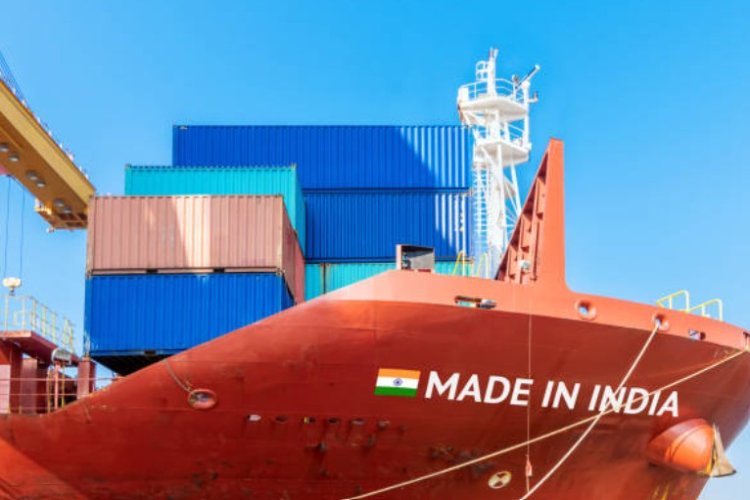
India’s exports may cross $1 trillion in FY27: India is expected to cross $1 trillion in exports in FY27. The country has exported a record $863.1 billion worth of goods and services in FY26 with merchandise exports of $441.8 billion and services exports of $421.3 billion. The momentum has continued into the current financial year. During April-September FY27, combined exports reached approximately $479 billion with a growth of 14.5% over the corresponding period. The latest April-October estimates put exports at $568.84 billion, a 16.66% increase. Merchandise exports grew 21.96%, while services exports expanded 10.93%.
These figures have increased the confidence in the economy’s ability to maintain export momentum and hence, $1 trillion ambition looks within reach.
READ | What India’s exports boom leaves behind
However, India’s export story has a problem. Services have become almost as significant as merchandise trade in generating export earnings. Information technology, business services, financial services and global capability centres have helped India establish a strong position in international markets. However, a country with large workforce like India cannot rely on a narrow range of high value services to deliver employment and industrial expansion.
India is looking to become a manufacturing powerhouse and merchandise exports are where these ambitions face their biggest test. Electronics, engineering goods, pharmaceuticals, chemicals and textiles have emerged as important export drivers. In September 2026, engineering goods exports rose 20.9% on-year to $12.17 billion, while electronics exports grew 70.4%. Petroleum products and chemicals also recorded strong growth. The problem with manufacturing is that India needs to capture considerable ground in moving from assembly-led production to manufacturing with more domestic value addition.
READ | India-EU FTA puts India’s car exports ambition to the test
The electronics sector is a study case. The PLI scheme has helped attract investments and expand manufacturing capacity. As of June 2026, investments under the 14 PLI schemes had crossed Rs 2.58 lakh crore, while cumulative production and sales exceeded Rs 23.79 lakh crore. Exports generated by participating sectors stood at Rs 15.53 lakh crore. These are great numbers. But, higher exports do not mean stronger domestic supply chains. In several electronics segments, manufacturers continue to depend heavily on imported components. India’s export success will come when it can manufacture not just the final product but also a larger share of the components, materials and technologies that go into it.
India’s exports: The tariff contradiction
The government wants domestic manufacturers to compete globally but high duties on intermediate goods and capital equipment has raised their production costs. The Economic Survey has highlighted the problem of inverted duty structures, where inputs attract higher import duties than finished products. This has made domestic manufacturing less competitive and can discourage participation in global value chains. Protection may provide temporary relief to domestic producers, but exporters cannot become globally competitive if their inputs are more expensive than those available to their international rivals.
Textiles, footwear, leather, toys and furniture are all labour intensive industries but India has failed to capitalise. India has struggled to capture the manufacturing opportunities created by companies diversifying their supply chains away from China. Bangladesh and Vietnam have established stronger positions in several export-oriented manufacturing segments. Their advantage is not just lower wages but also manufacturing scale, integrated supplier networks, predictable trade policies and the ability to meet large international orders. The next phase of export reforms must address these issues.
India has massive trade opportunities thanks to FTAs with the UAE, Australia, the UK and EFTA countries. The next step is to help businesses actually use these arrangements. This requires helping them with rules of origin, certification requirements and product standards. It also requires Indian companies to become more competitive in markets where tariff advantages alone cannot guarantee buyers. Export promotion should therefore move beyond negotiating agreements to helping firms establish distribution networks and comply with international standards.
READ | Rice exports expose India’s groundwater paradox
The nuance of export numbers
During April-October FY27, India’s imports reached $662.19 billion, against exports of $568.84 billion. The combined trade deficit widened to $93.35 billion from $83.25 billion a year earlier. Merchandise exports may be expanding rapidly but merchandise imports are also growing. India is highly dependent on imported energy, electronics, machinery and industrial inputs. A larger export economy must eventually strengthen its domestic production capabilities.
The $1 trillion export target is an achievable milestone but it should not become the sole measure of success. India needs to ask how much of this growth comes from domestic value addition and how many MSMEs enter global markets and whether new export sectors can sustain themselves without continuous government incentives. Services will remain a major strength but manufacturing must become a much stronger pillar.
India must become a dependable manufacturing hub sooner than later. Crossing $1 trillion would make for an impressive headline but building the industrial capabilities for the long run would be the more meaningful achievement.