





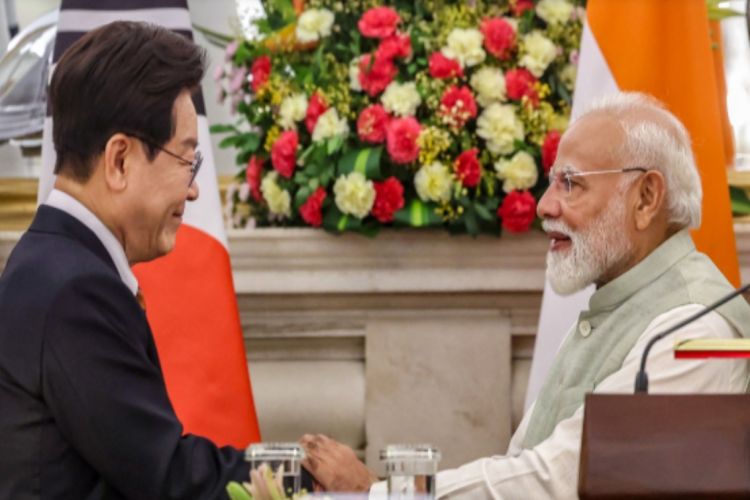
India-Korea ties: The visit of South Korean President Lee Jae-myung to New Delhi has refocused attention on the India-South Korea relationship. The summit shows an attempt to align an existing economic partnership with shifting geopolitical and trade realities. Agreements were signed and sectors identified. The test will be execution. Both sides acknowledged that economic ties have underperformed. Bilateral trade is about $27 billion. The new target is $50 billion by 2030. South Korea remains a major investor in India’s manufacturing base, spanning automobiles and electronics. Yet trade intensity has not matched investment flows.
This gap is not new; India’s trade deficit has widened since the India-South Korea Comprehensive Economic Partnership Agreement (CEPA). South Korea recorded a $12.8 billion surplus last year, with exports of $19.2 billion and imports of $6.4 billion, according to Korea International Trade Association data.
READ | Hormuz disruption and the rising risk to sea trade
Talks to upgrade CEPA have been ongoing. India has flagged tariff asymmetries, rules of origin, and non-tariff barriers. These are correctives at the margin. The underlying constraint is weaker export competitiveness.
Shipbuilding as strategic anchor
The ‘Shared Vision for Operation of Yard Assisted Growth with Efficiency and Scale’ (VOYAGES) agreement puts shipbuilding at the centre. The sector has strategic weight. Maritime routes and supply chains are contested. South Korea dominates high-value shipbuilding, including LNG carriers.
For India, the attraction is capacity. Dependence on China persists in key inputs. The agreement aims to shift this balance.
India and South Korea will jointly design and manufacture maritime and port equipment, including cranes. India relies on China for over 90% of its port cranes. Reducing this dependence is a stated objective. Scaling domestic capability will take time.
Supply chains and the China+1 calculus
The partnership sits within a wider supply chain shift. South Korean firms have been early movers in diversifying production beyond China. Investments by companies such as Samsung Electronics, Hyundai Motor Company, and LG Electronics anchor this shift in India.
India’s policy response has included production-linked incentive schemes to attract large manufacturers. The intent is to integrate into global value chains. The outcome has been mixed. Much of the Korean investment remains oriented to the domestic market, not exports. Supplier ecosystems remain shallow.
Competition is intense. Vietnam and Indonesia have absorbed a larger share of export-oriented manufacturing in electronics and components. This limits India’s ability to translate investment into trade growth.
READ | India-US trade deal remains stuck in limbo
Manufacturing, semiconductors, and steel
The summit widened the scope of cooperation. Semiconductors, electronics, steel, and green technologies feature prominently. South Korea’s strengths lie in advanced manufacturing and high-tech components. India’s aim is to move up the value chain.
The constraint is transfer and absorption. South Korean firms retain control over high-value technologies. India’s past record in deep technology absorption is uneven. Without domestic capability, value addition will remain limited.
In steel, the focus is low-carbon production. This is driven by external pressure. The European Union’s Carbon Border Adjustment Mechanism raises the cost of carbon-intensive exports. Indian producers will need cleaner processes. South Korea has relevant technologies. Adoption will determine competitiveness.
Climate finance and energy security
The two countries agreed to cooperate under Article 6.2 of the Paris Agreement. This creates a framework for carbon markets and climate finance. India has signed few such agreements with developed economies. The intent is to mobilise investment through carbon credit mechanisms.
Energy security remains a shared concern. Both economies depend on imports. The commitment is to maintain stable and open trade in petroleum and related resources.
Financial linkages and institutional mechanisms
Financial ties are set to deepen. The Korea Development Bank plans an India office. India has invited South Korea’s National Pension Service to follow. Korean banks already operate in India. Expansion will support investment flows.
A ministerial-level economic cooperation committee has been created. Cooperation in nuclear power is also on the table. Institutional structures exist. Their effectiveness will depend on follow-through.
READ | RBI rate pause signals hard trade-offs for Indian economy
Geopolitical alignment in the Indo-Pacific
There is a broader convergence. Both countries face China’s growing economic and strategic weight. Both must navigate uncertainty in US policy. South Korea’s reliance on US security guarantees has limits. Diversification is now explicit.
India’s role in Indo-Pacific frameworks adds context. But bilateral defence-industrial cooperation remains limited. Economic alignment is moving faster than strategic integration.
India-Korea trade: Execution constraints will bind outcomes
The constraint is not intent. It is execution. Land acquisition, logistics costs, and regulatory uncertainty continue to affect manufacturing scale. Port efficiency remains uneven. Policy shifts on tariffs have raised investor concerns.
If India does not improve export competitiveness, trade gaps will persist. If projects slow, announced investments will stall. If technology transfer remains shallow, value addition will not shift.
The summit produced a roadmap. Similar roadmaps exist from earlier engagements. Implementation has lagged before. This time will not be different without domestic reform.