





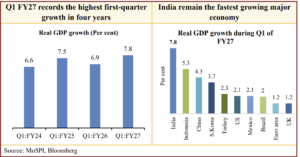
Only a competition-friendly economy can sustain growth: India remains one of the fastest-growing major economies, but the government is warning against assuming that this performance will sustain itself. The Finance Ministry’s latest Monthly Economic Review projects real GDP growth of 7.3% in the September quarter of FY27, down from 7.8% in the June quarter. More important than the modest slowdown is the policy question raised by the review: can India sustain high growth as global capital becomes more expensive and geopolitical risks intensify?
The ministry argues that India needs to become more “competition-friendly” rather than merely “business-friendly”. The distinction goes beyond terminology. Incentives can persuade a company to enter a market. Competition determines what happens after it enters: whether an incumbent can be challenged, whether smaller firms can expand, whether inefficient producers lose market share and whether capital and labour move towards more productive businesses.
That is the harder part of the growth story.
READ | ISP: India’s services economy finally gets a monthly measure
From attracting investment to improving productivity
India has spent much of the past decade improving its investment climate. Corporate tax cuts, production-linked incentives, infrastructure spending, the Insolvency and Bankruptcy Code, digital public infrastructure and efforts to simplify regulation have reduced some of the barriers facing businesses. These measures have helped attract investment and expand productive capacity.
The next phase requires a different test. Investment has to produce higher productivity.
An economy that protects incumbents for too long can add capacity without creating enough competitive pressure to improve it. Unpredictable regulations can discourage firms from making long-term investments. High compliance costs can weigh disproportionately on smaller companies, allowing established firms to consolidate their advantage. Unequal access to markets, finance, infrastructure or government contracts can also weaken competition even when headline investment incentives are generous.
This is why the Finance Ministry’s emphasis on governance and state capacity is significant. A competitive economy requires governments that can make decisions in reasonable time, enforce contracts consistently, provide reliable infrastructure and settle disputes without leaving businesses in prolonged uncertainty. For an investor considering a factory with a 20-year life, the credibility of the rules can matter as much as the incentive offered at the beginning.
India’s recent investment experience illustrates the point. Foreign direct investment has improved, but the composition of that investment remains important. Greenfield projects that create new productive capacity, bring technology and build supplier networks matter more to manufacturing competitiveness than an increase in the headline FDI number alone.
READ | India’s space economy needs capital, not privatisation
Expensive global capital raises the cost of complacency
The external environment makes these domestic reforms more urgent. Higher global bond yields have made Indian assets compete with relatively safer investments in developed markets. Foreign portfolio investors have been cautious, with large outflows from Indian equities during September as oil prices and US bond yields rose.
This does not mean India has suddenly become unattractive. Its growth prospects remain stronger than those of many large economies. But a country cannot assume that foreign capital will continue to arrive simply because its GDP is growing faster than that of its peers.
The quality of domestic institutions becomes more important when global capital is costly. Investors need confidence that policies will be implemented consistently, contracts will be enforceable and regulatory decisions will not alter the economics of a project midway through its investment cycle. The Finance Ministry’s call for sustained, high-quality and reasonably swift decision-making is therefore as much about investment as it is about administration.
There is a second external vulnerability. The ministry has flagged supply-side risks from climate conditions, geopolitical tensions and elevated crude oil prices. A weak agricultural season can push up food prices, while an oil shock can raise both inflation and the import bill. For the Reserve Bank of India, this makes the task of responding to demand conditions more complicated because temporary supply shocks can become persistent inflation if expectations and costs adjust upwards.
READ | Rural non-farm economy suffer from low productivity
Exports show the opportunity and the weakness
India’s trade figures provide some reassurance. Merchandise and services exports during April-August 2026-27 are estimated at $399.27 billion, 15.55% higher than in the corresponding period a year earlier. Merchandise exports rose 17.85% to $215.91 billion, while services exports reached an estimated $183.36 billion.
The pace puts India within sight of $1 trillion in annual exports if momentum is sustained. Services are providing an important cushion. In August, the services trade surplus of $17.45 billion offset about 65% of the merchandise trade deficit for the month.
But the merchandise trade deficit for April-August also widened to $147.09 billion from $123.88 billion a year earlier. The export performance is therefore encouraging without resolving the deeper weakness in India’s goods trade.
Services can generate substantial foreign exchange, but manufacturing has a different role in an economy where millions of workers need productive employment outside agriculture. India will need firms that can compete internationally on cost, quality, reliability and delivery. Subsidies and production incentives can help firms overcome initial disadvantages, but they cannot substitute indefinitely for productivity.
Recent evidence from India’s manufacturing investment pipeline reinforces this concern. Greenfield investment announcements fell in 2025 even as overall FDI inflows increased, suggesting that attracting capital is not the same as creating a broad manufacturing base.
Trade policy is becoming part of the growth strategy
The geopolitical environment makes competitiveness still more important. Trade policy is increasingly being used as an instrument of strategic pressure. The United States’ new Russia-related sanctions law, signed by President Donald Trump on September 18, authorises tariffs of up to 100% on countries that continue to buy Russian energy. India, a major buyer of Russian crude, could be affected, although the law does not itself impose such a tariff on Indian goods.
The episode illustrates how decisions taken for energy security can have consequences for trade and investment. India has strong reasons to retain access to competitively priced crude, particularly because it imports most of its oil. At the same time, dependence on any single market or supplier can create vulnerabilities when geopolitical tensions spill into commerce.
That makes export competitiveness more than a question of securing market access through trade agreements. Indian firms need enough productivity and cost advantage to withstand changes in tariffs, freight costs, exchange rates and supply chains.
India cannot build its next decade of growth on the assumption that favourable global conditions will persist. The 7.8% GDP growth recorded in the June quarter is evidence of economic strength, but it does not by itself establish that the underlying growth model is durable. The more demanding test is whether India can make growth less dependent on favourable circumstances.
That requires a shift in policy attention from how many businesses enter India to how effectively businesses compete after they enter. The distinction will determine whether investment merely adds capacity or raises productivity, exports and incomes.