





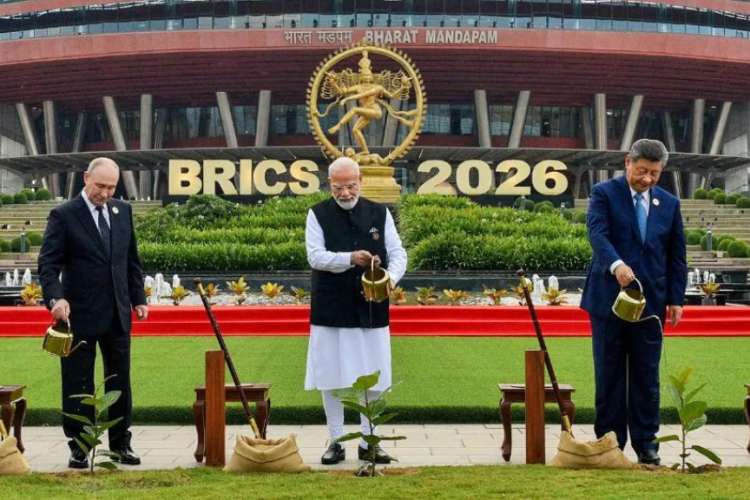
The 18th BRICS Summit in New Delhi ended with a long list of proposals on critical minerals, artificial intelligence, manufacturing and payment systems. This marked a change in emphasis for a grouping once preoccupied with reform of multilateral institutions. BRICS is now trying to build economic arrangements of its own. The difficulty is that several of these sectors are already dominated by China. Any new framework must widen the choices available to members rather than deepen their dependence on Beijing.
The Declaration calls for more reliable and diversified supplies of critical minerals. It also supports local processing so that countries with mineral reserves retain more of the value generated from them. These commitments address a weakness in the global economy: mining may be geographically dispersed, but the processing of several essential minerals remains concentrated in a few countries. Whether BRICS can alter that structure will depend on investment and technology transfer, not the language adopted at its summits.
READ | BRICS trade ambitions run into market-access reality
Lithium, cobalt, nickel, graphite and rare earth elements are essential to batteries, electric vehicles, electronics, renewable-energy equipment and advanced defence systems. Control over their extraction matters. Control over processing matters more. China occupies a dominant position in the refining of several minerals and has used export controls on strategic materials. That makes supply-chain security an immediate concern for India’s manufacturing plans.
BRICS supply chains cannot depend on China
Prime Minister Narendra Modi warned the summit against the “weaponisation” of technology and critical minerals. Recent experience has shown how export controls, sanctions and restrictions on technology can turn commercial dependence into a strategic liability. India remains reliant on imported minerals, components and manufacturing equipment, much of it sourced directly or indirectly from China.
This presents BRICS with an awkward question. The grouping cannot claim to promote economic autonomy if its supply chains merely shift dependence from Western suppliers to Chinese ones. A supply chain becomes resilient when firms have alternative suppliers, transparent rules and adequate inventories, and countries possess some domestic processing capacity. Changing the nationality of the dominant supplier achieves little.
The declaration acknowledges this problem. It describes critical-mineral supply chains as reliable, responsible, diversified, fair and sustainable. It also defends the right of resource-rich countries to retain sovereignty over their minerals and obtain a larger share of the value created from them. The language is welcome. Its meaning will depend on investment agreements, technology transfers, processing facilities and enforceable commercial rules.
Expansion has given BRICS greater economic and geographical reach. It has also made agreement more difficult. Its members differ in political systems, relations with the United States, dependence on China and attitudes towards sanctions. Some export energy and minerals; others are large importers. Each government will measure cooperation against its own strategic interests.
For that reason, declarations of solidarity will not produce economic integration. Firms need predictable tariffs, compatible standards, efficient customs procedures, investment protection and reliable dispute settlement. These are less stirring subjects than multipolarity, but they determine whether goods, capital and technology can move across borders.
Xi’s proposals carry an important caveat
Chinese President Xi Jinping used the summit to propose five initiatives. They cover an open-source artificial-intelligence community, cooperation among special economic zones, a digital ecosystem cloud platform, smart factories and an alliance for training engineers.
Several proposals address real impediments to commerce. A partnership among special economic zones could help align investment procedures and reduce the friction faced by companies building supply chains across BRICS economies. Cooperation on factories, skills and technical standards could also help poorer members acquire manufacturing capabilities.
READ | BRICS supply chain resilience needs a practical framework
Yet the design of these arrangements will matter. An open-source AI community led by China could widen access to technology. It could also draw members into a Chinese technological ecosystem built around its platforms, standards and infrastructure. The proposed cloud platform raises similar questions about data storage, cybersecurity, intellectual property and control over digital infrastructure.
India has strengths of its own in software, digital public infrastructure and technology services. It has an interest in cooperating with China where the gains are clear. But participation should be based on open standards, reciprocal access and national control over sensitive data. BRICS cooperation will lose credibility if collective projects become vehicles for one member’s technology companies.
Local-currency trade needs functioning markets
The same difficulty appears in the debate over payments. BRICS has discussed greater use of national currencies for years. The New Delhi Declaration supports stronger cross-border payment arrangements and local-currency financing. Iran and Russia have compelling reasons to promote these mechanisms because sanctions have restricted their access to conventional financial channels.
The economic case is less straightforward for other members. Businesses will use a currency when it is convertible, liquid and stable enough for trade and investment. They must be able to hedge exchange-rate risk, repatriate profits and invest surplus balances in deep financial markets. Political declarations cannot create these conditions.
Local-currency settlement can reduce transaction costs in particular trading relationships. It does not amount to an alternative international monetary system. Most BRICS currencies lack the market depth and convertibility required for that role. Until these limitations are addressed, talk of dedollarisation will run ahead of commercial practice.
BRICS should therefore concentrate on payment interoperability, lower remittance costs and financing arrangements for transactions among its members. These are achievable goals. An attempt to manufacture a common geopolitical currency would divide the grouping and produce little usable financial infrastructure.
READ | Climate finance gap gives BRICS a larger role in 2026
Economic delivery will decide BRICS’ relevance
The expanded BRICS does not share a common view of the wars in Ukraine and West Asia, relations with the United States, energy policy or the international monetary system. That need not make the grouping ineffective. Its members have identifiable common interests: cheaper development finance, less concentrated supply chains, better access to technology, food and energy security, and greater representation in global institutions.
Progress will require narrower commitments and measurable outcomes. Members could identify a small number of mineral-processing projects, agree on standards for selected manufactured products, link customs documentation and improve cross-border payment systems. Such measures would give businesses a reason to treat BRICS as an economic arrangement rather than an annual diplomatic event.
Its widening membership can become an advantage if it creates new markets and investment links. Without sustained implementation, expansion will merely add more governments to an already cumbersome forum. New Delhi has supplied the agenda. The test begins after the summit.
Durgesh Jha is an independent policy researcher based in New Delhi.