





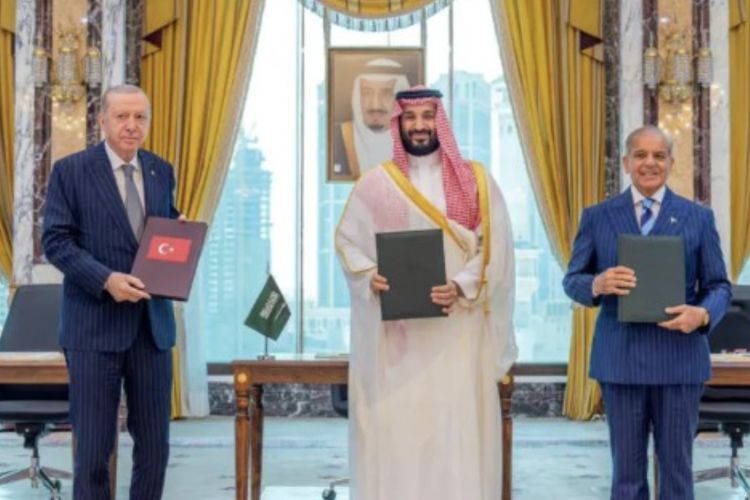
Saudi Arabia, Turkey and Pakistan signed the Makkah Joint Defence Agreement on August 7, committing themselves to treat an armed attack on one as an attack on all three. The inevitable description, an “Islamic NATO”, makes the agreement sound more formidable than it currently is. However, dismissing it would be equally unwise. Bangladesh is now considering joining, and Pakistan says the arrangement is open to other countries. For India, the issue is therefore less the wording of the agreement than what follows: who joins, what institutions are built, and whether Saudi money, Turkish technology and Pakistani military capacity begin to work together in ways they have not before.
Why the Mecca defence pact was signed
The agreement comes after a series of reminders that the old Gulf security bargain is less dependable than it once appeared. The 2019 attacks on Saudi Arabia’s Abqaiq and Khurais oil facilities briefly knocked out more than half the kingdom’s crude production, but brought no American military retaliation. Then came the Israeli strike in Doha in September 2025, targeting Hamas leaders while they were discussing a ceasefire proposal. For Gulf rulers, the message was hard to miss. Hosting American bases and buying American weapons do not guarantee protection from every threat.
READ | NATO crisis deepens over US-Iran war divide
The war that began with US and Israeli attacks on Iran on February 28 made that anxiety harder to ignore. Fighting disrupted shipping through the Strait of Hormuz and exposed, once again, the vulnerability of the Gulf’s energy infrastructure. American military power in the region remains unmatched, but its presence does not amount to an insurance policy against every contingency. Saudi Arabia, Turkey and Pakistan are responding to that uncertainty in their own ways. The Mecca pact is one attempt to reduce the risks of depending too heavily on a security architecture designed elsewhere.
The three signatories bring different assets to the table. Saudi Arabia has financial weight. Turkey has NATO experience and a defence industry that has become a significant exporter of drones and other weapons. Pakistan contributes a large military establishment and nuclear weapons. Their purposes are less neatly aligned. Riyadh wants greater room to protect itself in a volatile neighbourhood. Ankara sees strategic influence and defence markets. Islamabad gains another route to investment, military technology and diplomatic relevance.
Such differences do not prevent cooperation. They do place limits on the kind of alliance that can emerge.
Mutual defence without an alliance machine
The headline provision says an armed attack on one country will be regarded as an attack on all three. The language resembles NATO’s collective-defence principle. The machinery behind it is another matter.
Turkey has said the pact will create political and military mechanisms involving foreign ministers, defence ministers and senior commanders. Joint exercises are planned, along with cooperation in air defence, unmanned systems, electronic warfare and defence production. Pakistan acknowledged as recently as August 27 that the agreement’s operationalisation remains at an early stage.
READ | NATO’s decline: Why the alliance has outlived its purpose
There is no comparable integrated command structure, established force planning system or common military doctrine. Nor do the three countries face the same adversaries. Pakistan’s principal military problem lies to its east. Turkey’s security calculations run through NATO, Syria, the eastern Mediterranean and its increasingly difficult relationship with Israel. Saudi Arabia must reckon with Iran, the Houthis and the security of Gulf energy infrastructure.
The mutual-defence clause is therefore best treated as a political commitment whose military content remains to be built.
Defence industry may matter more than war plans
That does not make the pact inconsequential. Its most important results may emerge well below the threshold of collective war.
Turkey and Pakistan already have substantial defence links. Their armed forces conduct regular exercises, while the two governments have established permanent mechanisms covering security, defence and intelligence. Pakistan has acquired Turkish drones, and Turkey has built MILGEM-class warships for the Pakistan Navy. In April, the two sides again discussed defence-industry collaboration and deeper strategic cooperation.
The Mecca agreement gives Saudi Arabia a place inside this relationship. That matters because capital can change the scale of defence-industrial cooperation. Joint production of drones, air-defence systems, electronic warfare equipment or autonomous weapons could prove more consequential for India than any promise that Saudi or Turkish forces would enter a future India-Pakistan conflict.
There are limits to Saudi financing. Vision 2030 makes large demands on public investment, and the war has disrupted the kingdom’s economy. The IMF still sees substantial fiscal strength, helped this year by higher oil prices, but also argues that Saudi Arabia will require medium-term fiscal consolidation. Riyadh can finance ambitious defence projects. It cannot treat every strategic project as costless.
Expansion is the Indian test
The next question is membership.
Pakistan has described the agreement as open to countries willing to accept its principles. Bangladesh is considering an invitation, according to its junior foreign minister. Dhaka has yet to decide, and membership would carry serious diplomatic costs for a country that maintains important relationships with India, China, the United States and the Gulf.
READ | Bigger NATO budgets will not preserve western dominance
For New Delhi, however, Bangladesh joining would alter the significance of the arrangement. A three-country pact centred on West Asian security can be observed with some detachment. Expansion into South Asia would bring the structure closer to India’s immediate strategic environment and give Pakistan another institutional platform through which to internationalise regional rivalries.
Membership therefore deserves closer attention than labels about an Islamic military bloc. A loose arrangement among three governments is one thing. An expanding security institution is another.
American power remains embedded
The agreement also needs to be read against claims that West Asia is moving beyond the United States. That conclusion is premature.
Turkey remains a NATO member, and Ankara insists Washington is not withdrawing from the alliance even as the US presses its partners to assume a larger share of defence responsibilities. Saudi Arabia retains extensive security and economic links with Washington. This month, the Trump administration submitted a US-Saudi civil nuclear agreement to Congress, though its future has been tied to the politically difficult question of Saudi normalisation with Israel.
The Mecca pact therefore looks less like a replacement for the American order than an attempt by three states to acquire more insurance within an uncertain version of that order. Regional powers are learning to hedge. They have not acquired the means to dispense with Washington.
India should watch capability, not rhetoric
New Delhi’s response has so far been proportionate. The Ministry of External Affairs said on August 11 that it was examining the pact’s implications for national security and regional stability. External Affairs Minister S Jaishankar later questioned how much the agreement had achieved during actual military crises facing its members, while saying India would nevertheless factor it into its security calculations.
There is little reason to assume that Saudi Arabia will suddenly adopt Pakistan’s position on India. India and Saudi Arabia have built a Strategic Partnership Council covering political, economic and security cooperation, while wider engagement with the Gulf is expanding. India and the GCC formally launched negotiations for a free trade agreement in February, and another GCC-India ministerial meeting is scheduled for September.
Turkey-Pakistan military cooperation deserves closer scrutiny. It predates the Mecca pact and already covers drones, naval platforms, exercises and defence technology. China remains the much larger strategic factor. An Indian Army deputy chief said after the May 2025 conflict that Beijing had supplied Pakistan with “live inputs” on Indian positions, an allegation Pakistan subsequently rejected.
India’s task is therefore to follow what can be measured: new members, permanent institutions, joint weapons programmes, financing arrangements and changes in military interoperability.
Diplomacy matters equally. The second India-Arab Foreign Ministers’ Meeting took place in New Delhi in January after a ten-year gap, while India-GCC economic negotiations have restarted. Those mechanisms need greater political weight. India has substantial relationships with Saudi Arabia and other Gulf states, continuing interests in Iran, and valuable defence ties with Israel. Preserving room to deal with each on its own merits remains an advantage.
The strongest Indian response will ultimately be domestic. A country able to design and manufacture its own drones, missiles, electronic-warfare systems, secure communications and space assets has less reason to fear every new alignment abroad.
The Mecca agreement becomes strategically important for India if it converts money, technology and military manpower into durable capability, especially if the arrangement expands eastwards. That is the test worth applying. The photographs from Makkah matter much less than the institutions and weapons programmes that may follow them.
This article draws from a discussion on the subject organised by EGROW Foundation, a Noida-based think tank.