





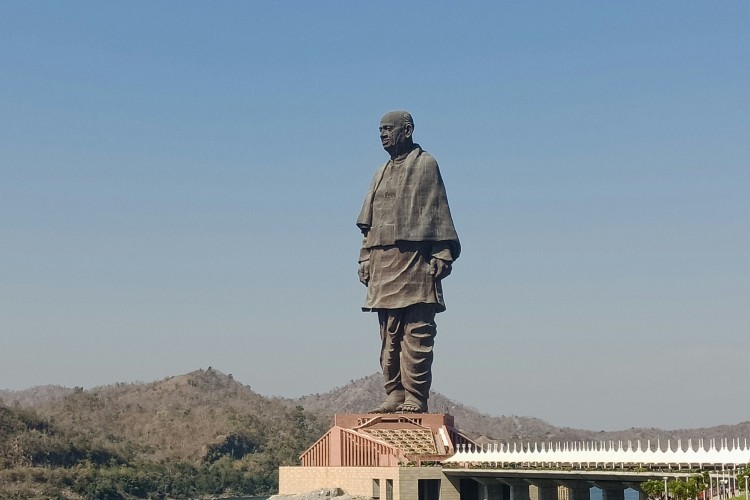
Gujarat model: The Gujarat-Tamil Nadu comparison is usually reduced to a choice between growth and welfare. It is a poor shorthand. The two states account for roughly a fifth of India’s output. Both states saw their share increase after 2000. Gujarat has done better on this count. Its gains came from industry, ports, transport links and a state policy culture that favoured investors.
That success has not produced the same gains in human development. Global Data Lab’s Subnational Human Development Index placed Gujarat at 0.531 in 2000 and Tamil Nadu at 0.547. By 2023, Tamil Nadu had moved to 0.734, while Gujarat was at 0.686. The gap is sharper in health and education. The Economic Survey 2025-26 puts Gujarat’s infant mortality rate at 20 per thousand live births in 2023, against Tamil Nadu’s 12. NITI Aayog’s multidimensional poverty data show nutrition deprivation at about 38 per cent in Gujarat, compared with roughly 19 per cent in Tamil Nadu. In secondary education, Gujarat’s gross enrolment ratio is 61 per cent. Tamil Nadu’s is 89.4 per cent. In higher education, the two figures are 24 per cent and 47 per cent.
READ | Migrant labour welfare needs portable benefits
The usual explanation is history. Gujarat’s economy grew out of trade, enterprise and a market-friendly state. Tamil Nadu drew from the self-respect movement and Dravidian politics, which put caste, schooling, food and social access at the centre of state action. This explanation is useful only up to a point. Tamil Nadu’s outcomes were not inherited. They were paid for through budgets. Gujarat now has the fiscal room to make a similar correction. The question is whether its model will treat human capital as an input into growth, not as a benefit that growth may one day deliver.
Welfare intensity in Gujarat and Tamil Nadu
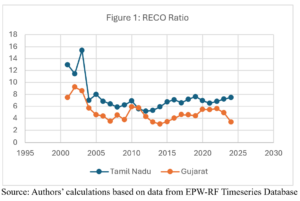
Revenue expenditure includes salaries, pensions and interest payments, so it cannot be treated as welfare expenditure. Still, the ratio of revenue expenditure to capital outlay says something about the shape of a state budget. It shows how much a government spends on current commitments for every rupee spent on capital assets. It is a rough indicator, not a direct welfare measure.
On this measure, Tamil Nadu has stayed well above Gujarat for most of the past 25 years. In 2024, Tamil Nadu’s revenue expenditure was about seven times its capital outlay. Gujarat’s was about three times. Figure 1 shows that Tamil Nadu’s RECO ratio remained higher across political cycles. This was true even in years when Tamil Nadu’s debt burden was lower than Gujarat’s. Higher welfare intensity, by itself, did not explain higher debt.
That point matters for Gujarat. A low RECO ratio can indicate fiscal caution. But when human development indicators lag, it may also indicate underinvestment in people. Gujarat does not need to copy Tamil Nadu’s welfare politics. It needs to spend more deliberately on health, nutrition, school retention and higher education access.
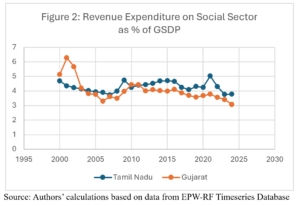
The more direct comparison is social sector spending as a share of GSDP. Since 2000, Tamil Nadu has usually spent more than Gujarat on the social sector. The gap is not an accounting curiosity. It is visible in infant survival, nutrition and enrolment. Gujarat’s economic base gives it room to move. Its social outcomes show where that room should be used.
READ | Welfare rights, not freebies, must guide India
This does not mean all revenue spending is desirable. Consumption transfers that add little to capability and lock the budget into permanent commitments should be treated with caution. Free power, cash promises and poorly targeted subsidies can weaken the case for social spending. Health centres, nutrition programmes, school completion and college access are different. They build capability. Gujarat’s problem is not that it spends too much on capital. It is that its human development record has not caught up with its growth record.
Fiscal space for Gujarat govt
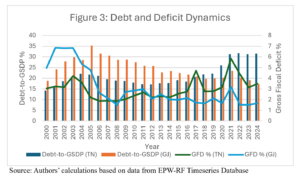
The fiscal position strengthens the case for a policy correction. State-level fiscal rules generally keep the deficit ceiling around 3 per cent of GSDP. Gujarat has been comfortably below that in recent years, excluding the pandemic shock. Its debt ratio has also stayed below the levels seen in many large states. That gives Gujarat space to increase spending on health and education without cutting capital outlay.
Tamil Nadu faces a different problem. Its welfare record is stronger, but debt is now a constraint. The pandemic pushed its debt ratio up sharply, from about 25 per cent of GSDP in 2020 to around 30 per cent in 2021, where it broadly stabilised. Its fiscal deficit has also remained above the usual 3 per cent comfort mark in recent budget years. Tamil Nadu now has to protect the welfare state without allowing debt servicing to crowd out future spending.
The older comparison is still useful. Before 2017, Tamil Nadu’s debt ratio was below Gujarat’s in several years even as it maintained a higher RECO ratio. That weakens the claim that welfare necessarily produces fiscal stress. Debt depends on growth, revenue mobilisation, committed expenditure and the quality of spending. Welfare can damage public finance when it becomes an open-ended transfer machine. It can also support growth when it raises health, education and labour quality.
The Gujarat model and the Dravidian model are often discussed as fixed alternatives. They are better seen as incomplete models. Gujarat has shown how infrastructure, industry and a pro-investment administration can raise output. Tamil Nadu has shown how welfare spending can widen access to education and health. Each now faces the weakness of its own success.
READ | Rising state debt: Welfare politics meets fiscal limits
Gujarat’s task is clearer. It has the fiscal room, the economic momentum and the evidence of lagging human development. A higher social sector push will not dilute the Gujarat model. It will correct it. Tamil Nadu’s task is harder in fiscal terms. It must keep the welfare base intact while bringing debt down over time.
The next phase will not be settled by slogans around growth or welfare. Gujarat has to prove that industrial growth can finance better human development. Tamil Nadu has to prove that welfare can be sustained with fiscal discipline. Both states have enough evidence before them. The remaining question is whether their budgets will follow it.
Rewanth Raichooti is a Research Associate at the Council for Social Development, Hyderabad; Savani Mane is a Research Assistant with Foundation for Agrarian Studies, Bengaluru. Dr Tuhinsubhra Giri is a fellow at the Academy of International Affairs NRW, Germany and teaches economics at CHRIST University, Bangalore.