





Care economy jobs: India has two deficits that are usually debated separately: too few good jobs, especially for women, and too little organised care for children, older people and persons with disabilities. The connection is direct. Care already keeps households and labour markets working. India simply leaves most of it unpaid, informal and female.
That arrangement can’t absorb the next phase of demand. Population ageing, smaller households, migration and women’s education are weakening the old reliance on unpaid family labour. India will spend more time and money on care in any case. The policy choice is whether that spending remains invisible inside households, or becomes a source of decent work.
READ | Women workforce rise hides a deeper care economy crisis
India’s care deficit is now a labour-market issue
India’s development is creating care needs that households cannot meet on their own. Children need affordable childcare. Older people need daily support, health care and assistance with mobility. Persons with disabilities need services that go beyond episodic family help.
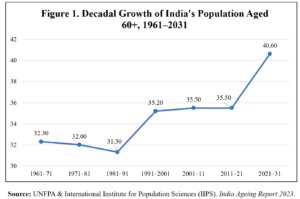
Ageing is the sharpest pressure point. The UNFPA-IIPS India Ageing Report 2023 estimated the current decadal growth rate of India’s elderly population at about 41% and projected that the elderly share of the population will rise to over 20% by 2050. It also said the population above 80 would grow by about 279% between 2022 and 2050.
These numbers will reach households before they reach budgets. Longer lives mean more years of dependence, illness and daily support. Urban migration has already thinned family networks. Nuclear households have fewer adults available for unpaid care. Women, who carried most of the burden, have less time as they study, work or try to enter paid work.
The care deficit is therefore no longer a private household matter. It affects employment, productivity and women’s participation in the labour market.
READ | Care-deficit nation: India’s care economy needs a reboot
Unpaid care work keeps women out of paid work
Most of India’s care economy remains inside the home. Childcare, eldercare, disability support, cooking, cleaning and other household services are still treated as family duty. Women do most of this work, and the economy receives the subsidy without recording the cost.
The National Statistics Office’s Time Use Survey 2024 shows the scale of the imbalance. Among people aged 15–59, 75% of men and only 25% of women participated in employment-related activities during the 24-hour reference period. Female participants in unpaid domestic services spent 305 minutes a day on those activities. In caregiving, 41% of women participated, against 21.4% of men; women who participated spent about 140 minutes a day, compared with 74 minutes for men.
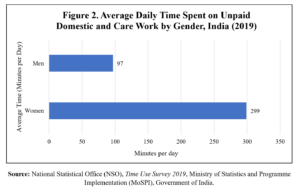
This is not an accounting curiosity. When a woman spends hours caring for children, parents or disabled relatives without pay, the household may function, but her own labour-market choices shrink. Many reduce paid work, accept irregular work, or stay out of the workforce.
Unpaid care also masks a fiscal choice. Services that would otherwise require public provision, private spending or employer support are being supplied by women at home. The economy counts the output made possible by this work. It does not count the work itself.
Care economy jobs need standards, not sentiment
The growing demand for care can create employment because care remains labour-intensive. Technology can help with records, monitoring, payments and matching workers to households. It cannot replace the work of feeding a child, assisting an older person, supporting a person with disability, or providing daily supervision.
Formal care services can create jobs for childcare workers, home-based caregivers, eldercare aides, disability support workers, counsellors, supervisors and trainers. The International Labour Organisation has long treated unpaid and paid care as central to gender inequality in households and labour markets, and has identified care deficits as a potential source of decent job creation when backed by policy.
For India, such jobs have three advantages. They are local. They are hard to offshore. They can be built around community-level provision, where demand already exists but payment and standards do not.
But this sector can also become another low-wage trap. India already has a large informal domestic-work market, marked by low pay, weak contracts and little social protection. If care services expand without standards, formalisation will only give old informality a new label.
READ | Social registries cannot settle women’s cash transfers
Building India’s care economy requires public spending
The first requirement is public investment. India needs more childcare centres, eldercare facilities, home-based support services, disability care and community-based day care. These facilities need trained workers, inspection, safety norms and predictable financing. Without public money, care will either remain unaffordable for most families or badly paid for workers.
The second requirement is professionalisation. Care workers need training, certification, skill ladders and enforceable pay standards. A caregiver cannot be treated as a domestic servant with a new designation. Poorly trained care workers will produce poor care; poorly paid care workers will not stay.
The third requirement is clear institutional ownership. Care cannot sit only in welfare language. The Union and state governments need to place it across labour, health, women and child development, social justice and urban policy. Ministries already spend on fragments of care. The missing step is to treat these fragments as economic infrastructure.
Private providers and civil society organisations can deliver parts of the service. They cannot set the floor. That must come from budgets, regulation and labour standards.
India has long counted unpaid female labour as family virtue. That fiction is losing economic utility. The care deficit is growing, and the jobs deficit remains stubborn. A care economy will not solve India’s employment problem. It can create useful local jobs and release some women from unpaid work that blocks paid work. That is reason enough to take it out of the home and into policy.
Archita Gaur is an MA Economics graduate from the Centre for the Study of World Economy, Jawaharlal Nehru University.