





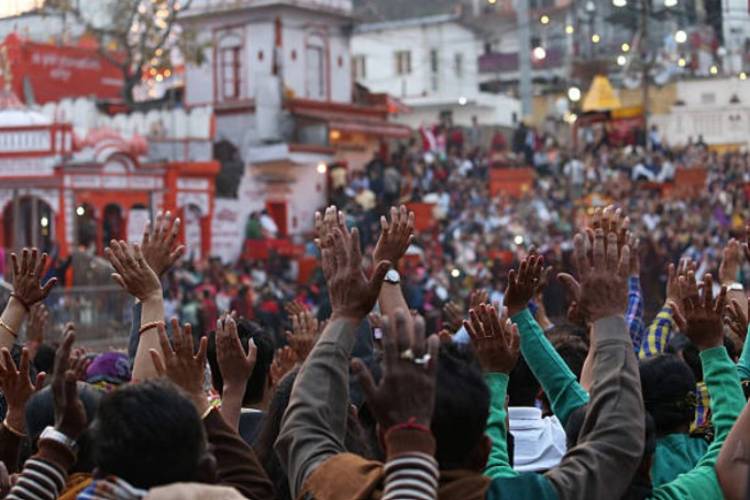
Crowd safety at places of worship: India’s places of worship are living institutions—repositories of belief, ritual, and collective memory. They are also among the most densely crowded public spaces anywhere. Of India’s 44 UNESCO World Heritage Sites, 10 are classified as Religious Heritage. The country’s temples, mosques, churches, gurudwaras, and shrines draw millions every year.
Religious tourism has surged. Ministry of Tourism data shows visits rising from 10.5 crore in 2020 to 143 crore in 2022, with annual totals continuing to climb. The headline is growth. The operational reality is pressure: constrained streets, fixed ritual timings, emotionally charged crowds, and limited room for error.
READ | A double whammy for Assam’s miya Muslims
Footfalls now routinely match the scale of a major city. In 2024, extraordinary visitor numbers were recorded at Ayodhya (16 crore), Ujjain (7.32 crore), Kashi (11 crore), and Tirupati (2.55 crore), according to the Ministry of Tourism. Protection is not theatre. It is the duty to safeguard life while preserving sanctity—so faith is practised without fear.
What this moment demands is a shift: from security optics to science-backed, resilience-first risk mitigation.
Crowd safety at places of worship
Places of worship face two broad risk clusters: terror threats and crowd-related incidents. Terror attacks draw justified attention, but the larger, repeat risk sits elsewhere. History is blunt: deaths from crowd-related incidents have often exceeded fatalities from acts of terror.
The National Disaster Management Authority (NDMA) identifies stampedes, crowd crushes, fires, structural failures, and panic-triggered surges as primary causes of fatalities during large gatherings. These are rarely single-point failures. They emerge from cascading breakdowns: poor flow design, delayed communication, misinformation, blocked exits, a small stumble that turns into pressure waves, or a rumour that outruns the public address system.
READ | Menstrual health is enforceable right after Supreme Court ruling
The risk profile has also evolved. Vulnerabilities now include insider collusion, sabotage of utilities, and interference with communication systems. Yet safety planning at many sacred spaces remains threat-centric—heavy on perimeter security, light on resilience.
Resilience-first planning starts from one question: when stress and surge arrive, do systems bend or break?
NDMA crowd management and predictable failure points
Crowd behaviour is not inherently chaotic. It is patterned—and that is the point. Density, speed, bottlenecks, and pressure thresholds can be measured, modelled, and managed.
Crowd science allows planners to work with predictability rather than against panic. Evidence-based interventions are familiar but unevenly implemented: wider circulation paths, separated entry and exit flows, timed access, real-time counting, continuous monitoring of crowd pressure, and rapid adaptation when conditions change. These are not “add-ons”. They are the core design of safety.
The lesson from large pilgrimages is consistent. At events like the Hajj—millions of pilgrims, fixed schedules, restricted geography—authorities treat density as a hard constraint, not an afterthought. Research cited in Annals of Global Health notes that once density crosses roughly 4–5 persons per square metre, stampede risk rises sharply, often without visible warning. Waiting for visible warning is, in practice, waiting too long.
The objective is prevention, not heroics. When movement feels guided and information is clear, anxiety falls and collective behaviour stabilises. Calm is engineered.
Early warning systems and non-intrusive technology
Technology is most valuable when it functions as early warning, not post-incident evidence.
AI-enabled CCTV analytics can flag congestion, abnormal stoppages, and unusual accumulation in specific zones. Sensors and counters can quantify density at chokepoints. But the most underestimated tool remains the public address system. Clear, calm, authoritative instructions—delivered early—can stop rumours from metastasising and prevent a surge from becoming a crush.
None of this requires turning sacred space into an airport. Systems should be designed to respect reverence: discreet placement, camouflaged hardware, and an operating philosophy that treats safety as part of care, not an intrusion.
READ | Probiotics for cancer and diabetes?
Training, SOPs, and humane crowd control
Infrastructure and technology fail without trained human coordination. Scenario-based Standard Operating Procedures (SOPs) prepare teams for predictable contingencies: sudden surges, medical emergencies, weather shifts, power failures, and misinformation. NDMA’s crowd management framework emphasises response time as the most critical factor in reducing fatalities.
That response time is delivered by people: trained volunteers and marshals who can de-escalate, coordinated policing that prioritises flow over force, and emergency services that are positioned to arrive in minutes, not after the crowd has already compressed.
A common objection is cultural: modern safety infrastructure will dilute the spiritual experience. In practice, the opposite is more often true. Non-intrusive upgrades—discreet bollards, structured queuing, shaded holding zones, visible signage, well-positioned medical aid posts—reduce stress and uncertainty. Devotion does not flourish in fear.
Vatican City offers a useful reference point: soft barriers, guided queuing through holding zones, controlled access points, trained marshals, and multilingual public messaging. The principle is not coercion. It is calm, secure movement at scale.
Resilience-first protection of sacred spaces
Safety does not compete with faith. It protects it.
India’s places of faith have endured because they adapted while holding to core values. Science-backed risk mitigation is not a departure from tradition. It is continuity—care expressed through design, planning, and preparedness.
As India continues to host the world’s largest religious gatherings, crowd safety becomes more than an operational necessity. It is a moral obligation. If institutions and administrations embrace crowd science, build early warning systems, train frontline manpower, and upgrade infrastructure with respect, faith remains not only enduring—but safe for generations to come.
Kunal Bhogal is COO, IIRIS Consulting.