





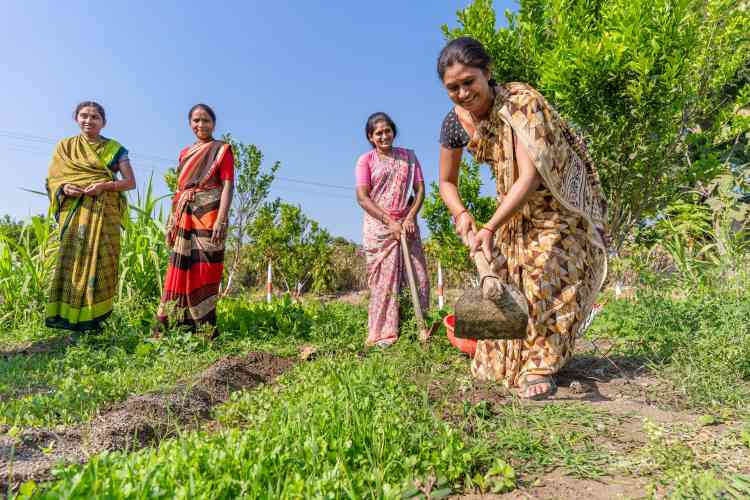
Women’s self-employment boom masks a manufacturing divide: India’s rising female labour force participation has been accompanied by a marked increase in self-employment. The Periodic Labour Force Survey (PLFS) shows that self-employment among working women rose from 51.9% in 2017–18 to 67.4% in 2023–24. The trend has often been interpreted as evidence of growing entrepreneurship. Yet the expansion of self-employment tells us little about the economic strength of the enterprises women run.
The distinction becomes clearer in the Annual Survey of Unincorporated Sector Enterprises (ASUSE), which separates Own Account Enterprises (OAEs), operating without regular hired workers, from Hired Worker Enterprises (HWEs), which employ at least one worker on a regular basis. Women have a substantial presence in the former category but are far less represented among enterprises that employ workers.
READ | BRICS must connect women’s skills with better jobs
The latest ASUSE figures reinforce the importance of examining enterprise ownership alongside employment. Women headed more than 60% of unincorporated manufacturing establishments in 2025, although their share of proprietary establishments across manufacturing, trade and other services was only about 27%.
The distinction between ownership and enterprise performance becomes especially revealing when India’s major states are compared. Gross value added (GVA) per establishment, a measure of economic output generated by an enterprise, varies considerably across states. The draft’s analysis of 20 major states suggests a negative association between female ownership and GVA per establishment, particularly among own-account enterprises. States with a higher proportion of women-owned businesses often have lower average output per establishment.
This relationship requires careful interpretation. GVA per establishment measures average enterprise output rather than labour productivity, and a negative correlation does not establish that female ownership causes lower output. Differences in enterprise size, industry composition, capital intensity and access to markets may explain much of the variation.
Women-owned enterprises struggle to become employers
Tamil Nadu and Maharashtra illustrate the gap between women owning businesses and women owning enterprises that hire workers. According to the state-level calculations presented in the draft, women account for about 68% of own-account manufacturing enterprises in both states. Their share among hired-worker enterprises falls to 10.8% in Tamil Nadu and 8.2% in Maharashtra. Even these considerably lower figures exceed the corresponding national average of 6.7%.
The difference is more pronounced in West Bengal and Jharkhand. Women reportedly own approximately 73% of own-account manufacturing enterprises in both states, compared with a national average of 67%. Among enterprises hiring workers, however, female ownership falls to around 3%, less than half the national average.

These figures suggest that women’s participation in enterprise ownership is concentrated among businesses operating without regular employees. They do not, by themselves, demonstrate that individual women-owned enterprises lose female ownership as they expand. Establishment-level data tracking businesses over time would be needed to establish that transition.
The disparity nevertheless raises an important question about the quality of women’s self-employment. A household enterprise can provide income and economic independence without generating sufficient returns to support investment or paid employment. The ability to employ workers is an imperfect but useful indication of whether a business has moved beyond reliance on the proprietor and unpaid household labour.
READ | Women farmers carry Indian agriculture without equal access
Why Tamil Nadu and Maharashtra perform differently
Tamil Nadu combines substantial female participation in own-account manufacturing with a well-established industrial economy. Its manufacturing base extends across textiles, electronics, automobiles, pumps and paper. The state’s industrial clusters connect smaller suppliers to larger producers, while its urban centres provide access to markets and financial services.
These conditions can help women-owned enterprises operate in sectors with greater opportunities for investment and higher value addition. The association between female ownership and relatively strong enterprise output in Tamil Nadu is consistent with the advantages offered by an established industrial ecosystem, although the survey alone cannot establish how much each factor contributes.
Maharashtra presents a comparable picture. Its manufacturing economy includes automobiles, pharmaceuticals, chemicals, capital goods and textiles. Major industrial centres offer access to suppliers, customers and financial institutions that is less readily available to enterprises operating in geographically dispersed or predominantly household-based production systems.
The experience of these states suggests that the economic prospects of women-owned enterprises depend partly on the industrial environment in which they operate. A larger manufacturing base may provide opportunities for business expansion that are unavailable to equally capable entrepreneurs elsewhere.
There is, however, a qualification. The relatively low share of women-owned hired-worker enterprises in both states shows that a diversified industrial economy does not automatically translate into proportionate female ownership of larger businesses. Access to capital, business networks, property and markets may still limit women’s ability to expand.
READ | Childcare infrastructure needed to lift women’s employment
West Bengal and Jharkhand face a different constraint
West Bengal has a particularly high concentration of women-owned own-account enterprises, but average GVA per establishment remains relatively low in the draft’s state-level comparison. Much of the state’s informal manufacturing activity is associated with garments, handlooms and household-based production, where businesses often rely on family labour and operate with limited capital.
Such enterprises can provide an important source of household income, particularly where regular wage employment is scarce. Their capacity to expand may nevertheless be constrained by low margins, dependence on intermediaries and limited access to larger markets. High female ownership can therefore coexist with modest enterprise output.
Jharkhand exhibits some of the same constraints. Its informal manufacturing sector includes small-scale production serving local markets, with many women participating through own-account enterprises. Limited market access and investment opportunities can restrict the scope for expansion.
The comparison with Tamil Nadu and Maharashtra also cautions against treating self-employment as a uniform economic category. An enterprise supplying a developed manufacturing cluster operates under substantially different conditions from a home-based producer dependent on irregular local demand. Both may be recorded as self-employed businesses, although their opportunities for raising income and employing workers differ considerably.
India’s female entrepreneurship policy needs a growth focus
The ASUSE 2025 findings provide useful context for this distinction. The total number of unincorporated non-agricultural establishments increased from 7.34 crore in 2023–24 to 7.92 crore in 2025. Their combined nominal GVA grew by 10.87%, while average annual GVA per market establishment rose from ₹2.46 lakh to ₹2.53 lakh. The survey also reported an increase in internet use among establishments, from 26.7% to 39.4%.
These developments indicate expanding economic activity in the unincorporated sector, but they do not establish that women-owned manufacturing enterprises are moving into higher-output categories at the same rate. Ownership shares, output and employment need to be examined together.
Policies supporting female entrepreneurship should therefore pay closer attention to the conditions under which women-owned enterprises can expand. Access to working capital is especially important for businesses seeking to purchase equipment, accept larger orders or employ workers. Reliable market connections and participation in industrial supply chains could also help enterprises move beyond household production.
The policy response must recognise differences across states. In Tamil Nadu and Maharashtra, stronger links between women-owned enterprises and established manufacturing clusters may offer considerable scope for growth. In West Bengal and Jharkhand, improving market access and production capabilities among smaller businesses may be a more immediate priority.
The challenge is also broader than enterprise finance. Women’s ability to expand a business may depend on ownership of assets, access to collateral, household responsibilities and the availability of paid employment outside self-employment. For some women, a secure wage job may offer better prospects than running a very small enterprise.
India’s employment statistics increasingly reflect women’s participation in economic activity. The next test is whether this participation translates into higher earnings and businesses capable of sustained growth. A policy that counts new women entrepreneurs without tracking how their enterprises perform risks mistaking necessity-driven self-employment for successful entrepreneurship.
Yugandhara Barve is an independent researcher. Satyaki Dasgupta is Assistant Professor at Christ University, Bangalore.