





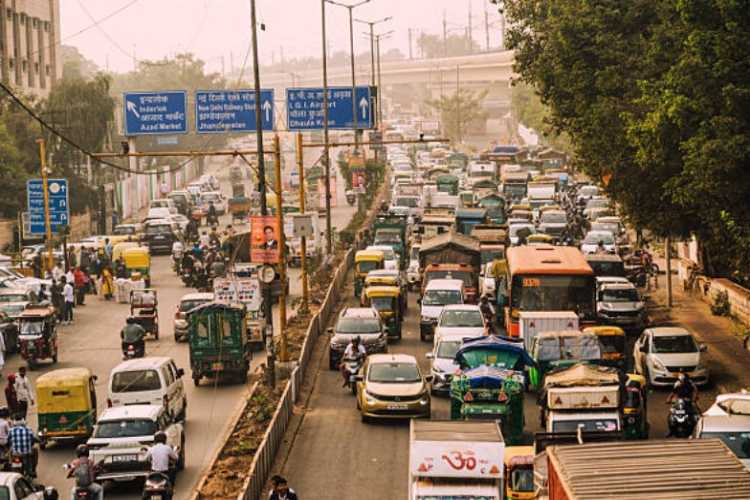
India’s urban transport crisis: Sustainable, climate-resilient public transport will determine whether India’s cities become engines of growth or congestion traps. By 2050, India will need an estimated $2.4 trillion in resilient urban infrastructure to serve nearly a billion city residents; by 2070, that requirement could rise to $10.9 trillion. Yet the lived reality remains grim. Millions still navigate overcrowded buses, unsafe footpaths, erratic fares, and paralysing traffic. The distance between aspiration and experience is already widening.
Transport is not merely a technical service. It is the backbone of urban opportunity. Efficient mobility widens access to jobs, education, and markets. Weak systems do the opposite—deepening inequality, cutting productivity, and amplifying climate risks. India’s cities are not short of roads. They are short of systems that convert movement into reliable mobility.
READ | Green hydrogen buses to power India’s public transport
Mobility is governance in disguise
Urban transport ultimately reflects governance choices. How fares are set, how rules are enforced, and how information is shared shape commuter behaviour as directly as taxes or regulations. In India, that governance is fragmented. Fare revisions appear arbitrary. Surcharges lack transparency. Service levels vary sharply across routes and cities. The result is mistrust.
When commuters cannot predict costs or reliability, they hedge by clinging to private vehicles. Predictability changes behaviour. A stable pricing framework—linked to affordability benchmarks and service guarantees—can persuade users to shift modes. In Delhi, where commuters lose roughly 150 hours annually to traffic congestion, even a modest move from cars to dependable buses or metros would unlock large productivity gains.
What global experience gets right
Cities that have treated transport as a credibility problem offer useful lessons. Singapore’s fare adjustment formula, in place since 2005, limits annual changes within a narrow, publicly explained band. Seoul’s integrated ticketing and pricing system has pushed public transport’s share above 60% of daily trips. Stable fares do more than reduce congestion; they make public transport habitual.
Urban design matters too. Copenhagen’s bicycle-centric planning and Vienna’s human-scale urban design demonstrate how consistent policy, not grand projects, delivers lower emissions and higher quality of life. These outcomes were not achieved through flyovers but through predictable systems that commuters could trust.
READ | India eyes transport planning overhaul to power economic growth
Data gaps can be costly
Infrastructure without information is inefficient. Without real-time data on traffic flow, service frequency, and crowding, commuters cannot plan journeys and regulators cannot manage demand. The outcome is familiar: half-empty buses on some routes and dangerous overcrowding on others.
Only one in five Indian cities has a functional Integrated Traffic Management Centre. In Delhi, poor coordination alone costs drivers an estimated seven litres of fuel per week, translating into as much as $10 billion annually in wasted fuel and time. Targeted investment in data systems, staff training, and enforcement would allow cities to shift from reactive control to predictive management.
Economic cost of unreliable transport
Congestion is not an inconvenience; it is an economic leak. Estimates suggest that by 2030, congestion in Delhi alone could cost $14.7 billion annually—more than the yearly budgets of several Indian states. Cities such as London and Stockholm have shown that congestion pricing can cut traffic while generating revenue for public transport.
India’s losses are compounded by weak credibility. When fares and services feel unreliable, commuters default to private vehicles, raising fuel bills and cutting productivity. Technologies for integrated ticketing and seamless payments already exist. Their slow scaling reflects institutional inertia, not technical limits.
READ | Electric vehicles are steering the future of transportation
Social exclusion and climate risk
The burden of unreliable mobility falls heaviest on women, the working poor, the elderly, and persons with disabilities. Ahmedabad’s Janmarg BRTS illustrates both progress and gaps. While it introduced tactile paving, audio-visual aids, and fare concessions, unsafe boarding points and weak feeder integration continue to limit inclusivity. Poor transport governance nudges households toward private vehicles, reinforcing congestion and exclusion.
Transport already accounts for roughly 20% of India’s emissions, a share set to rise sharply as cities expand. Studies suggest that well-designed urban policies could cut emissions by up to 80%, yielding savings of about $122 billion—roughly equivalent to India’s annual public health expenditure. Climate stress will intensify this challenge. By mid-century, India could see 50% more extreme heat days and nights, worsening urban heat islands and increasing the risk of cascading infrastructure failures. Even limited flooding—affecting just 10–20% of roads—can wipe out over half of a city’s functional transport capacity.
What needs to change
Policy intent is not absent. Under PM e-Drive, Bengaluru plans to induct 4,500 electric buses. But without dedicated lanes, depot charging, and reliable schedules, the gains will be limited. Non-motorised transport offers faster returns. Investments in safe walking and cycling infrastructure could reduce road accidents by 28–37% in cities such as Surat and Udaipur.
India needs a transport model that builds trust in shared mobility. That requires Comprehensive Mobility Plans that integrate buses, metros, walking, and cycling—while also accounting for time poverty, safety, mental health, and climate resilience.
A choice that cannot be deferred
India faces a clear choice. It can lock itself into a high-cost, high-pollution urban model, or it can invest in systems that deliver sustainable growth. The path forward is well known: predictable and inclusive pricing, integrated modes through smart hubs and digital systems, and explicit alignment of transport policy with social and climate goals.
By mid-century, nearly one billion Indians will have lived in cities. Whether these cities become engines of growth or traps of congestion will depend less on the number of flyovers and more on the credibility of the systems that manage them.
Nearly 70% of India’s urban settlements are small and medium-sized cities, yet policy attention remains metro-centric. Closing the knowledge gap on their demographics and economic trajectories is essential. Getting transport right in these cities will determine whether urbanisation becomes India’s greatest economic lever—or its most expensive failure.
Dr Sumit Haluwalia is an Assistant Professor, Economics at Christ University, Bangalore. The data for the discussion in this article were taken from the Opportunities for Climate Mitigation and Sustainable Development (OPTIMISM) report by Ahmedabad University (2022) and the Towards Resilient and Prosperous Cities in India by the World Bank (2025).