





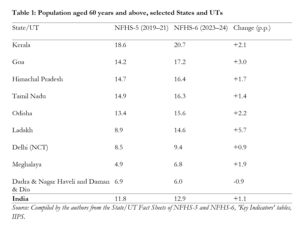
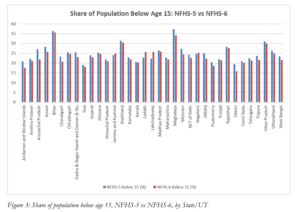
India is ageing fast, but the data available to policymakers have not kept pace with the demographic change. NFHS 6 puts the share of the population aged 60 and above at 12.9%, compared with 11.8% in NFHS 5. The increase of 1.1 percentage points at the national level masks larger changes in some states and Union territories. Kerala now has 20.7% of its population in this age group, while in Ladakh this has risen from 8.9% to 14.6%. Bihar and Uttar Pradesh, by contrast, have recorded increases of only 0.4 and 0.3 percentage points.
These numbers have consequences for health policy. An ageing population brings greater demand for the management of chronic disease, geriatric care, long-term care and protection from recurring medical expenditure. Those demands are dealt with largely by state and district health systems, where the national average of 12.9% tells policymakers relatively little. Kerala cannot plan for its elderly population in the same way as Bihar, just as a sharp increase in the elderly population of a place such as Ladakh raises a different set of questions about capacity and access.
READ | Fertility decline: India is ageing before prosperity
The difficulty is that India’s health information system does not provide enough regular, age-specific information to answer many of these questions. NFHS already collects some health measurements from older adults, but much of the information is either reported in broad age groups or is unavailable beyond the age limits of its individual questionnaires. India also has the Longitudinal Ageing Study in India (LASI), which was designed specifically to study the health, economic and social conditions of older people. Its first national wave, however, was conducted mainly in 2017–18.
With the government having extended AB-PMJAY to all citizens aged 70 and above, the gap between the information available and the decisions that now have to be made has become harder to ignore.
India’s ageing pattern is highly uneven
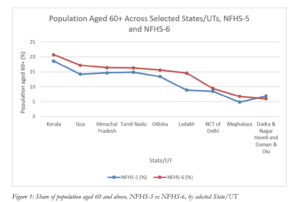
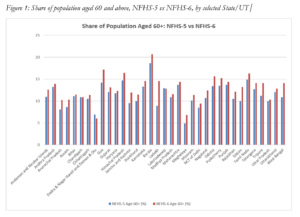
Kerala remains the state with the highest share of people aged 60 and above, at 20.7%, compared with 18.6% in NFHS-5. Goa follows at 17.2%, Himachal Pradesh at 16.4%, Tamil Nadu at 16.3% and Odisha at 15.6%. Ladakh recorded the largest increase among states and Union Territories, from 8.9% to 14.6%, a rise of 5.7 percentage points. Sikkim and West Bengal each recorded increases of 3.2 percentage points, while Goa’s share rose by 3 percentage points.
At the other end, Bihar’s elderly share rose from 11.1% to 11.5%, and Uttar Pradesh recorded an increase of only 0.3 percentage points.
The implication for health planning is straightforward. States that already have a high share of older people need greater capacity for geriatric and long-term care. Younger states have more time to prepare. That does not make ageing a problem only for Kerala, Tamil Nadu or other older states. It means that the timing of investment can differ substantially across states.
The differences also caution against treating India’s ageing population as a single national category. The pace of demographic change, the burden of chronic disease and the capacity of health systems will not evolve uniformly. Planning based only on national averages risks overlooking where demand is already becoming concentrated.
NFHS counts older people better than it describes them
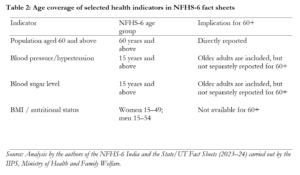
NFHS-6 contains 101 headline indicators. One directly identifies the population aged 60 and above. Several health measurements include older adults, but the published fact sheets do not generally report these indicators separately for the 60-plus population.
Blood pressure and random blood glucose are measured among adults aged 15 years and above. The associated questions on diagnosis and medication also make it possible to examine hypertension and diabetes-related measures among older adults. Yet the published fact sheets pool these adults into broad age ranges rather than showing the 60-plus population separately. A 25-year-old and an 85-year-old therefore appear within the same broad adult population for these indicators.
The problem is more basic for nutrition. NFHS-6 reports body mass index for women aged 15–49 and men aged 15–54. Anthropometric measurements therefore do not provide a basis for assessing the nutritional status of older adults through the survey. The absence of such information is significant because nutritional status, frailty and functional capacity become increasingly relevant to health service requirements in later life.
Health financing presents another limitation. NFHS reports whether a household has a member covered by a health insurance or financing scheme, but household-level coverage does not establish whether an older individual is adequately protected against his or her own health expenses. For an ageing population, that distinction becomes more important because healthcare costs can become recurrent rather than episodic.
READ | Kerala ageing population needs rights-based elder care
These gaps arise from the basic design of NFHS. The survey uses household, women’s, men’s and biomarker questionnaires. In NFHS-5, the individual questionnaires covered women aged 15–49 and men aged 15–54, while blood pressure and random blood glucose were measured for adults aged 15 and above.
The design is understandable. NFHS was built around population, health and family-welfare monitoring, with a substantial emphasis on maternal and reproductive health. It was never intended to be an ageing survey. The problem is that India’s demographic structure has changed while much of that questionnaire architecture remains oriented towards a younger population.
This distinction also matters when deciding what should change. If information is already collected but not reported by age, the solution is largely a reporting decision. If information is not collected at all, changing the situation requires additional fieldwork, with implications for questionnaire length and cost.
NFHS and LASI should divide the work
India already has a survey specifically designed to study ageing. LASI, conducted by the International Institute for Population Sciences, covers the health, economic and social dimensions of ageing. Its first national wave included 73,396 people aged 45 and above across India’s states and Union Territories, with fieldwork conducted mainly from 2017 to 2018.
LASI addresses many of the questions that NFHS cannot answer for older adults, including healthcare use and expenditure, functional health, economic circumstances, family and social networks, and other dimensions of ageing. It is therefore neither necessary nor desirable to turn NFHS into a second LASI.
The two surveys have different strengths. NFHS offers a regular, broad population-health picture and provides geographically detailed estimates. LASI goes much deeper into the experience and circumstances of ageing. The logical objective is to make the two systems more complementary.
The timing problem is important. LASI Wave 1 provides the most recent nationally representative ageing-specific evidence currently available, but its fieldwork dates mainly from 2017–18. IIPS says preparations for Wave 2 are under way.
That gap would be less consequential if policy for older people were static. It is not. In October 2024, the Union government expanded AB-PMJAY to provide up to ₹5 lakh a year in treatment benefits to all citizens aged 70 and above, irrespective of socioeconomic status.
The expansion creates an immediate need for better information. Policymakers need to know how chronic and multiple morbidity varies among people aged 70 and above, where functional limitations are most prevalent, how much older people already use healthcare services and pay out of pocket, and whether states ageing rapidly have adequate geriatric capacity.
A baseline that is eight years old is of limited use for answering such questions when the policy environment and the population have changed. The point is not that older data become worthless. It is that their value for current service planning declines as the interval between survey rounds grows.
READ | Kerala’s ageing crisis needs a governance reset
Use existing data before creating new systems
The first priority should be to extract more value from information NFHS already collects.
Where blood pressure and blood glucose measurements are available for older adults, NFHS should publish age-disaggregated estimates for the 60-plus population. The accompanying information on diagnosis and medication already provides a basis for examining prevalence, awareness and treatment. This would require changes in reporting rather than additional fieldwork.
The second issue is anthropometry. NFHS-7 could consider extending height and weight measurements to older adults. Unlike the first proposal, this would require additional data collection and therefore carries a real cost. But it would address a gap for which the existing NFHS records cannot simply be re-tabulated.
Third, the age ceiling for the individual questionnaire could be reconsidered. It need not mean extending the full questionnaire to every older respondent. A short module for adults above the current ceiling could cover areas particularly relevant to service planning, such as healthcare use, out-of-pocket expenditure, functional limitation and work status. The existing biomarker questions need not be duplicated.
The fourth priority is LASI itself. A predictable schedule for future waves would make the survey more useful for policy. IIPS has envisaged LASI as a longitudinal programme, with repeated waves designed to follow changes in India’s ageing population.
Finally, the two surveys should be designed to work alongside each other. Comparable definitions, age groups, geographic classifications and reference periods would make it easier to use NFHS for regular monitoring and LASI for deeper analysis of functional health, care needs, economic circumstances and healthcare expenditure.
There is a broader lesson in the NFHS-6 experience. The number of headline indicators has fallen from 131 in NFHS-5 to 101 in NFHS-6. The Union government has said the selection followed recommendations of the Technical Advisory Committee and a data-harmonisation approach, with some indicators being tracked through other official sources. That explanation is relevant to the ageing question because it argues against simply adding more indicators to every round of NFHS.
The case for ageing data therefore has to be made within the existing architecture of India’s health statistics, not by assuming that every survey should measure everything. NFHS can report more of what it already knows. LASI can provide the depth that NFHS was not designed to provide. The two can be made more useful by improving their timing and comparability.
India’s ageing population will change the health system’s priorities. Knowing how many older people there are is the starting point. For governments deciding where to build capacity, how to finance care and which services to expand, the more important questions are where those older people live, what health conditions they face and what support they require. India’s surveys already contain much of the architecture needed to answer them. The policy task now is to make that architecture work together.
Tanya Singla is a research student and Megha Jacob an Assistant Professor at the Department of Economics, Jesus and Mary College, University of Delhi. Karan Babbar is an Assistant Professor of Economics at XLRI Jamshedpur.