





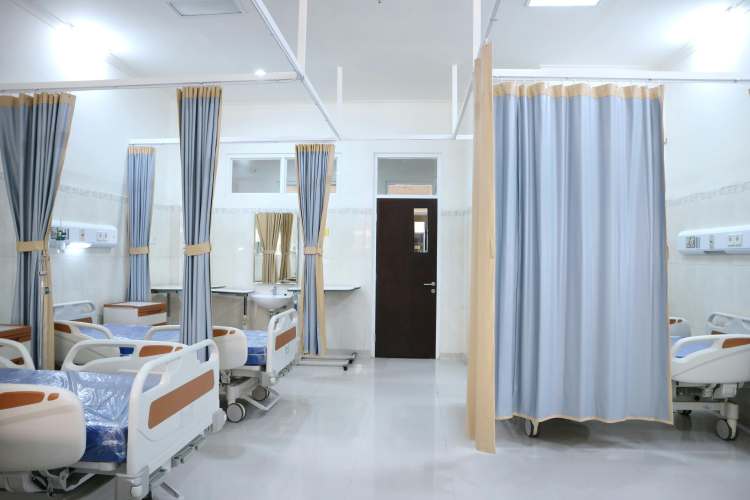
Healthcare real estate missing from reform debates: Most debates on healthcare reform stay trapped in the usual frame: doctors, technology, insurance, and how much households or governments can spend. They rarely ask a prior question: where does healthcare happen, and who owns that space That omission matters. Hospitals, nursing homes, clinics, and diagnostic centres are no longer shaped only by medical logic. They are increasingly shaped by real-estate economics. The infrastructure of care is now also an asset class.
Across many countries, healthcare facilities are no longer treated only as public infrastructure or service platforms. They are managed as corporate healthcare real estate assets. Research in the Journal of Corporate Real Estate has shown that healthcare organisations now treat buildings as strategic assets, with decisions on space use, asset performance, and value creation folded into corporate strategy rather than left to administrative routine.
READ I Universal health coverage begins with prevention, not insurance
Healthcare real estate changes hospital behaviour
This shift is not neutral. Ownership structures create financial obligations that influence how hospitals function. If a hospital owns its land and buildings, capital is locked in. If it leases them, rent becomes a fixed obligation, payable regardless of patient load, disease burden, or public-health emergencies. Either way, healthcare real estate costs shape managerial choices. But leasing makes the pressure more immediate and more visible inside the balance sheet.

That changes behaviour. A hospital operating under recurring rent obligations must secure predictable cash flow. The pressure does not appear directly in the consultation room, but it travels there. It can tilt priorities towards high-margin procedures, premium diagnostics, and service lines that generate steady returns, while preventive care, outreach, and low-margin community health services slip down the order. The issue is not that clinicians suddenly stop caring. It is that institutions begin to behave like tenants carrying a fixed monthly burden. Once that happens, medical judgment operates inside a tighter commercial frame.
READ I India’s global health opportunity amid US withdrawal
Investor capital is moving into healthcare property
This is not a local or isolated development. Research published in Healthcare has documented the sharp rise of investment in healthcare property across Europe and the United States. The appeal is obvious: ageing populations, steady demand, and long-term returns. Hospitals, rehabilitation centres, and senior-care facilities are increasingly seen as relatively low-risk assets within diversified real estate portfolios.

That marks a structural change. Healthcare real estate is being drawn into capital markets — leased, traded, valued, and optimised for financial performance. The building is no longer just where care is delivered. It is also a revenue-generating asset for investors far removed from patients and communities.
A recent Lancet article points to the growing role of healthcare real estate investment trusts in healthcare delivery. Hospitals are increasingly functioning as tenants rather than owners, leasing facilities from financial entities. That may reduce the upfront burden of owning expensive infrastructure. But it also exposes hospitals to rent obligations that can shape clinical and managerial decisions in quiet but consequential ways.
READ I Menstrual health is enforceable right after Supreme Court ruling
Invisible property costs raise the price of care
Patients do not usually see these costs clearly. Hospital bills rarely carry a line item marked rent, lease servicing, or property yield. Those costs are folded into bed charges, consultation fees, diagnostic tests, and procedure costs.
So the property structure of a hospital becomes part of the price of care without ever being named as such. The patient pays not only for treatment, staff time, and equipment, but also for the financial architecture that sits underneath the institution.
That is why healthcare real estate cannot be treated as a technical back-end issue. It affects affordability. It affects pricing. And it affects which kinds of care are institutionally favoured.
Healthcare access is shaped by land and location
The implications go beyond hospital finances. Healthcare real estate also has consequences for equality and access.
Large medical institutions reshape neighbourhoods. They influence surrounding land values, commercial activity, and urban development. Research in urban economics and related literature has long shown that anchor institutions such as hospitals can alter local property markets and patterns of exclusion. A new hospital may improve access for some populations while making nearby land more expensive and pushing lower-income residents or smaller care providers to the margins.

This makes location a policy issue, not just a business decision. When healthcare infrastructure follows land appreciation, private demand, and investor interest, care provision may move away from areas of greatest need. The result is a geography of healthcare that mirrors purchasing power more closely than public-health priorities.
South Asia cannot ignore healthcare infrastructure
This matters even more in South Asia, where rapid urbanisation, uneven infrastructure, and the expansion of private healthcare are reshaping access to care. In such settings, healthcare facilities do not merely contain medical activity. They structure organisational behaviour.
As research in the Journal of Corporate Real Estate argues, healthcare facilities are not passive containers of care. Space allocation, facility planning, and location decisions influence staff behaviour, patient experience, and institutional priorities. If these decisions are driven primarily by investor requirements rather than health needs, the distortion is built into the system from the start.
What works as an investment strategy in the United States or Europe may not work in South Asia. Income levels are lower, public systems are weaker, and access deficits are larger. A financing model built around predictable returns from leased infrastructure may sit uneasily in a region where affordability and uneven geography remain central healthcare problems.
Healthcare crises expose risks of lease-driven system
The policy risk becomes sharpest in a crisis. A hospital tied to fixed lease payments has less room to adapt during a pandemic, epidemic, or other emergency. Rent does not fall because elective procedures are postponed or public-health priorities shift.
That makes the system more brittle. A healthcare institution under financial pressure may struggle to preserve surge capacity, absorb temporary losses, or redirect resources quickly. A system loaded with fixed property costs is less resilient when flexibility matters most. This is where the ownership question stops being invisible. It becomes part of preparedness.
Healthcare does not begin at the consultation table. It begins with land, buildings, leases, and ownership structures that shape every decision taken inside those walls. Ignore that, and one of the most powerful forces in modern healthcare remains hidden in plain sight.
Gunika Dubal is an intern, and Dr Isha Sharma Assistant Professor at School of Social Sciences and Fellow, Centre for Studies in Population and Development, Christ University, Delhi NCR Campus.