





GM mustard delay: India imports more edible oil than any other country. In 2024-25, imports were about 15-15.5 million tonnes, meeting roughly 60% of domestic demand. That dependence has one central cause: low oilseed yields, including in mustard. Nearly a decade ago, Indian scientists developed a possible response. DMH-11, a genetically modified mustard hybrid, and the hybridisation technology behind it showed yield gains of 25-30% in field trials. The Genetic Engineering Appraisal Committee cleared it in 2017. Yet it has still not reached farmers’ fields.
That raises a narrow but important question. What has the delay cost India in economic terms?
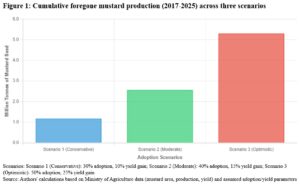
Here’s a look at the economic cost of not commercialising GM mustard after the 2017 clearance. The exercise estimates what India might have gained had deployment begun then. Three adoption scenarios were used, based on global patterns in GM crop uptake. The conservative case assumes 30% of mustard area under GM hybrids by 2025, with a 10% yield gain. The moderate case assumes 40% adoption and a 15% yield gain. The optimistic case assumes 50% adoption and a 25% yield gain. Using agriculture ministry data on mustard area and output from 2017 to 2025, the analysis calculates the extra production that could have resulted.
READ | GM crops: India must embrace future, but after allaying fears
The economic cost of GM mustard delay
The results are substantial. Between 2017 and 2025, India may have forgone 1.18 million tonnes of extra mustard seed in the conservative scenario, 2.56 million tonnes in the moderate case, and 5.30 million tonnes in the optimistic one.
The upper-end estimate is not trivial. It is equal to roughly 44% of India’s actual mustard output in 2024-25, when production touched a record 12 million tonnes. In effect, the delay may have cost the country close to half a year’s output.
At prevailing prices, the cumulative value of this foregone production ranges from about ₹6,900 crore to ₹30,900 crore over nine years. Even the middle estimate of ₹14,885 crore is sizeable. It is about 9% of one year’s edible oil import bill.
The broader context matters. In 2023-24, India produced only 11-12 million tonnes of edible oils against consumption of 27-28 million tonnes. The gap was filled by imports, mainly palm oil from Southeast Asia and soybean oil from the Americas.
Each additional tonne of mustard seed would have produced about 300 kg of mustard oil. Under the optimistic scenario, the extra 5.30 million tonnes of mustard seed would have yielded around 1.59 million tonnes of oil. That could have reduced import dependence by about 10%.
Mustard yields matter for edible oil self-reliance
Other countries did not move this slowly. Canada introduced GM herbicide-tolerant canola in 1995. Adoption rose quickly, crossing 90% by 2008. Annual canola output climbed from around 5-6 million tonnes in the early 1990s to about 20 million tonnes in recent years, with GM technology contributing alongside better agronomy and other improvements.
READ | PMFBY: Crop insurance scheme faces coverage crisis
Bangladesh offers a closer comparison. It approved Bt brinjal in 2013 and commercialised it in 2014. The government faced opposition but proceeded. Within a few years, more than 65,000 farmers had adopted it, reporting 40-50% higher yields and sharply lower pesticide use. The irony is familiar. The same Bt brinjal technology was developed in India, but has remained under moratorium since 2010.
The contradiction goes further. India already consumes GM-derived edible oils through imports, and also uses Bt cotton seed oil domestically in vanaspati. A 2024 government affidavit before the Supreme Court stated that India imports around 55,000 tonnes of canola oil and 280,000 tonnes of soybean oil, much of it sourced from GM crops grown abroad. India is thus willing to consume GM oil, but unwilling to let its own farmers produce a GM oilseed crop cleared by its regulator.
Biosafety regulation needs decisions, not drift
The larger issue is not mustard alone. It is the way India regulates agricultural biotechnology.
A system that keeps files moving without taking decisions imposes its own cost. That cost shows up in missed farm income, a larger import bill and weaker progress towards edible oil self-reliance.
Three changes would help. First, scientific regulators such as the GEAC need clearer authority, firmer timelines and fewer bureaucratic choke points. Second, biosafety data should be released proactively, with a structured process for public engagement. Delay thrives in opacity. Third, India should consider phased or conditional releases, including region-specific deployment with post-release monitoring, instead of treating approval as an all-or-nothing event.
There is also a case for linking GM mustard to the National Mission on Edible Oilseeds. Public-sector seed production could keep prices affordable and reduce fears of market concentration. That would align biotechnology with a national objective already backed by public funds.
READ | Concerns over environmental impact of GM mustard could delay approval
In 2024-25 alone, India’s edible oil import bill exceeded ₹1.6 lakh crore. Against that backdrop, the estimated ₹6,900 crore to ₹30,900 crore loss in mustard production value between 2017 and 2025 is not a statistical curiosity. It points to a policy failure.
Policy cannot ignore the cost of delay
The lesson is straightforward. Biosafety assessment must be rigorous. But delay is not neutral. Delay also has consequences.
From 2017 to 2025, India may have lost billions in output value because a yield-enhancing technology remained stuck after regulatory clearance. That meant lower income for farmers, higher import dependence and slower progress in a strategically important crop.
India needs a regulatory framework that evaluates risk seriously but acts on evidence. Without that balance, the country will go on importing what it refuses to produce.
Prof Vidya Vemireddy teaches at Indian Institute of Management, Ahmadabad. Suresh Kumar, A Amarendar Reddy and KC Bansal work with the Indian Council of Agricultural Research. All views expressed by the authors are personal and do not reflect any institutional view. We acknowledge Nicky Johnson for his research assistance. Views are personal.
READ | Gene-edited crops offer hope for farmers

Suresh Kumar is a retired Indian Administrative Service officer with nearly four decades of distinguished leadership in governance, public policy formulation, administrative reform, agriculture transformation, water governance, and institutional restructuring. Widely respected as one of Punjab’s most influential policy architects, he served as Principal Secretary to the Chief Minister (2003–07) and subsequently as Additional Chief Secretary, Punjab and Chief Principal Secretary to the Chief Minister (2017–21). Educated at the London School of Economics, with extensive global exposure through the World Bank, IMF Institute for Capacity Development, UNDP, UNICEF, UNESCO, ILO, Columbia University SIPA, TERI, IIM Bangalore, and LBSNAA, he blends field-level governance depth with global development perspectives. He is also a prolific public policy commentator whose work has shaped national discourse on federalism, sustainability, agricultural policy, governance reform, institutions, and public administration.