




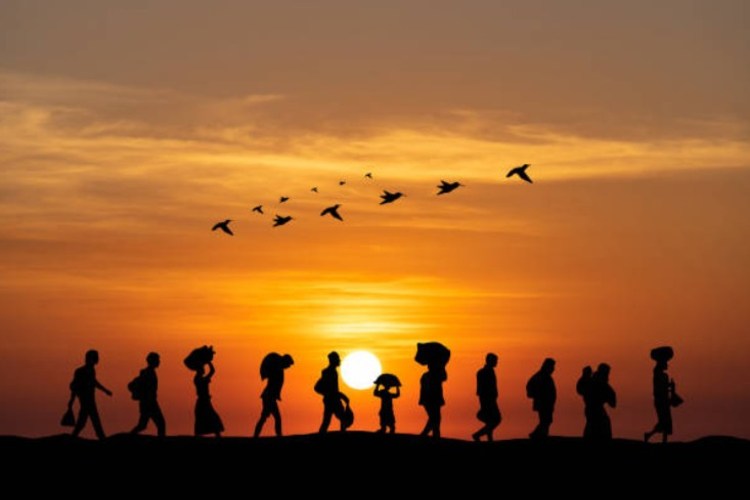
Migration drives a significant share of India’s economic activity. Each year, millions leave home in search of work, safety, or dignity. Many move to escape drought, debt, caste restrictions, or climate stress. When mobility takes place through informal channels and without documentation, economic migration can slide into coercion.
Distress migration and human trafficking are not independent phenomena. Rather, they reinforce each other through structural vulnerabilities that demand closer policy attention.
READ | Wealth inequality blind spot: The missing data on the rich
Distress migration in India and risk of trafficking
The NITI Aayog’s Circular Migration in India (2024) warns that climate-linked displacement and job losses could affect 45 million Indians by 2050, sharply increasing vulnerability to unsafe recruitment. Reports by the ILO and UN Women reveal how women in informal work face disproportionate risks because they lack information, legal recourse, and language support. This widening gap in protection makes India’s mobile workforce highly susceptible to coercion and exploitation.
The National Crime Records Bureau (2022) recorded over 6,000 trafficking cases, a 2.8% increase from the previous year. Women make up nearly 60% of victims, and children account for almost half. Yet these numbers reflect only registered cases. Survivors often return to communities where they confront stigma, prolonged legal processes, and repeated displacement—conditions that worsen trauma rather than resolve it.
India’s larger mental-health crisis compounds the problem. The Global Burden of Disease Study (2024) estimates that 197 million Indians live with mental disorders, but fewer than one in ten receive adequate care. For trafficking survivors, barriers to access are even higher. Shame, fear of retaliation, and the absence of trauma-informed professionals make sustained care difficult to obtain.
Mental health policy in India
India’s mental-health infrastructure has expanded, but design gaps keep survivors outside the framework. The District Mental Health Programme (DMHP) covers about 90% of districts, and Tele-MANAS has handled more than 500,000 calls since 2022. But these platforms do not integrate with rehabilitation homes, NGOs, or shelters. Survivors who seek help often face language barriers, ill-matched referrals, and no follow-up.
Welfare schemes such as One Nation One Ration Card, Ayushman Bharat–PM-JAY, Ujjawala Homes, and One Stop Centres offer useful entitlements. Yet coordination remains minimal across health, police, labour, and social-welfare departments. Survivors are asked to repeat their stories multiple times, reliving trauma without receiving emotional support.
The e-Shram portal, despite registering over 300 million workers, does not track psychosocial indicators. It counts workers but does not assess whether they are coping with trauma or displacement—revealing a major blind spot in India’s migration governance.
Migrant workers welfare
Survivors within the Integrated Leaders Forum Against Trafficking (ILFAT) highlight these gaps. Many describe rescue as a process that solved one problem and created another. One ILFAT leader from West Bengal recalls being asked to repeat her story to every official without anyone enquiring about her emotional state. These testimonies make clear that trauma does not end with rescue; it begins there.
Some initiatives show what is possible when policies focus on survivors’ emotional needs. The SAMVAD initiative, led by NIMHANS, has trained thousands of frontline workers to recognise distress among children affected by trafficking. Kerala’s Aawaz Insurance Scheme, which covers inter-state migrants regardless of documentation, demonstrates how inclusive design can reduce vulnerability.
But these are isolated pilots, not systemic practice. Scaling these models requires institutional commitment and cross-state coordination.
Community-based rehabilitation
Long-term recovery depends on restoring agency and belonging. Community-based rehabilitation (CBR) allows survivors to rebuild their lives within familiar environments, supported by local networks. This approach reduces isolation and strengthens self-worth—two pillars of trauma recovery. When survivors participate in self-help groups, skill programmes, or local governance mechanisms, they regain control over their futures.
ILFAT’s survivor-led collectives demonstrate how community leadership transforms rehabilitation into a sustainable process rather than a bureaucratic formality.
Building a survivor-centred system for rehabilitation
Strengthening India’s response requires integrating trauma-informed care at every stage of rescue and rehabilitation. Counsellors trained in trauma therapy must be embedded into shelter homes and legal processes. Interoperable health and welfare records would allow survivors to access care across states without repeating their stories. District-level safe-migration desks could offer psychosocial first aid, entitlement information, and legal guidance, reducing the risk of re-trafficking.
Survivor leadership must shape these reforms. Those with lived experience understand gaps and risks that officials often overlook. Their participation improves trust, credibility, and intervention quality.
Updating laws and frameworks
The Mental Healthcare Act (2017) and National Mental Health Policy (2014) protect the right to access care, but neither explicitly addresses trauma related to trafficking or forced migration. Without integrating mental health into justice delivery and rehabilitation, survivors continue to navigate a fractured system on their own.
Migration, trafficking, and mental health form a continuum of vulnerability. India already has the components of a strong welfare architecture, but they operate in silos. A national strategy that connects rescue to recovery, health to justice, and migration safety to mental well-being is now essential.
Unless mental health and community-based rehabilitation become foundational pillars of anti-trafficking governance, India will continue to rescue bodies while abandoning minds.
Dr Swati Saxena is a public health researcher. She collaborated with Integrated Leaders Forum Against Trafficking (ILFAT) for this article.