





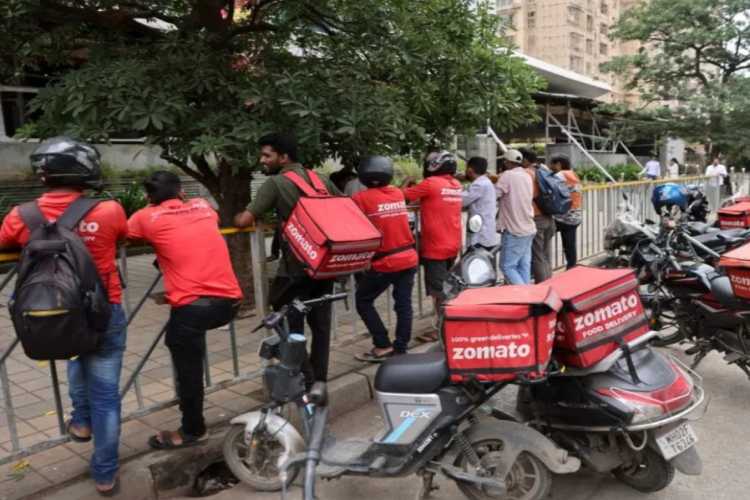
The Union Budget 2026-27 remains anchored to India’s post-pandemic fiscal strategy: capital expenditure, infrastructure-led growth, and incremental structural reform. The gig economy appears in this framework, but largely as a footnote. The acknowledgement is symbolic, with little fiscal or institutional follow-through. That gap exposes a deeper policy contradiction. The state increasingly recognises new forms of work, but has yet to internalise their distributive and social-protection consequences.
India’s gig workforce has expanded sharply. The Economic Survey 2025–26 estimates a near-55% increase, from 7.7 million workers in FY2020–21 to about 12 million in FY2024–25—roughly 2% of total employment. Projections suggest non-agricultural gig work could account for 6.7% of the workforce by 2029–30, contributing an estimated ₹2.35 lakh crore to GDP by FY2030. These numbers establish scale. They also signal the depth of exposure embedded in this labour segment.
READ | Budget 2026: Export facilitation and MSME liquidity take centre stage
Gig platforms have altered labour-market visibility by digitally recording work histories, earnings, and skills. In principle, this chips away at the opacity of informal employment. By December 2025, over 312 million workers were registered on the e-Shram portal. The Employees’ Provident Fund Organisation reported a net addition of nearly two million members in May 2025—the highest monthly increase on record. Formal identifiers and databases are expanding faster than formal protection.
Identification, however, has not translated into income security. Survey evidence shows close to 40% of gig workers earn under ₹15,000 a month, face sharp income volatility, and remain outside institutional credit and insurance systems. Platform-mediated work continues to shift costs—health care, pensions, income risk—onto workers. Flexibility persists. Security does not.
The contrast with micro, small and medium enterprises is instructive. MSMEs receive explicit fiscal backing through credit guarantees, interest subventions, and formalisation incentives. Gig workers do not. Budget 2026 raised health spending by about 6% to ₹92,000 crore and education outlays by roughly 5% to ₹1.27 lakh crore—modest increases that leave labour-protection systems thinly resourced. For gig workers, policy recognition stops short of redistribution.
READ | Budget 2026 treats MSMEs as infrastructure, not beneficiaries
One reason redistribution remains politically hesitant lies in the fiscal treatment of platforms themselves. Platform firms operate as large, formal corporate entities, yet their role as labour intermediaries sits awkwardly within existing tax and contribution frameworks. GST is levied on commissions or services rendered, not on employment relationships. Labour costs are structurally externalised, while platforms retain balance-sheet flexibility. This asymmetry narrows the state’s immediate fiscal levers. Recognition of gig workers, in this context, is administratively easier than enforcing contributory obligations on platforms without reopening questions of classification, valuation, and compliance.
The Code on Social Security, 2020 formally brought gig and platform workers into the legal framework. Implementation has lagged. Provisions on insurance, minimum earnings, and grievance redressal lack enforceability and assured funding. Without mandatory platform contributions or binding standards, risk remains with workers. Employment growth built on this foundation is fragile.
READ | Budget 2026: Urban policy evolves from smart cities to City Economic Regions
Policy fragmentation across states adds another layer of constraint. Labour being a concurrent subject, several states have experimented with welfare boards, accident insurance, or platform-linked registration systems for gig workers. These initiatives remain uneven in coverage, funding, and enforcement. Budget 2026 does little to reconcile this divergence or provide a national fiscal anchor. The result is a patchwork of recognition without uniform protection, reinforcing the Centre’s preference for enumeration over redistribution.
Budget 2026 and gig workers
Budget 2026 therefore marks continuity rather than course correction. Gig work is acknowledged, but not integrated into the fiscal and social compact. If the sector is to become a stable employment pillar rather than a holding zone for precarity, policy will have to move beyond enumeration. Redistribution, not recognition, remains the missing step.
The challenge is no longer avoidable. With projections pointing to nearly 23 million gig workers by 2030, marginal treatment is no longer defensible. Digital labour markets will deliver scale. Without fiscal and regulatory embedding, they will not deliver security.