





India has 21 years left to reach the economic goal attached to Viksit Bharat. The distance is considerable. India remains a lower-middle-income economy, while the World Bank currently places the threshold for high-income economies at a gross national income per capita of more than $14,375. Reaching that level will require sustained growth on a scale India has managed only for shorter periods.
NITI Aayog Vice-Chairman Ashok Lahiri has put a number on the Viksit Bharat ambition. He estimates that India’s per capita income must rise from about $2,813 in 2026 to around $18,000 by 2047. That implies a nominal growth rate of 9.25% a year for 21 years. The World Bank says the country needs an average real growth of 7.8% until 2047 to reach developed status. India averaged a GDP growth rate of 6.3% between 2000 and 2024.
READ I Next banking reform cycle must look beyond mergers
The estimate imposes a severe test of economic performance. India’s growth rate crossed 7% several times and sustained such growth for a few years. Maintaining something close to the required rate across two decades would be a different achievement.
India entered the lower-middle-income group in 2007-08. Countries that reached high-income status generally experienced long periods of rising investment and productivity, accompanied by a movement of workers from low-productivity occupations. India has made progress on each count, though not yet at the pace required to achieve the 2047 target.
There is also an unusual feature of India’s economic structure. Large private fortunes coexist with low average incomes. The World Inequality Lab estimated that the richest 1% received 22.6% of national income and owned 40.1% of wealth in 2022-23. The top 0.1% alone held about 29% of national wealth.
Household balance sheets provide another part of the picture. The UBS Global Wealth Report 2026 estimates that financial assets account for 25.8% of gross household wealth in India. Property and other physical assets make up most of the remainder. Large stocks of private wealth therefore do not translate automatically into financial capital available for corporate investment.
READ I SHANTI rules put a price on India’s nuclear ambition
Viksit Bharat will need higher investment rate
The investment rate is the clearest constraint on faster growth. India’s investment performance improved after the 1991 reforms and rose sharply during the high-growth years of the 2000s. It has since settled at a lower level.
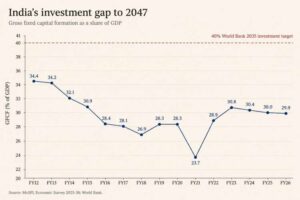
China offers a useful comparison because of the speed and duration of its industrial expansion. Its investment rate exceeded 40% of GDP for long periods during the 2000s and 2010s. India’s rate reached around 35% during parts of its earlier high-growth phase, then declined. The Economic Survey 2025-26 estimates gross fixed capital formation at about 30% of GDP in FY26.
The World Bank’s accelerated-reform scenario assumes total investment rising from about 33.5% of GDP to 40% by 2035. Under that assumption, along with faster productivity growth and other changes, India averages real growth of 7.8%. A less ambitious path, with investment reaching 37% by 2035, produces growth of about 6.6% in the Bank’s model and leaves India short of high-income status in 2047.
Moving investment towards 40% of GDP would require a substantial increase in private capital expenditure. Government spending can finance highways, rail networks, ports and power infrastructure, but public budgets cannot carry an investment increase of this size on their own. Companies would have to add capacity on a much larger scale.
Financing such investment raises the question of savings. A country cannot indefinitely sustain investment near 40% of GDP with a much lower domestic savings rate unless foreign capital fills the difference. Lahiri has consequently drawn attention to the savings rate as part of the 2047 calculation.
READ I India’s skills vs degrees debate misses the real problem
Capital must produce more output
The amount invested tells only part of the growth story. The output generated by that capital also determines how fast the economy can expand.
India’s incremental capital-output ratio has compared favourably with China’s in recent years. Lahiri has placed it at roughly 4.5 to 5, while cautioning against reading too much into a crude aggregate measure. A lower ICOR suggests that less additional capital is required to generate an additional unit of output.
India’s problem is that a relatively efficient use of capital cannot compensate indefinitely for an investment rate below the level required by the growth target. The World Bank’s 2047 calculations assume improvement in total factor productivity alongside the increase in investment.
Where capital goes also affects the outcome. Investment in machinery, technology and transport capacity can raise output differently from investment concentrated in assets with limited productive use. India’s household preference for property and other physical assets therefore sits uneasily with an economy that needs larger pools of risk capital and long-term finance for firms.
Productivity also depends on the movement of labour. Capital invested in a modern factory or logistics network produces limited economy-wide gains if large numbers of workers remain in occupations where output per worker is low.
The employment shift remains incomplete
Agriculture still employs about 45% of India’s workforce. Its share of national output is far smaller. That gap reflects the low productivity of a large part of agricultural employment and explains why the movement of workers out of agriculture remains central to higher per capita income.
East Asian industrialisation absorbed large numbers of workers into manufacturing. India has followed a different route. Services have contributed heavily to growth, including software, finance and other skill-intensive activities, while manufacturing has not become a mass employer on the scale seen in China, Vietnam or South Korea.
High-end services can raise exports and national income, but their employment requirements are limited by skill and education. India therefore needs expansion in activities capable of employing workers moving out of agriculture at substantially higher levels of productivity. Manufacturing, construction, logistics, tourism and a range of urban services will have to absorb a much larger workforce.
Labour-force participation adds another constraint. The World Bank’s high-income scenario assumes overall participation rising from 56.4% to more than 65%, with a significant increase in women’s participation. Without such an increase, a large share of the working-age population will remain outside paid economic activity even as India attempts to raise per capita income several-fold.
The demographic advantage also has a finite life. India’s working-age population will remain large for years, but the age structure will change over time. The economic return from the demographic dividend depends on how many people find productive employment while that favourable structure lasts.
India begins the next two decades from a stronger economic position than it occupied at the start of this century. The banking system is healthier than it was after the bad-loan crisis, public infrastructure has expanded and formalisation has increased. Digital payments and public digital systems have lowered transaction costs across large parts of the economy.
Those gains do not settle the 2047 arithmetic. The World Bank’s estimate still requires growth averaging 7.8% for more than two decades, an investment rate approaching 40% of GDP and a much larger movement of workers into productive employment.
India has previously achieved parts of this combination for limited periods. It has yet to maintain them together for anything close to 21 years. Viksit Bharat will depend on whether that record changes.