



India education budget: India is a developing nation which is galloping towards the centennial year of its independence, high on aspirations for a “Viksit Bharat”. As the nation is enjoying a rare window of demographic dividend, the educational expenditure is required to rise up and help the nation achieve its ambitions of becoming a developed nation.
The Union Budget 2026-27 hence assumes great significance as it can make or break India’s growth momentum. This year, the Budget is big on infrastructure ambitions and tried to signal a renewed commitment to education. But a closer look at the data reveals a familiar pattern- the modest increases in headline allocations are bound to fall short of what India’s demographic realities and global ambitions demand.
READ | Budget 2026-27 doubles down on infrastructure push
Finance Minister Nirmala Sitharaman allocated Rs 1.39 lakh crore to the Ministry of Education for the financial year 2026-27, up 8.27% from the Rs 1.28 lakh crore budgeted in 2025-26. This is touted as the highest ever allocation for the education ministry, and is indeed a record in absolute rupee terms. Of this, approximately Rs 83,562 crore has been earmarked for school education and Rs 55,727 crore for higher education and skills. School education’s allocation rose around 6.35% year-on-year, while higher education saw an increase of roughly 11.3%.
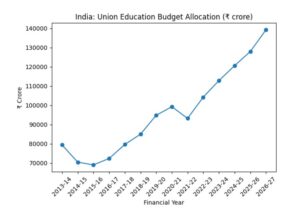

However, the truth remains that even at Rs 1.39 lakh crore, education accounts for barely around 2.6% of total government expenditure. Critics have at many times pointed this as inadequate given the scale of India’s human capital challenge. Put in perspective, India’s long-standing target of 6% GDP on education is a distant aspiration. Actual combined public education (central and state level) spending is often estimated at around 4 to 4.6% of GDP, still significantly short of NEP 2020 goals and of the levels early industrialisers committed to during their take-off phases.
Education budget: The missing demographic arithmetic
India is in the rare phase of a peak working-age population, with a median age under 30 and millions entering the labour force each year. This demographic dividend is projected to persist over the next decade and can be a catalyst for rapid productivity gains. However, to unlock this, sustained investments in foundational learning, lifelong skills and higher education quality is needed.
READ | Healthcare allocation rises, but structural gaps remain
History offers compelling contrasts. In the late 20th century, South Korea and China both made education a fiscal priority early in their development and invested aggressively in universal schooling, technical training and higher education. South Korea’s public spending on education surged throughout the 1970s and 1980s, lifting literacy and technical skills alongside industrial diversification. China’s massive scale-up of second and third-tier education in the 1990s and 2000s helped it transition from low-cost manufacturing to advanced electronics and innovation industries. The rate of return on these investments was direct economic multipliers in employment, productivity and export competitiveness.
Smaller economies, like Ireland during its Celtic Tiger years, expanded tertiary education with an eye on technology and services exports. The result was not just higher average incomes, but a reconfiguration of the workforce that supported high-value industries.
India’s performance has been less transformative. While headline enrolment numbers have improved, learning outcomes remain weak. Large national assessments continue to show that many students leave school without foundational literacy and numeracy. Investments in physical infrastructure has not been matched by commensurate investment in teacher training, learning materials, assessments and curriculum reform. The Budget’s incremental increases in key programmes like Samagra Shiksha Abhiyan and PM POSHAN are welcome, but the scale of funding relative to the need remains modest.
The government’s push around STEM, digital education and girls’ hostels is an attempt to align education with jobs and gender equity. Plans to establish a girls’ hostel in every district and to set up five university townships aimed at improving access and campus culture. But such initiatives cannot substitute for deeper structural investments required to lift the average schooling years and skills levels of the working age population.
READ | Budget 2026 bets on industrial policy amid constraints
The 2026-27 Budget continued to prioritise roads, highways and capital infrastructure, with outlays like Rs 3.10 lakh crore for roads and Rs 2.81 lakh crore for railways. Yet the mismatch between physical infrastructure and human capital investment raises questions. Education often has a higher medium-term multiplier because it increases labour productivity which is the engine of sustained growth and formal employment creation.
India’s demographic dividend window is not permanent. By the early 2040s, working-age population growth will taper and the costs of ageing will rise. If India fails to meaningfully raise its investment in education while its workforce is growing, it will create a large cohort of under-skilled workers trapped in low-productivity and informal sectors. Other emerging economies such as Vietnam have shown that aligning demographic advantage with education and skills development can deliver growth and structural transformation.
Presently, states carry much of the burden for schooling and teacher salaries but many face constrained fiscal space. Without stronger central support, disparities in human capital across states will deepen.
The 2026-27 Budget is not apathetic; an 8% rise in allocations is positive in absolute terms. But as a statement of national priorities, it does not match the scale demanded by the demographic moment and the structural challenge before India. History suggests that countries won, often when incomes were similar or lower than India’s today, by putting education at the heart of their fiscal strategy.