





The ministry of electronics and information technology (MeitY) sits at the centre of India’s digital and technology ambitions, spanning digital public infrastructure, electronics manufacturing, semiconductors, cybersecurity, and artificial intelligence. The Union Budget 2026–27 does not expand this remit. Instead, it recalibrates spending in line with execution experience, signalling a shift from headline ambition to selective deepening.
In Budget Estimates (BE) 2026–27, MeitY has been allocated ₹21,632.96 crore, lower than the ₹26,026.25 crore provided in BE 2025–26. Read in isolation, this suggests a sharp contraction. Compared against Revised Estimates (RE) of 2025–26, however, the picture changes. The current allocation represents an increase of about ₹1,400 crore, or nearly 7%, over the previous year’s revised outlay of ₹20,232.95 crore.
READ | Global semiconductor alliance exposes India’s tech vulnerability
With total Union Budget expenditure projected at ₹53.47 lakh crore in 2026–27, MeitY’s share remains modest at roughly 0.4%. What matters is not the aggregate number, but where the additional spending is being directed.
Semiconductor and Display Manufacturing Ecosystem
The most pronounced expansion is in semiconductors. Allocations under the Modified Programme for Development of Semiconductors and Display Manufacturing Ecosystem rise from ₹4,300.08 crore (RE 2025–26) to ₹8,000 crore in BE 2026–27.
Notified in December 2021 with an overall outlay of ₹76,000 crore, the programme rests on four pillars: fiscal support for semiconductor fabs, incentives for display fabs, assistance for compound semiconductors and assembly–testing–packaging units, and the Design Linked Incentive scheme for chip design. Execution over the past three years has clarified where the bottlenecks lie.
The launch of India Semiconductor Mission (ISM) 2.0 in Budget 2026–27 reflects that learning. With an initial allocation of ₹1,000 crore, ISM 2.0 extends the policy lens beyond fabs to equipment, materials, intellectual property, and supply-chain resilience. This is a material shift away from a fab-centric approach toward ecosystem completeness.
Equally telling is the jump in funding for modernisation of the Semiconductor Laboratory at Mohali, from ₹20 crore to ₹900 crore. This is less about capacity expansion than about restoring domestic R&D and strategic manufacturing capability that had atrophied over time.
READ | India semiconductor mission must shift from subsidies to skills
Electronics Components Manufacturing
The Electronics Components Manufacturing Scheme sees the sharpest proportional increase in the budget. From a token ₹6.8 crore in RE 2025–26, allocations rise to ₹1,500 crore in BE 2026–27.
Notified in April 2025, the scheme addresses a long-standing weakness in India’s electronics story: heavy dependence on imported components despite strong growth in final assembly. The scale-up suggests policy recognition that assembly-led growth has reached its limits without domestic value addition deeper in the supply chain.
Digital India Programme
Allocations for the Digital India Programme increase from ₹4,344.45 crore (RE 2025–26) to ₹4,741.51 crore in BE 2026–27. The rise is incremental rather than transformative.
A decade after its launch in 2015, Digital India has largely achieved access expansion. As noted in the State of India’s Digital Economy Report 2024, India now ranks among the top three globally in digitalisation. The budgetary emphasis has therefore shifted toward cybersecurity, resilience of digital public infrastructure, and capacity building rather than connectivity alone.
IndiaAI Mission
The IndiaAI Mission, approved in March 2024 with a five-year outlay of ₹10,371.92 crore, records a modest increase from ₹800 crore (RE 2025–26) to ₹1,000 crore in BE 2026–27.
The focus remains on operationalising compute capacity, including deployment of over 10,000 GPUs through public–private partnerships. The incremental increase reflects a transition from mission approval to phased implementation, rather than any acceleration in ambition.
READ | STT hike in Budget 2026 sharpens push to rein in derivatives trading
Reading the Numbers: BE, RE and Execution
Budget assessment for MeitY requires reading BE numbers against RE rather than against the previous year’s headline allocation. The ₹21,632.96 crore provided in BE 2026–27 represents a recovery from under-utilisation rather than a retreat.
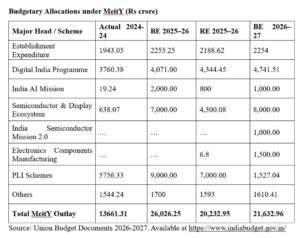
The table illustrates this recalibration:
Budgetary Allocations under MeitY (₹ crore)
Total outlay rises from ₹20,232.95 crore (RE 2025–26) to ₹21,632.96 crore (BE 2026–27).
Semiconductor and display allocations nearly double year-on-year on a revised basis.
Electronics components move from pilot scale to meaningful funding.
Digital India and IndiaAI show steady, execution-linked increases.
Production Linked Incentive (PLI) allocations fall sharply.
The contraction in PLI outlay stands out. Launched in 2020 across 14 sectors, PLI has already catalysed over ₹2 lakh crore in actual investment by September 2025, according to the Economic Survey. The reduced allocation likely reflects a transition from capital-intensive expansion to consolidation, rather than policy retreat.
Taken together, the MeitY Budget 2026–27 signals a maturing policy stance. The government appears to have internalised lessons from early execution shortfalls, redirecting resources toward areas where ecosystem gaps remain most binding.
Semiconductors, components, and foundational digital infrastructure receive sharper focus, while schemes that have crossed their initial scale-up phase are allowed to taper. This is not a budget of grand announcements. It is one that privileges follow-through over fresh signalling.
Dr Sweety Supriya is Assistant Professor, Department of Electronics, LS College, Muzaffarpur, Bihar.