






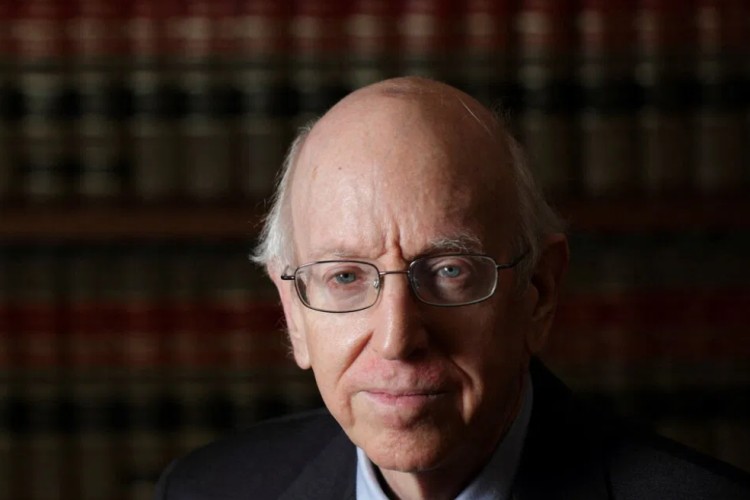
For nearly 15 years, I have taught Richard Posner’s Economic Analysis of Law to law students. The book has consistently challenged them to look beyond the text of a rule and ask what it actually does. Posner, who died on November 10 at the age of 87, made that question central to the study of law. It is worth asking in India, where a delay in enforcing a contract can change what it is worth, and a judgment cancelling an unlawful allocation can affect people who had no part in the original decision. Posner’s work helps us see those consequences. The harder question, especially in a constitutional democracy, is how much weight they should carry.
Posner joined the University of Chicago Law School in 1969 and was appointed to the US Court of Appeals for the Seventh Circuit in 1981. He served on the court for nearly 36 years, including seven as chief judge from 1993 to 2000. He wrote thousands of opinions, bringing the same willingness to question established assumptions to the bench that he brought to legal scholarship.
READ | International law is alive, its enforcement is not
What legal rules do
First published in 1973, Economic Analysis of Law applied economic reasoning to subjects as varied as contracts, property, torts and criminal law. A rule governing contractual liability, for instance, determines what a party can recover after a breach. It can also influence how the parties negotiate and allocate risk before they sign. Posner helped make those earlier decisions part of the lawyer’s inquiry.
Students often meet this approach with scepticism. They are used to asking what a rule requires and how a court has interpreted it. Posner asks them to consider how people will respond to the rule in practice. As they work through his examples, they begin to see why two rules that look equally plausible in a textbook may have quite different effects outside the courtroom.
The economic costs of judicial delay
Consider a business deciding whether to extend credit to a new customer. If recovering an unpaid debt could take years, it may insist on payment upfront or decline the order. A delay in court can thus shape a transaction that never becomes the subject of a lawsuit. India’s National Judicial Data Grid records how long pending cases have been in the system. Some of the costs of those delays arise in decisions that will never appear in the grid.
The economic effects of court rulings are harder to establish. In a 2019 interview with Indira Jaising, senior advocate Harish Salve argued that Supreme Court decisions had contributed to India’s economic slowdown. He cited the cancellation of 2G spectrum licences and coal block allocations, among other cases. The cancellations could disrupt business plans and deter some investors. Establishing how much they contributed to a nationwide slowdown would require evidence that the interview did not provide. And allowing an unlawful allocation to stand can impose costs of its own on firms that were denied a fair chance to compete.
READ | ILO gig-work convention exposes gaps in India’s labour laws
A court’s duty to review the legality of an allocation and its choice of remedy raise distinct questions. Where the law leaves room for discretion, judges can ask who will bear the cost of a remedy, including people who relied on the original decision in good faith. The same attention to consequences is useful in digital competition cases. If a platform gives its own products more prominent placement, a competition authority needs to consider whether the practice makes the service easier to use and whether rival sellers can still reach customers on fair terms.
Richard Posner’s claims: What willingness to pay leaves out
One of Posner’s most disputed claims was that wealth maximisation could provide a standard for judging common-law rules. The attraction is easy to see. If resources move to those who value them more, there is a gain that can, in principle, be measured. The difficulty lies in the measure itself. Willingness to pay depends in part on ability to pay. A person with fewer resources may have more at stake and still be able to offer less.
Consider a dispute over urban land. A developer may be able to offer more for a plot than the families who live there could raise to stay. The offer tells us something about what the land could earn in commercial use. It tells us much less about what residents stand to lose if they must move away from their jobs or from relatives who help care for their children.
The Indian Constitution gives those interests a place in public decision-making. Article 14 guarantees equality before the law and equal protection of the laws. Article 21 protects life and personal liberty. The Directive Principles call on the state to promote welfare and reduce inequalities. These commitments shape how public authorities weigh the benefits of development against the burdens it puts on people with the least room to absorb them.
Posner’s later work placed greater emphasis on pragmatism and on what legal institutions could do in practice. I still want students to ask his first question about what a rule does. In a dispute over that plot of land, I would ask them to go one step further. Before calling the transfer efficient, they should be able to say what the families would lose and what the law owes them when the developer can pay more.
The author teaches Economic Analysis of Law at the School of Law, Christ University, Bengaluru, and writes on the intersection of law, economics and public policy.