





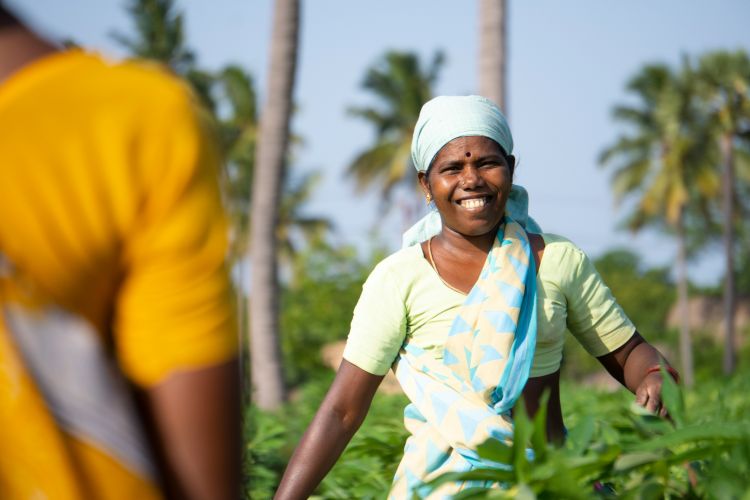
Women farmers: Indian agriculture has a recognition problem. Women do a large part of the work on farms, but the institutions that determine access to land, credit, insurance and markets still tend to recognise the farmer through formal ownership and documentation. A new report from grain commerce platform Arya.ag, Her Harvest 2026, attempts to put an economic cost on this mismatch.
The report estimates that unequal access to productive resources could be costing India ₹1.2-2 lakh crore in agricultural output every year. That number needs some qualification. It is an extrapolation, obtained by applying an FAO estimate of the potential output gain from closing resource gaps to India’s agriculture and allied sector GVA of about ₹48.7 lakh crore in 2023-24. It is not a measured loss from Indian farms. Even so, the calculation draws attention to an old problem that has acquired greater economic importance as women’s role in agriculture has grown.
READ | Why fertiliser subsidy reform is vital for Indian agriculture
More women are working in agriculture
The Periodic Labour Force Survey for 2023-24 shows that 64.4% of India’s working women were employed in agriculture, up from 57% in 2017-18. Among rural working women, the proportion was even higher at 76.9%. The share of male workers in agriculture fell from 40.2% to 36.3% during the period.
These numbers are sometimes misread. The 64.4% figure is the proportion of working women who are in agriculture. It is not women’s share of India’s agricultural workforce.
A second PLFS figure is more revealing. More than half of the women working in agriculture in 2023-24 were classified as helpers in household enterprises. Only 30.1% of them were classified as workers or employers. The statistical category captures a central feature of rural India: a woman can spend the agricultural season working on the family farm without having an independent income or economic identity as its operator.
Land statistics tell a similar story. Female operational holders accounted for 13.96% of operational holdings and only 11.72% of operated area, according to the Agriculture Census 2015-16. Field data collection for the Agriculture Census 2021-22 was completed, but the exercise was still under way. The 2015-16 figures therefore remain the latest published benchmark.
The gap between work and control over productive assets matters because land documentation remains influential in the delivery of farm support. PM-KISAN, for example, is explicitly a benefit for landholding farmer families. A woman cultivating family land that stands in someone else’s name does not acquire an independent entitlement merely because she does much of the farming.
Formal eligibility does not guarantee access
The problem, however, should not be reduced to a claim that every agricultural scheme excludes farmers without land titles. That would be inaccurate.
The Reserve Bank of India’s Kisan Credit Card guidelines expressly include tenant farmers, oral lessees and sharecroppers, as well as self-help groups and joint liability groups involving such cultivators. Crop insurance rules can also cover tenants and sharecroppers, although they may need tenancy agreements, land records or other documents permitted by state governments to establish an insurable interest.
READ | India’s agriculture sector struggles amid WTO paralysis, tariff hikes
The difficulty lies partly in translating formal eligibility into usable access. Informal tenancies are often poorly documented. Women may have little control over household land records, bank accounts or decisions on borrowing. The distinction between legal eligibility and practical access is important because the policy response differs in each case.
There is evidence of the gap in formal finance. The government told Rajya Sabha in March that women accounted for around 22% of account holders who had accessed agricultural credit under the Kisan Credit Card-linked Modified Interest Subvention Scheme. That is well below women’s importance in agricultural employment.
Credit is only part of the constraint. Storage determines whether farmers can wait for better prices instead of selling after harvest. Extension services influence the use of seeds and farm practices. Access to machinery affects both productivity and the physical burden of farm work. Farmer producer organisations can improve bargaining power and market access. Weak participation at any of these points can reduce the returns from labour.
The productivity gap is about resources
There is strong international evidence that these resource differences have economic consequences. FAO’s 2023 assessment found a 24% gap in land productivity between female- and male-managed farms of the same size across the countries studied. It also found that women in agricultural wage employment earned on average about 82 cents for every dollar earned by men. These are global estimates and should not be presented as measurements of Indian farms, but they show why access to productive assets matters.
This makes the women farmer question an issue of resource allocation. A cultivator with limited access to affordable finance cannot invest as easily in irrigation, equipment or better inputs. A farmer without storage has less freedom over when to sell. Weak access to organised markets affects price realisation and the ability to reinvest in the next crop.
Policy should therefore identify where women farmers fall out of the system. Data on agricultural credit, crop insurance, procurement and membership of farmer producer organisations should routinely be published by sex. Formal entitlements for tenant farmers and sharecroppers are useful only if the administrative machinery allows them to establish their status without prohibitive paperwork.
Recognition also needs to extend beyond ownership. Joint land titles and stronger inheritance rights remain important, but changes in ownership will take time. Agricultural programmes can meanwhile improve ways of identifying the person who actually cultivates and manages a farm.
Give women control over productive assets
The Namo Drone Didi scheme offers one approach. The ₹1,261 crore programme was designed to provide drones to 15,000 women’s self-help groups for agricultural rental services. The Centre provides assistance equal to 80% of the cost of the drone package, subject to a ceiling of ₹8 lakh. The significance of the model lies in giving women’s groups control over an income-generating agricultural asset rather than treating technology simply as a service delivered to them.
The same principle can be applied to warehouse finance, farm machinery, extension services and market institutions. Women-led FPOs and self-help groups can provide an institutional route where individual land ownership remains a barrier. They can also make it easier for banks and government agencies to identify cultivators who are otherwise difficult to reach.
The United Nations has designated 2026 the International Year of the Woman Farmer, drawing attention to gaps in land tenure, finance, technology and agricultural services. India has an opportunity to use the occasion for something more durable than a commemorative programme.
A farm policy that cannot reliably identify the person managing a farm will misallocate credit, technology and risk protection. Women are already doing the work. The economic cost arises when the institutions surrounding agriculture fail to equip them to do it productively.