





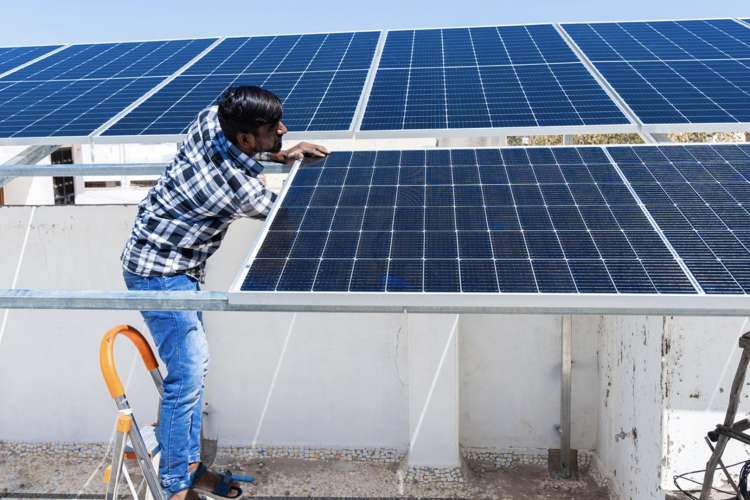
Rooftop solar programme: In February 2024, the government launched the PM Surya Ghar: Muft Bijli Yojana with a target of putting rooftop solar systems on one crore homes. The scheme promised capital subsidies and up to 300 units of free electricity a month. Applications and subsidy claims were routed through a national portal.
The response settled one question. Households will adopt rooftop solar when the price and process make sense. Registrations rose and installations accelerated. Any PM Surya Ghar 2.0 must now deal with the problems created by rapid expansion: weak distribution networks, uneven installation quality, limited storage and unequal access to rooftops.
READ | India’s solar module manufacturing boom meets US tariff wall
Rooftop Solar Programme has created demand
Residential rooftop solar had long been held back by high initial costs, low awareness and difficult approval procedures. PM Surya Ghar reduced each barrier. Subsidies lowered the household investment, direct transfers improved confidence and the portal made applications easier.
Demand is therefore no longer the principal constraint. Distribution companies, installers, lenders and equipment suppliers must be able to serve it. Poor installation or weak after-sales support can reduce output for years after the subsidy has been paid. The next phase should track how systems perform, rather than treat registration and commissioning as sufficient evidence of success.
Solar power requires stronger distribution grid
India’s distribution networks were designed to carry electricity from generating stations to consumers. Rooftop solar complicates that arrangement. Homes feed surplus electricity into the local network during the day, creating reverse flows that many transformers and distribution lines were not built to handle.
READ | Solar-powered buildings: The next big shift in climate resilience
Distribution companies will need better transformers, smart meters, digital substations and systems capable of managing two-way power flows. PM Surya Ghar 2.0 should link rooftop deployment to distribution-sector investment. Otherwise, installations may grow faster than the networks that must absorb their output.
Australia and Germany show that mass rooftop adoption depends as much on grid management as on household panels. India’s programme cannot remain administratively separate from electricity distribution planning.
PM Surya Ghar 2.0 must include storage
Solar generation peaks during the day, while household demand often rises in the evening. Batteries allow families to use more of their own electricity after sunset and reduce demand on the grid during peak hours. They also provide limited protection during outages.
Household batteries remain expensive. Future support should encourage combined solar-and-storage systems where they offer clear value. Financing and technical standards will matter more than a blanket subsidy. Poor-quality batteries would create safety risks and shorten the life of the investment.
Distributed storage can also help distribution companies manage peak demand and absorb more renewable electricity. It should be treated as part of network planning rather than an optional household accessory.
Rooftop solar access remains unequal
Independent homeowners have gained most from PM Surya Ghar because they control both the roof and the investment decision. Apartment residents, tenants and families in dense settlements often cannot participate even when they can afford the system.
The second phase should permit more workable models for housing societies, shared rooftops and community solar. Low-interest loans, rooftop leasing and targeted assistance could widen access beyond households able to finance the initial cost. Capital subsidies alone will continue to favour families with suitable property and spare cash.
This matters because electricity subsidies are paid from public funds. A programme financed by all consumers should not reserve most of its benefits for owners of large, unshaded roofs.
READ | India’s energy strategy: Why solar thermal deserves a second look
Measure electricity, savings and service quality
The government reports registrations, subsidy approvals and installed capacity because these figures are easy to count. They say little about whether a rooftop system continues to work or delivers the promised household savings.
Programme evaluation should include electricity generated, system uptime, installation defects, consumer complaints, subsidy delays and the effect on local grid reliability. Smart meters and digital monitoring can provide much of this information. Public dashboards should disclose performance by state and distribution company.
Such measures would also expose differences among vendors. Installers that repeatedly deliver faulty systems should lose empanelment. Consumers need clear warranties, service obligations and a credible complaints process.
India has built substantial utility-scale solar capacity. Rooftop solar poses a different administrative problem because assets are dispersed across millions of homes and connected to local distribution networks. PM Surya Ghar proved that subsidies and simpler applications can generate demand. Its successor will be judged by whether those systems produce reliable power, receive timely service and remain compatible with the grid.
Anusreeta Dutta is a columnist and climate researcher with experience in political research analysis, ESG research, and energy policy. Jyotsna Bharti is a researcher, columnist, and content strategist whose work focuses on public policy, current affairs, media, and digital culture.