





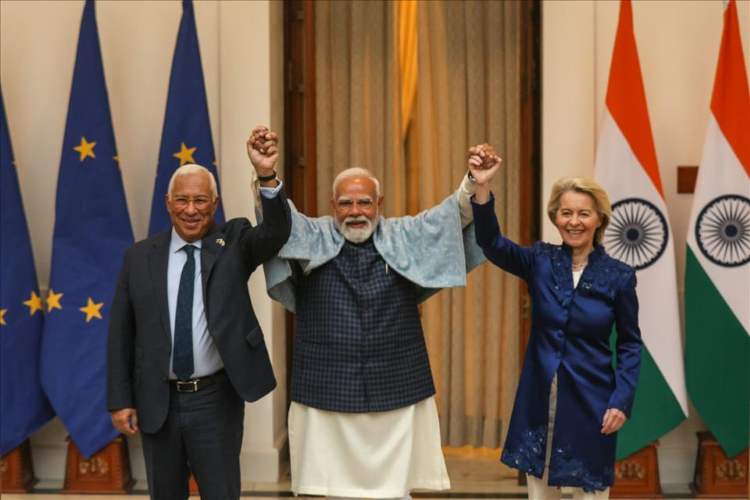
India is no longer a peripheral emerging economy whose foreign policy choices register only regionally. With nominal GDP above $3.7 trillion and export ambitions tied to manufacturing, technology and services, its external economic decisions now shape supply chains and political alignments well beyond Asia. That reality is reflected in two recent moves: the conclusion of a comprehensive India EU trade deal in January 2026, and a parallel, more limited trade arrangement with the United States aimed at easing tariff and market-access frictions.
Together, the two deals underline a shift in India’s external economic strategy — towards diversification without formal alignment – at a moment of geopolitical flux shaped by US-China confrontation, Europe’s post-Ukraine recalibration, and a loosening of old alliance certainties. What New Delhi must manage now is not ambition, but balance.
READ I India-US trade deal: A pact with promise and plenty of fine print
The India EU trade deal: Scale, not symbolism
The India EU trade deal finalised on 27 January 2026 ends nearly two decades of stalled negotiations. By value, it eliminates or sharply reduces tariffs on over 96% of bilateral trade. For the EU, this means lower barriers for automobiles, machinery, chemicals and high-end manufacturing. For India, it opens improved access for textiles, pharmaceuticals, marine products and engineering goods.
In 2024–25, India-EU trade stood at about $136.5 billion. The European Commission estimates tariff savings for EU exporters at roughly €4 billion annually once the agreement is fully implemented. For Indian exporters, the gain is less about tariff arithmetic than predictability — regulatory alignment, rules of origin, and labour-mobility provisions that matter to firms planning long-term capacity.
The agreement also carries clauses on security cooperation and standards convergence. That matters. Brussels is not signing trade deals in isolation anymore. It is building supply-chain resilience after its over-dependence on China was laid bare.
For India, the attraction is straightforward: market diversification and investment at a time when access to the US market is becoming more conditional.
READ I India-US trade deal: Tariff relief and trust deficit
Why timing of India EU trade deal matters
The India EU trade deal did not emerge in a vacuum. It coincides with renewed trade friction with the United States, including higher tariffs and tighter export controls affecting Indian manufacturers and technology firms. Washington remains India’s largest export destination, but the cost of dependence is rising. Diversification is therefore not ideological. It is defensive.
That logic also explains why New Delhi moved to close the EU agreement despite the regulatory and political complexity involved. The alternative – waiting for a benign global trade environment – no longer exists.
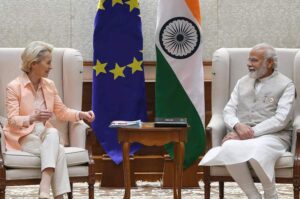
India and the United States have finalised a narrower trade deal that lowers punitive tariffs and resolves some long-standing disputes over market access. Washington cut tariffs on a wide range of Indian exports, easing pressure on sectors that had lost competitiveness over the past two years.
For New Delhi, the agreement offers near-term relief in its largest export market and reduces uncertainty for firms exposed to US trade policy volatility. But it stops well short of a comprehensive framework. Contentious issues — agriculture, digital trade, industrial subsidies and technology controls — remain unresolved, leaving the relationship structurally transactional rather than settled. The deal stabilises ties; it does not anchor them.
READ I What India-EU FTA means for exports, industry and services
Strategic autonomy, tested by economics
India’s foreign policy vocabulary continues to emphasise strategic autonomy. In practice, this has meant engagement across power centres without treaty-bound alliances. That approach has worked so far, but the room for manoeuvre is narrowing.
Relations with the US have deepened in defence, technology and the Indo-Pacific framework, including participation in the Quad. Yet trade disputes persist, and Washington’s willingness to weaponise tariffs and technology controls remains intact.
Over-reliance on the US market would therefore be a vulnerability, not an asset.
Russia: Declining dependence, not disengagement
India’s relationship with Russia illustrates how autonomy is being recalibrated rather than abandoned. Following sanctions on Moscow after the Ukraine invasion, India sharply increased imports of discounted Russian crude and fertilisers. By 2024, Russia had become one of India’s largest oil suppliers.
At the same time, defence dependence has been deliberately reduced. Russian platforms once accounted for nearly 70% of India’s military inventory; that share has fallen below 40% as India diversified procurement towards the US, France and domestic production.
This is not a geopolitical pivot. It is risk management. Russia remains integral to India’s defence ecosystem and regional calculations. But it is no longer the dominant pillar.
China: Unavoidable interdependence
China remains India’s principal strategic rival and one of its largest trading partners. Border tensions, technology restrictions and regional competition define the political relationship. Trade continues because supply chains cannot be unwound overnight.
India’s approach — economic engagement combined with military deterrence — reflects hedging rather than alignment. Participation in BRICS and RIC frameworks continues, not because rivalry has eased, but because disengagement would narrow options.
The EU deal does not change this equation. It merely adds another axis.
The real risk: Over-reading leverage
The India EU trade deal strengthens India’s negotiating position, but it does not confer immunity from pressure.
Closer ties with Europe will not shield Indian exporters from US trade actions. Nor will they insulate India from Chinese responses to deeper Western engagement. Strategic autonomy does not mean insulation; it means managing exposure.
The risk lies in assuming that diversification itself creates leverage. It does not. Execution does.
A narrower test ahead
Taken together, the India EU free trade agreement and the US tariff deal illustrate the narrow path India is attempting to walk. Europe offers diversification and regulatory predictability. The United States remains indispensable for exports, technology and defence, even as trade frictions persist. Neither partnership substitutes for the other.
The significance of these agreements will be determined less by diplomatic optics than by execution — whether Indian firms can meet European standards, whether investment follows intent, and whether access to the US market proves durable rather than contingent.
Strategic autonomy in 2026 is no longer about staying equidistant. It is about sequencing choices, accepting trade-offs, and recognising that in a fragmented global economy, every deal constrains as much as it enables.
Kumar Kuntikanamata is Councillor in Fleet Town council, Hampshire, UK. He is an expert in pharma industry and worked for many global firms. He has also worked as Vice Chairman for British South India Council of Commerce.