





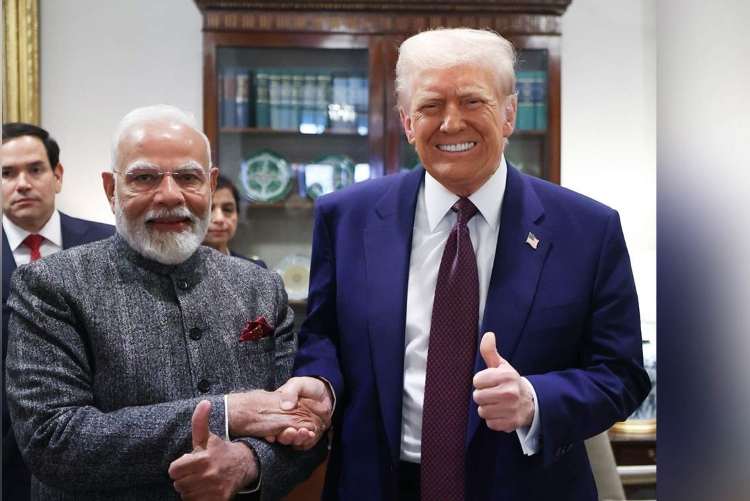
India-US ties: India’s emergence as a $4 trillion economy has altered its relationship with the United States in subtle but important ways. Public rhetoric still celebrates partnership, convergence and shared democratic values. Behind that façade lies a harder reality. As India edges toward becoming the world’s third-largest economy, Washington’s approach has become layered—supportive where interests align, obstructive where India’s autonomy threatens entrenched American advantages.
This is not hostility in the traditional sense. It is competitive management. The tools are no longer just tariffs and sanctions, but narratives, regulatory pressure, and market signals designed to shape India’s choices in trade, technology, energy, finance, and defence. The relationship today is best understood as cooperation bounded by rivalry.
READ | India-US trade deal nears completion
Tariffs as signals, not protection
The first clear signal came during Donald Trump’s first term. In 2019, the United States withdrew India’s preferential access under the Generalised System of Preferences, citing market-access concerns. The economic impact was modest. The political message was not. Washington was signalling discomfort with India’s industrial policy turn—Make in India, followed by Atmanirbhar Bharat—which sought to reduce import dependence in pharmaceuticals, electronics, medical devices, defence, and dairy.
Tariff actions on steel and aluminium, scrutiny of local content rules, and pressure on procurement norms were less about correcting trade imbalances than about testing India’s willingness to dilute self-reliance. The aim was restraint, not rupture. The United States wanted India open, but not independently industrialised.
Industrial policy under scrutiny
That pressure has continued through regulatory and legal channels. The Office of the U.S. Trade Representative has repeatedly challenged India’s production-linked incentive schemes, its digital services tax, and import-substitution policies in electronics and defence. At the World Trade Organisation, Washington has questioned India’s food-security regime and minimum support prices, even as advanced economies maintain far larger farm subsidies through opaque instruments.
Simultaneously, Indian firms operating in ports, payments infrastructure, pharmaceuticals, and defence manufacturing have faced recurring campaigns centred on governance, compliance, and environmental standards. Individually, these concerns may be legitimate. Collectively, they amount to a pattern—competitive pressure applied through reputational risk rather than formal sanctions. The objective is to slow India’s climb without openly opposing it.
READ | India-US mini trade deal: Relief with hidden risks
Cognitive pressure and perception management
In recent years, the contest has acquired a sharper informational edge. Market-moving allegations, amplified by global media and think-tank networks, have periodically cast doubt on India’s corporate champions and strategic sectors. Investor sentiment, rather than trade policy, has become the lever.
Energy and currency narratives reflect a similar logic. India’s discounted oil purchases from Russia have been portrayed as strategic vulnerability rather than economic prudence. Efforts to diversify payment systems away from exclusive dollar dependence are framed as destabilising, even as the United States itself weaponises finance through sanctions and secondary restrictions. The aim is not to force compliance, but to raise the reputational cost of autonomy.
Energy, food, and limits of tolerance
By the mid-2020s, these pressures converged across sectors. Washington objected to India’s oil sourcing from Russia, Iran, and Venezuela, while remaining silent on similar behaviour by other buyers. It questioned Indian generic medicines on safety grounds despite their approval by global regulators and their role in lowering healthcare costs worldwide. At the WTO, it challenged food-security policies central to India’s social contract.
These are not isolated disputes. They reflect discomfort with India’s refusal to align fully with American preferences—on energy security, trade architecture, or global finance. India’s strategy of diversified partnerships and issue-based alignment runs against Washington’s expectation of strategic conformity.
READ | Court ruling tilts India-US trade talks in Delhi’s favour
India-US ties: Tackling rivalry without picking sides
India’s response must be calibrated, not confrontational. Strategic rivalry theory offers a useful guide. The objective is not decoupling, but controlled interdependence—cooperation where gains are mutual, resistance where asymmetries threaten autonomy.
First, India must deepen indigenous manufacturing in defence and strategic industries through co-design and co-production, not mere assembly. Partnerships with France, Israel, Japan, South Korea, Russia, and selectively with the United States can expand technological depth without surrendering control.
Second, maritime and logistics strategy matters. Investments in ports, shipping corridors, and the broader blue economy convert geography into leverage and reduce dependence on any single power bloc.
Third, trade agreements should evolve from tariff bargains into production partnerships. Linking energy-intensive industries, critical minerals, and green technologies with resource-rich partners creates resilience and relative gains rather than new dependencies.
Fourth, energy diplomacy must remain diversified. Cheap Russian oil, Middle Eastern gas, and Latin American supplies are economic stabilisers, not ideological statements. The same logic applies to agriculture and pharmaceuticals, where scale and affordability are strategic assets.
Finally, financial sovereignty requires steady expansion of rupee-based trade, alternative payment mechanisms, and institutional capacity to counter misinformation. Narrative management is now a core element of economic policy.
America’s tariffs, regulations, and narratives are not signs of enmity. They are signals in a competitive environment where power is managed, not shared. India’s challenge is to read those signals accurately—and respond with patience, diversification, and institutional strength.
The goal is neither alignment nor defiance, but autonomy. In a world where partnerships are conditional and narratives are weapons, India’s rise will depend less on approval from others and more on its capacity to withstand pressure while staying open to opportunity.
Dr Ram Singh is Professor and Head, IIFT New Delhi. Views expressed are personal.