





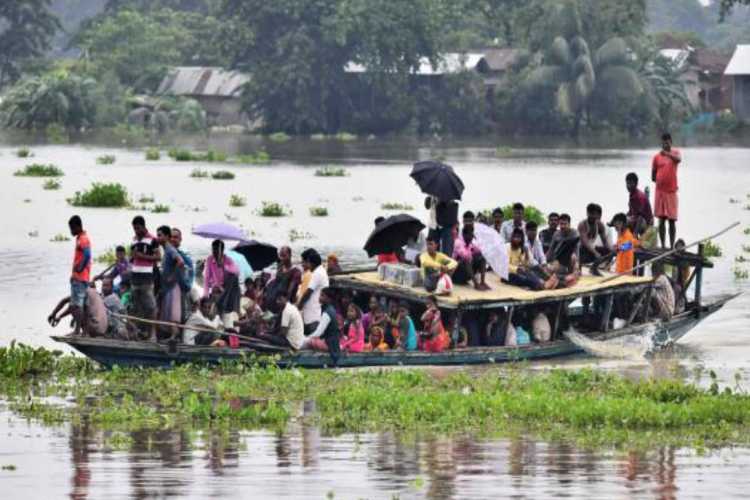
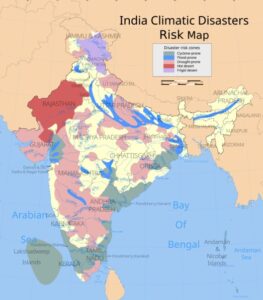
India disaster management systems: India faces a level of disaster exposure that would overwhelm most countries. Roughly 638 million people across 585 districts live with the risk of floods, cyclones, earthquakes or droughts. Vulnerability is hard-wired into geography: two-thirds of the cultivable land is drought-prone, almost one-eighth of riverine land is exposed to flooding, and a 7,500-km coastline lies open to cyclones and storm surges. Climate change has only thickened the plot by adding public-health shocks, internal displacement, violent flare-ups, and the occasional pandemic into the mix. A disaster today is rarely a simple event; it is a layered crisis that tests administrative nerves and institutional depth.
Yet India has built a respectable disaster-management system over the past two decades. The National Disaster Management Authority (NDMA), the network of forecasting systems, and state-level agencies now form an institutional spine that did not exist during the 1999 Odisha super cyclone. The change since then is striking.
READ | Why ASEAN-Taiwan relations matter in a tense Indo-Pacific
The forced improvisation of the late 1990s has given way to standard operating procedures, local-language early warning systems, and a more disciplined approach to relief camps. But the real revolution lies elsewhere: disasters are no longer viewed as spectacles of misery requiring charity; they are increasingly understood as governance challenges that demand community participation, not paternalism.
From sympathy to shared responsibility
The traditional disaster response relied on sympathy and relief. Victims were treated as passive recipients of philanthropy, while government agencies dictated priorities. Media images triggered donations, but the afflicted had little voice in deciding what they needed or how resources should be deployed. That model is both inefficient and disrespectful.
A more effective alternative has emerged: communities are being treated as equal actors in assessing damage, monitoring relief, claiming compensation, and rebuilding livelihoods. This shift strengthens dignity, improves targeting, curbs leakages, and ensures that the most vulnerable are not overlooked. In short, community agency delivers better outcomes than charity.
Policy has evolved, but implementation lags
India’s disaster legislation attempts to formalise this approach. The Disaster Management Act of 2005 and the National Policy on Disaster Management, 2009 set out the blueprint for coordinated preparedness, resilience planning, and risk governance. But implementation has been uneven. Resource shortages persist in local bodies; coordination across agencies is often inadequate; and the integration of public-health and mental-health systems into disaster planning remains patchy.
These gaps matter because today’s disasters are complex. A cyclone may coincide with a disease outbreak, a flood may cause both displacement and community tensions, and misinformation can spread faster than official communication. A technocratic, top-down system cannot handle all this alone.
Communities and disaster management
The value of empowered communities becomes clear when examining outcomes. In almost every major disaster, the first responders are neighbours, local volunteers, panchayat members, ASHA workers and youth groups — not government teams that may take hours to arrive. The contrast between the 10,000 deaths during the 1999 super cyclone and the near-zero casualties when Cyclone Phailin struck in 2013 is telling.
The difference did not lie in wind speeds alone; it lay in the mobilisation of community leaders who convinced families to evacuate well before landfall. Early-warning systems mean little if the message is not trusted, and trust resides locally.
Kerala’s social capital shows what works
Kerala’s pandemic response presented the clearest demonstration of what social capital looks like in action. The state deployed 26,000 ASHA workers, 33,000 Anganwadi workers, 45,000 youth volunteers, and a staggering 4.45 million Kudumbashree members in surveillance, community kitchens, isolation support, and contact tracing.
Local-body representatives worked at bus stations, border checkpoints and hospitals, ensuring that the state machinery functioned as an ecosystem rather than a hierarchy. Odisha, Maharashtra, Andhra Pradesh, Karnataka and Tamil Nadu also showed that when volunteers and local actors are empowered, governance capacity multiplies.
Local knowledge often beats heavy machinery
Local knowledge can be more effective than sophisticated technology. When 41 workers were trapped in a collapsed tunnel in Uttarakhand, it was a team of rat-hole miners from Jharkhand who made the breakthrough, armed not with advanced machines but with specialised skill.
During the 2018 Kerala floods, fishermen used country boats to rescue families from areas where naval craft could not operate. These examples offer a blunt reminder: resilience is built from the ground up, not rolled out from the top.
Wayanad 2024: Community strength in action
The August 2024 flash floods and landslides in South Wayanad reinforced this lesson. Community leaders conducted first rescues, shifted stranded groups to safer zones, ran community kitchens, arranged dignified funerals for unidentified victims and supported families in recovering vital documents. Digitally savvy youth volunteers logged camp-level data for district and state authorities.
Kudumbashree groups and the Harithakarma Sena managed waste in camps — once a chronic problem in relief operations. Social workers and mental-health professionals jointly addressed trauma, depression and anxiety among survivors. Such a coordinated response was possible only because local communities were not treated as helpless victims but as partners.
Sharing lessons across states and systems
These success stories deserve systematic documentation. They form the lived, practical complement to NDMA’s guidelines and technical manuals. This was the premise behind the International Conference on Community-Based Disaster Management (CBDM) held at the Indian Institute of Science, Bengaluru, in June 2025.
Organised by Jeeva Raksha Trust, alongside RGUHS, the Defence Forces, NDMA and several civil-society partners, the conference aimed to bridge professional disaster planning with grassroots experience. A hands-on workshop at the Indian Railway Institute of Disaster Management reinforced that preparedness improves when theory is matched with practice.
The larger message is unavoidable. India’s institutional machinery has grown stronger, but it performs best when paired with empowered communities. A country so exposed to climate and humanitarian risks cannot rely solely on bureaucratic muscle. It needs decentralised capacity, continuous training, and the willingness to let local actors lead.
Centralised systems may save lives; decentralised systems save many more. India’s most reliable shock absorber is not a government department — it is the community itself.
Dr Antony KR is a Kochi-based consultant in public health policy and systems. He has served UNICEF as health and nutrition specialist. He can be contacted at krantony53@gmail.com.