





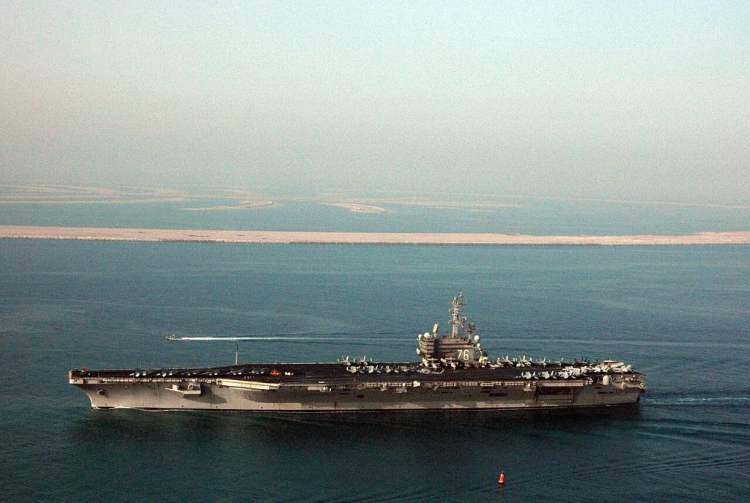
US military bases in the Gulf: In what is being described as a “serious blow to US surveillance capabilities” in the troubled Gulf region, the destruction of an American airborne warning and control system aircraft at the Prince Sultan Air Base in Saudi Arabia, in an Iranian missile attack on March 27, does not portend well for the world’s most powerful military power.
In the early days of the ongoing Iran-US-Israel war, Iranian missiles destroyed an expensive state-of-the-art radar system at an American air base in Jordan.
As the conflict escalated, several other US military bases were targeted in Qatar, Saudi Arabia, United Arab Emirates, Bahrain, Oman, and Kuwait, with reports claiming that 13 such facilities across West Asia are no longer habitable.
READ I Crude prices, LPG shortages, and the cost of Gulf dependence
With the war now into its fourth week, the hostilities have revived a debate that sits at the uncomfortable intersection of alliance politics and international law about what host nations actually owe foreign powers when they permit US military bases on their soil. After all, the US’ military footprint in West Asia – an outcome of a client-patron relationship – is “extensive”, allowing it to respond to regional threats.
Spain’s refusal to allow the use of its jointly operated installations at Rota and Morón for American operations against Iran is not merely a diplomatic irritant; it is a stress test for many of the assumptions that have long gone unexamined in the architecture of Western security alliances. Italy took a similar stand, denying permission for US military aircraft to use an air base in Sicily.
The Gulf conflict has raised contentious issues: does access to US military bases constitute a standing military commitment or does sovereignty retain its veto?
The controversy cannot be understood without recognising what Status of Forces Agreements (SOFAs) and bilateral basing treaties typically do and, crucially, what they do not provide. The 1953 US-Spain Agreement on Defence Cooperation and its subsequent renewals establish the operational framework for Rota and Morón. Like most such instruments, it grants access and logistical facilitation but does not automatically authorise the use of Spanish territory for offensive operations beyond the defined scope of the agreement.
READ I NATO crisis deepens over US-Iran war divide
Gulf states’ responsibilities
This distinction is crucial. Under Article 2(4) of the UN Charter, states are prohibited from using or threatening force in a manner inconsistent with the purposes of the UN. If military operations launched from a host nation’s territory are of contested legality under international law, a live question in the Iran context, where the threshold for self-defence under Article 51 has been subject to fierce debate, then the host state faces a genuine legal dilemma.
Lending a state’s territory for such operations could, depending on the circumstances, engage its own international responsibility under the Articles on State Responsibility (ARSIWA), particularly Article 16, which addresses the responsibility of states that knowingly aid or assist another state in committing an internationally wrongful act.
While the Spanish government made a legally defensible judgement, US threats of economic retaliation and warnings of reduced trade are worth examining in this light.
Economic coercion deployed against a sovereign state to compel a specific foreign policy decision sits uneasily with the principle of non-intervention, recognised in the UN General Assembly’s Declaration on Friendly Relations (Resolution 2625) and affirmed by the International Court of Justice in Nicaragua v. United States. The US is on thin legal ground when it frames economic pressure as a legitimate response to a sovereign ally’s exercise of its treaty rights.
While the client-patron relationship between the US and some European countries is weakening, it remains strong insofar as ties between West Asian states and America are concerned. West Asia has several groupings based on the client-patron principle. On the one hand, the US-Israel relationship has made Tel Aviv increasingly dependent on American support and guarantees.
On the other hand, the Arab states allowed US military bases to be built on their territories largely as a means to keep comparatively powerful states such as Iran and Israel at bay.
One of the most consequential and inadequately theorised dimensions of overseas basing is the legal and strategic exposure it creates for host nations. This risk operates on two levels that are often conflated but should be kept analytically distinct.
The question of complicity under international law gains prominence in such cases. Operations conducted from a host nation’s territory cause civilian casualties, destroy civilian infrastructure, or are deemed violations of international humanitarian law, such as the laws of armed conflict, codified in the Geneva Conventions and their Additional Protocols, could put residual international responsibility on it.
READ I Iran war tests BRICS — and reveals its limits
Not immune from culpability
The International Court of Justice’s jurisprudence on state responsibility and the work of the International Law Commission on ARSIWA make clear that the absence of direct participation does not immunise a material contribution to an internationally wrongful act.
Iran’s demonstrated willingness to strike US military bases in West Asian states, illustrates that host nation territory can become a legitimate military target in the adversary’s operational calculus, whether or not international law would sanction such strikes. The ongoing US-Iran confrontation is stress-testing the credibility of long-standing American security guarantees.
The assumption that overseas bases can serve as consequence-free logistical platforms is becoming operationally unsustainable. Host nations are rationally recalculating the risk premium in such cases and forcing them to rethink whether alignment with Washington guarantees stability or imports conflict onto their soil.
The ongoing war is strengthening US-Israel strategic alignment in the short term, but it is also complicating their broader regional relationships. Gulf states share concerns about Iran, yet they are increasingly uneasy about being drawn into a deeper US-Israel military framework. While some may continue quiet security cooperation with Israel, public normalisation could slow due to rising domestic and economic risks from prolonged conflict.
Three key trends are likely to emerge. First, US-Gulf security ties may become more transactional, with Gulf states seeking firmer and more explicit guarantees, possibly through formal treaties. Second, the Gulf countries may hedge their risks by diversifying partnerships, including with China, or by cautiously improving relations with Iran. Third, the region may become more militarised yet fragmented, making US influence more conditional, contested and costly rather than dominant.
Unlike European countries that maintained strategic distance, Gulf states such as Qatar and the UAE are deeply embedded in the US security system, exposing them to retaliation, economic vulnerability and domestic pressures.
Spain’s refusal to participate militarily highlights how international legal frameworks allow states to limit involvement. For Gulf states, this underscores the need to expand diplomatic flexibility, diversify security ties and pursue de-escalatory strategies to reduce overdependence and manage conflict exposure.
Abhinav Mehrotra is Associate Professor, Jindal Global Law School, O.P. Jindal Global University, Sonipat, Haryana. Amit Upadhyay is Associate Professor, Jindal Global Law School, O.P. Jindal Global University, Sonipat, Haryana. Originally published under Creative Commons by 360info .
.