





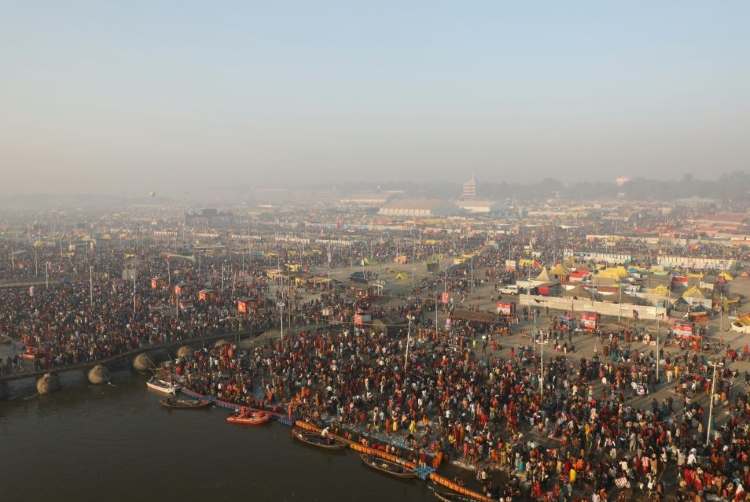
Mahakumbh 2025 made headlines last year as the largest human gathering on Earth. Hosting nearly 660 million people over six weeks, this spectacle of faith, tradition, and collective belief also revealed a striking paradox. In a country grappling with chronic urban waste crises, this fleeting megacity managed what Indian cities struggle to achieve: efficient, large-scale waste management. What can India’s cities learn from this temporary, yet highly effective, sanitation model?
The Uttar Pradesh government planned a massive waste management system for the artificially created district Mahakumbh Nagar, made especially for the Kumbh Mela. The main challenges there were different from regular city waste management. Short-term infrastructure was needed to tackle the varieties and quantity of waste material, from organic, plastic, sanitary, ritual, solid municipal, biochemical to construction and demolition waste.
Coordination among sanitary workers, management of temporary infrastructure, effective planning of logistics, and waste treatment technology were needed to ensure minimal public health risks at the Mahakumbh. The findings from the authors’ unpublished field study, which examines the government’s systematic initiatives to manage the event, show how this model can address waste management challenges, river water contamination and toxic air quality in Indian cities.
Mahakumbh’s remarkable sanitation effort
As per government estimates, the fair generated an average of 400 metric tons of solid waste. About 15000 sanitation workers worked in multiple shifts to maintain cleanliness across ghats, roads, camps, and public spaces. Their dedication often motivated them to work beyond their shifts, especially during bathing days, when the footfall was significantly high and required the seamless collection, bagging, and transportation of waste material.
The government ensured protective equipment, mechanized tools, trolleys, and transportation systems for worker safety and nonstop cleanliness operations in the mela area. Round-the-clock logistics enabled trucks to transport the waste material to treatment plants. Alongside, NGOs like Ganga Sevaduts volunteers ensured the cleanliness of the ghats by removing devotees’ offerings from the river. This collective approach reinforced the idea of Swachh Bharat (Clean India) in the entire temporary district.
Technology and infrastructure as enablers
Along with the treatment of solid waste, liquid waste was managed with the intervention of 10 sewage treatment plants (STPs) under the Namami Gange Mission. Every day, 340 million litres of sewage was treated by the facilities available at Salori, Rasulabad and Naini before discharging it to the Ganga and Yamuna, minimizing pollution levels during peak footfall days. Sewage water from drains was intercepted through drain-tapping before reaching the river. This wastewater was redirected through alternative channels to water treatment facilities, where bacteria was used to break down the majority of hazardous substances within. Such technological interventions ensured minimum degradation of river water quality.
The specialized Hybrid Granular Sequencing Batch Reactor (hgSBR) technology— developed by the Bhabha Atomic Research Centre under the Indian Government’s Atmanirbhar Bharat initiative and tested for large gatherings during the fair— ensured the effective reduction of biochemical and chemical oxygen demand, which is a measure of pollution levels, to improve water reusability. A real-time monitoring system was used to display water quality in regular intervals for awareness-building about biodiversity, cleanliness, and river conservation under the Namami Gange initiative.
The main challenge for the organizers was the management of human waste. Approximately 12,000 Fiber Reinforced Plastic toilets, 20,000 community urinals, 16,100 prefabricated steel toilets, and 20,000 garbage bins were arranged for visitors’ use. About 3.775 million liner bags were used for managing waste disposal, ensuring the area remained clean despite the huge footfall.
The state government commissioned the first bio-CNG plant before Mahakumbh 2025, further strengthening the sustainability narrative. The wet waste from temples, food establishments, and hotels was converted into bio-CNG and manure to demonstrate the concept of waste-to-energy and circular resource usage.
The main aim of waste management planning was to reduce non-biodegradable waste materials. Plastic items were not allowed within the event premises. However, due to its scale, its implementation depended on the pilgrims’ awareness, which the government emphasized through posters and announcements regarding the importance of cleanliness as a way of effecting behavior change.
Moving towards circular economy
Much of the developed infrastructure for the event, such as STPs, bio-CNG plants, monitoring platforms, and logistic networks, are permanent and can serve the same purpose for other localities. The STPs can be utilized for treating sewage water in nearby localities, impacting river water quality. Bio-CNG plants can be used to treat waste material and generate energy, increasing energy supply to nearby cities. Prefabricated sanitation units can be used for the annual Magh Mela (a mini-Kumbh), disaster relief, festivals, and to fill the gap in urban sanitation in nearby localities.
The study findings indicate that sanitation investments yield the greatest reward when located within a circular economy framework. Activities such as waste segregation at source, water treatment to improve reusability, waste-to-compost conversion, and waste-to-energy generation offer alternatives for treating waste, material reuse, and energy generation, suitable for solving the problems of future megacities.
STPs can be modified based on data related to high waste generation rates, and similar systems can be deployed into all Smart City projects in India. As freshwater demand in urban areas is very high, STPs offer an efficient water treatment process to maintain good water quality at freshwater sources. Bio-waste to CNG production is also a good approach for generating energy from waste. This can help India’s future megacities be self-sufficient in terms of energy generation from their own generated waste.
The sanitation workers’ dedication at the Mahakumbh can motivate urban municipality waste management teams for efficient waste segregation and collection. However, their work should be recognised as city waste management is a perpetual process. Sanitation workers in India encounter multifaceted challenges such as caste-based stigma and occupational immobility. Their work is frequently informal, resulting in low wages, restricted social security, healthcare, and welfare provisions. These issues must be addressed by policymakers through formalizing of work and offering social protection within the sanitation governance framework.
Water quality monitoring platforms can be established in every riverside megacity to display water quality values and motivate city dwellers for behavioral change towards reduced use of products containing toxic materials. These monitoring centres can be also converted to research facilities for developing city wastewater treatment.
Policy Implications
Any future scope lies in the deployment of the various solutions implemented to address daily waste management challenges, river water contamination and toxic air quality in major Indian cities. While the Government of India announced programmes such as Swachh Bharat and Namami Gange, the ground level impact of these initiatives is missing in the waste management practices of metro cities.
Mahakumbh 2025 served as the testing ground for some solutions that can be easily implemented. Moves like strict prohibition of single-use plastic, biodegradable waste treatment, and waste-to-energy generation need to be implemented in every Indian city. For this, the government must ensure adequate budget allocation for the establishment of waste treatment and waste-to-energy generation facilities in all Indian metros.
The next big policy change may be to incorporate waste management as part of school curricula to educate the youth about the importance of waste segregation at source and how to deal with different waste materials.
A special acknowledgement to Dyutima Tiwari and Kritika, who helped the authors with their field study and the collection of secondary data for writing this article.
Debraj Bhattacharjee is Assistant Professor, Department of Operations and Analytics, FLAME University. Naman Dubey is Assistant Professor, Department of Human Resource Development, FLAME University. Animesh Ghosh is Senior Research Fellow, Ashoka Centre for a People-centric Energy Transition (ACPET), Ashoka University. Originally published under Creative Commons by 360info .
.