





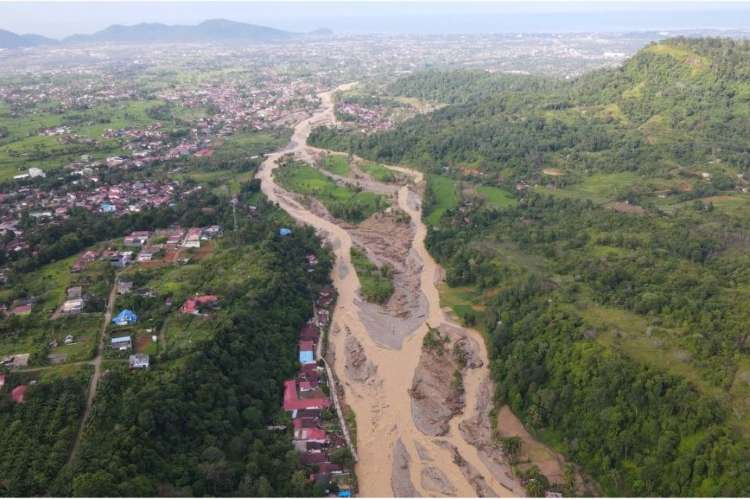
The deadly floods and landslides that swept across Sumatra in late 2025 have become a stark reminder of how fragile Indonesia’s ecological foundations have become. Triggered by Cyclone Senyar, the disaster killed hundreds, displaced more than a million people, and devastated communities across West Sumatra, North Sumatra, and Aceh.
Environmental groups and government officials now acknowledge that the scale of destruction was not caused by extreme weather alone. Years of deforestation, peat drainage, mining, and watershed degradation amplified the cyclone’s impact, turning a rare meteorological event into a catastrophe. Investigations also revealed that even legally permitted logging contributed to the vulnerability of the region, as oversight gaps allowed forest clearing to continue with minimal accountability.
These events are not isolated. They are symptoms of a deeper structural problem: Indonesia’s economic model remains heavily dependent on land conversion. For decades, growth has been driven by expanding plantations, mining concessions, industrial estates, and infrastructure corridors. This land‑hungry model has delivered short‑term economic gains, but it has also eroded the natural systems that protect communities from disaster.
READ I Budget 2026: Sandalwood revival hinges on farmer ownership
A growth target that demands more land
The tension between ecological fragility and economic ambition is becoming increasingly visible. In 2024, the government announced its target of achieving 6–8 percent annual growth during the 2025–2029 period, with the explicit aim of propelling Indonesia out of the middle‑income trap.
The logic is understandable: Indonesia wants to reach high‑income status before its demographic bonus peaks around 2040. But the recent disasters in Sumatra show that the current path — one that relies on continuous land expansion — is becoming economically and ecologically untenable.
Indonesia’s growth strategy still leans heavily on land‑based sectors. Plantation expansion, mining, industrial estates, and infrastructure megaprojects remain central pillars of development planning . These sectors require vast tracts of land, and their expansion often comes at the expense of forests, peatlands, and agricultural areas.
Land scarcity in Sumatra
Land availability is becoming increasingly constrained by population growth, rapid urbanisation, and rising food demand. Spatial competition is intensifying, land acquisition costs are rising, and conflicts over land use are becoming more frequent. Indonesia may be geographically vast, but its usable land is finite — and the pressures on it are mounting. The Food and Agriculture Organization has warned that Indonesia faces long‑term food security risks if agricultural land continues to shrink.
Meanwhile, Statistics Indonesia Body data shows that rice field area has declined from more than 8 million hectares in 2015–2017 to just 7.38 million hectares in 2024. Much of this land has been converted for housing, commercial development, and infrastructure.
At the same time, Indonesia’s forests and peatlands have been systematically cleared over decades. Human Rights Watch has documented how peatlands and forests continue to be destroyed despite moratoriums and restoration pledges.
Peat drainage and forest clearing persist even in areas designated for protection and industrial expansion continues to threaten remaining forest areas.
These patterns weaken natural defences, destabilise slopes, and increase runoff — making floods and landslides more severe.
Growth that undermines its own foundations
The economic contradiction is becoming impossible to ignore. When disasters strike, the losses — damaged infrastructure, disrupted livelihoods, and costly recovery efforts — erode the very growth gains that land conversion was meant to deliver.
The World Bank has repeatedly emphasised that Indonesia’s long‑term growth prospects depend on strengthening environmental resilience and improving land governance.
Indonesia’s development challenge is no longer simply about generating growth, but about generating growth that does not destroy the ecological foundation on which the economy depends. A land‑efficient growth model is now a strategic necessity.
A smarter path: Land‑efficient growth
This requires several shifts.
First, productivity must replace expansion as the core driver of growth. Agriculture can increase yields through better seeds, mechanisation, and post‑harvest systems rather than clearing new land. International experience shows that intensification can raise output while reducing pressure on forests. Industry can modernise production processes and improve energy efficiency instead of relying on physical expansion.
Second, Indonesia must accelerate its transition toward value‑added and knowledge‑based sectors — manufacturing technology, digital services, and the creative economy — which generate high economic returns with minimal land use. The Asian Development Bank has stressed that boosting productivity and innovation is essential for escaping the middle‑income trap.
Third, development should prioritise the revitalisation of degraded land. Brownfield development — rehabilitating abandoned mining sites, idle land, and aging industrial zones — reduces pressure on forests while improving spatial efficiency. This approach aligns with circular economy principles and strengthens spatial planning.
Fourth, Indonesia can unlock the economic value of its environmental assets through carbon markets. Properly designed carbon trading mechanisms can incentivise forest protection and reforestation, turning ecosystems into productive economic assets rather than obstacles to development. With one of the world’s largest tropical forest carbon stocks, Indonesia has significant potential in this area.
The policy foundation must be strong
Strong spatial governance is essential. Enforcement of spatial planning regulations, protection of sustainable agricultural land, and decisive action against illegal or irresponsible land conversion must become central pillars of economic policy.
The World Bank’s Land Governance Assessment highlights persistent weaknesses in land administration, overlapping permits, and inconsistent enforcement — all of which undermine sustainable development.
Indonesia’s recent disasters are a warning: the land‑hungry growth model of the past is reaching its limits. If the country continues to expand by clearing forests and converting land, the economic gains will be increasingly overshadowed by ecological losses and disaster risks. Sustainable, land‑efficient growth is not an environmental ideal — it is the only viable path to long‑term prosperity.
Mohamad Dian Revindo is a researcher and lecturer in the Faculty of Economics and Business and the Graduate School of Sustainable Development, University of Indonesia. Mervin Goklas Hamonangan is a researcher in Institute for Economic and Social Research, University of Indonesia (LPEM UI)