





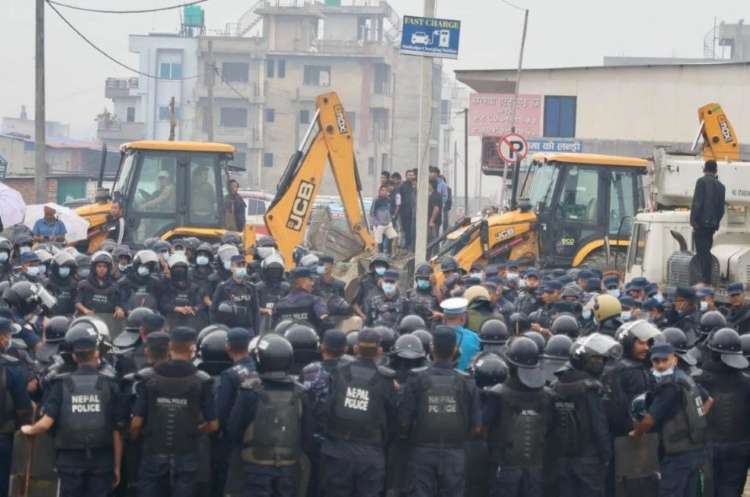
Slum demolitions in Nepal: The mass eviction of slums and informal settlements in Nepal’s capital Kathmandu and surrounding districts has displaced an estimated 15,000–20,000 people. On April 25, the Nepal government began forcibly removing landless residents from the Kathmandu Valley, later extending the drive beyond the capital.
Nepal faces a staggering crisis: more than 3.5 million people are landless or homeless. A government commission invited applications for registration, and 1.2 million people — mostly poor, Dalit, and indigenous — have already registered in the hope of receiving land. Ironically, these communities have borne the brunt of evictions carried out without adequate notice, consultation, or alternative housing. The lack of support has eroded their trust in the state.
The ruling Rastriya Swatantra Party (RSP) pledged to resolve landlessness within 1,000 days of office. Its 100-point action plan also promised relief to the landless. Yet, despite decades of settlement — some families have been living in Kathmandu’s slums for 60 years — the government demolished homes using the full force of the state. Nepal Police, Armed Police Force, Nepal Army, and the municipal police participated. Residents were harassed, threatened, and even detained before demolitions.
READ I India needs land reforms, tenancy policies to boost farm output
Mass slum demolition in Nepal
Authorities report 2,687 houses destroyed, affecting 15,300 people since April 25. District Administration Office (DAO) data show 2,501 families — 15,316 people, including 3,133 schoolchildren — evicted between April 25 and May 4, this year.
Eviction notices were issued on April 22, with demolitions beginning early on 25 April. Most residents were daily wage labourers, sanitation workers, shopkeepers, or informal sector employees. As bulldozers rolled in, women and children cried while men were away at work. Security forces cordoned off areas, barring civil society observers.
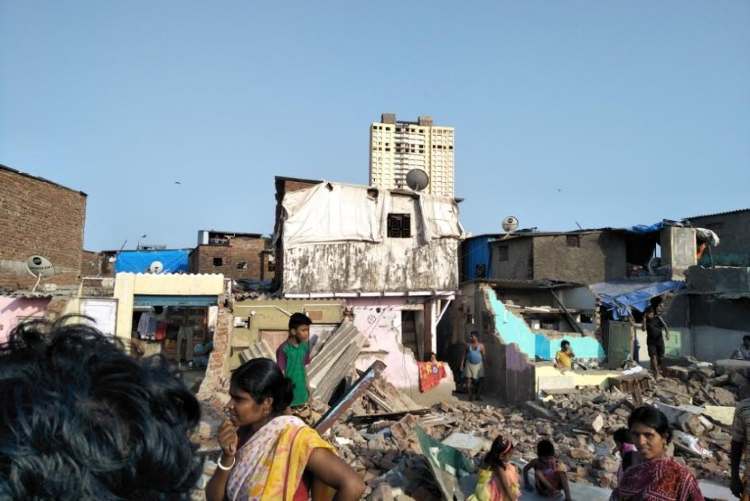
Evicted families were taken to the Rangashala (City Stadium) for verification. A High-Powered Committee for Integrated Development of Bagmati Civilization (HPCIDC) was tasked with verifying landless residents along the Bagmati riverbank. The government required that the evicted register for support. However, families — busy salvaging belongings — could not comply. Confusion surrounding the eviction and the resulting insecurity compounded the problem. As the security forces cordoned off the area, human rights defenders and journalists were denied access, rendering the process humiliating and opaque.
READ I SVAMITVA scheme turns rural land into bankable collateral
Human rights concerns
Seven holding centres were established in Kathmandu, Bhaktapur, and Kavre. These centres were heavily securitised, forbade movement outside the centres and subjected the residents to harassment. Though the government promised food and durable solutions, security personnel pressured families to leave. Nepal’s National Human Rights Commission (NHRC) reported ultimatums requiring displaced people to vacate centres, threats, and conditions leading to food insecurity.
Children suffered acutely. Many were scheduled to sit for 2026/27 school exams on April 16, and faced disruption because of the evictions. As families were scattered, not only was children’s education interrupted, they also endured discrimination and humiliation amongst their peers. As 63 percent of slum residents are estimated to be women, young mothers faced added burdens of childcare, insecurity, and humiliation.
Eventually, the government stopped food and water supplies in holding centres and chose to offer NPR 25,000 (about US $162) as compensation to the evicted families. They were urged to seek rented accommodation. This token support, coupled with forced removal from centres, underscored official impunity. Clearly, the authorities demolished the slums without assuming responsibility for consequences.
The evictions were criticised and condemned by international and national organisations. They urged immediate suspension of the drive and reminded the Nepal government that it should follow national laws and the Guiding Principles on Internal Displacement. They mandate eviction notices to be issued in advance, consultation with the target communities, data recording, and the provision of alternative housing.
Instead, the official chose the path of systematic repression. Already living on the margins, surveillance and securitised centres marginalised the evicted people further. Security forces pressured families to accept NPR 25,000 and leave, revealing the absence of a resettlement plan.
The haphazard evictions undermined rights guaranteed by Nepal’s 2015 Constitution. These included Article 27 – Right to Information; Article 35 – Right to Health; Article 36 – Right to Food; and Article 37 – Right to Housing. Thus several fundamental human rights were violated.
On April 23, a writ petition was filed in the Supreme Court seeking to halt demolitions until alternative housing was provided. The Court delayed issuing a show-cause order but, on May 8, finally granted an interim order stopping evictions. It expressed concern over holding centre mismanagement and deprivation of shelter, education, healthcare, and housing. The Court directed the government not to resume evictions and to provide effective services, while insisting that prescribed legal procedures be followed in future.
Nepal urgently needs a comprehensive, sustainable solution. This would entail consultation with affected communities, ensuring legal compliance with eviction procedures, and involving local government bodies in registering landless families, screening communities, and identifying land for resettlement.
Without such measures, forced mass displacement will remain a grave human rights violation, deepen vulnerability and erode constitutional guarantees.
Som Niroula is a research scholar at the Department of Conflict, Peace and Development, Tribhuvan University, Kathmandu, Nepal. He is also a member of the CRG Research Collective, Calcutta, and was a Junior Fellow at Institut für die Wissenschaften vom Menschen, Vienna. Originally published under Creative Commons.