


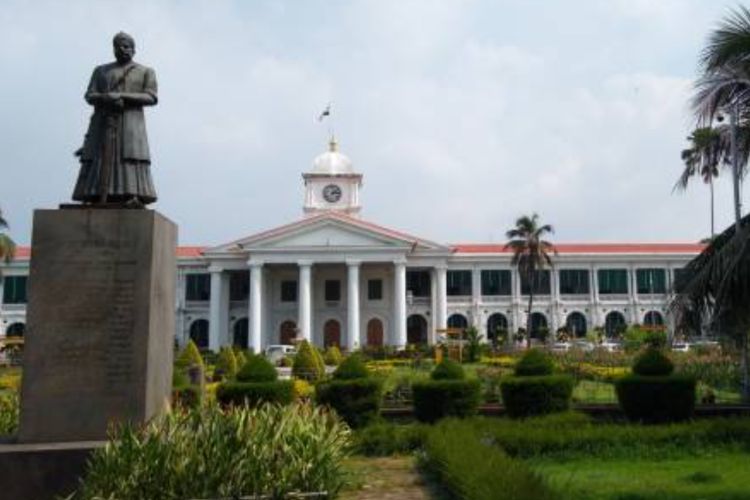
Kerala budget: Kerala’s revised Budget for 2026-27, presented by Chief Minister and Finance Minister V.D. Satheesan on June 19, marks a break in the state’s economic posture. The shift is from welfare-led redistribution to investment-led growth. The change is not merely rhetorical. The Budget accepts that remittances and public spending cannot carry Kerala’s next phase of growth. It asks private investors, including non-resident Keralites, to bring capital, technology and jobs into a state that has long treated private investment with suspicion.
The reason for the shift is also clear. Kerala’s debt has risen to ₹5.07 lakh crore. Salaries, pensions and interest payments absorb 77% of revenue receipts. Capital expenditure is just 1.3% of GSDP, among the lowest in the country. The state’s own tax revenue has slipped from 6.94% of GSDP in 2015-16 to 6.41% in 2025-26. These numbers leave little room for development spending unless the state raises private investment and improves tax collection.
READ | Kerala’s K-CDC must start with monsoon surveillance
Kerala budget and private investment
The most important proposal is the Invest Kerala cell. It is meant to work as an apex single-window system for land access, statutory clearances and post-investment support. This is sensible, provided it functions as more than a desk that forwards files. Kerala’s problem has rarely been the absence of declared intent. Investors have faced expensive land, slow clearances, high labour costs and unpredictable local resistance. The Budget acknowledges these constraints and promises time-bound clearances and a standard project implementation protocol.
Land remains the binding constraint. Kerala cannot compete with Gujarat, Tamil Nadu or Andhra Pradesh by offering large tracts for labour-intensive factories. Its population density, ecology and land prices point in a different direction. The state should choose investments that use skilled labour, technology and small land parcels. Electronics design, health technology, research services, maritime services, precision engineering and advanced materials fit that profile better than large factories employing low-skilled labour.
The Budget’s proposal for special investment zones should therefore be tested against existing industrial land. Kerala already has Special Economic Zones. The government should first examine their land use, occupancy, infrastructure gaps and litigation before announcing fresh zones. A land bank will help only if it identifies usable plots, resolves title issues and protects ecologically sensitive areas.
READ | Kerala fiscal crisis demands hard Budget choices
Kerala Knowledge Valley and MSMEs
The Budget’s education and skilling proposals move in the right direction. Kerala Knowledge Valley has been allocated ₹100 crore. A Research Park on the IIT Madras model gets ₹60 crore. The Global Job Watch Tower gets ₹2 crore. Gen-Z and New Gen Technology receives ₹50 crore. The Jawaharlal Nehru Centre for Scientific Temper gets ₹25 crore. The aim is to turn Kerala’s educated population into employable human capital.
The weakness is fragmentation. Kerala does not have the fiscal space to fund too many small institutions with overlapping mandates. These projects should be placed under one authority with common governance, shared data, pooled faculty networks and a measurable job-market mandate. The Global Job Watch Tower should not become a dashboard. It should tell universities, polytechnics and training providers which courses to close, which to redesign and which skills to add.
The MSME proposal has the same risk. The Budget promises 10,000 new micro, small and medium enterprises and sets aside ₹100 crore under the Kerala MSME Growth Scheme. The scheme will offer tax incentives, funds, techno-mentors and management mentors.
Kerala should avoid treating the number of new MSMEs as the measure of success. A service enterprise may survive on talent and local demand. A manufacturing MSME needs raw material access, power reliability, logistics, working capital and buyers. Each proposed MSME cluster should be tied to a supply chain, not merely registered as a unit. Existing MSMEs should get equal priority for technology adoption and scale. Many will create jobs faster than new firms started for the sake of a target.
Mission Samudra and logistics
The maritime proposals are among the Budget’s stronger ideas. India moves nearly 95% of its trade by volume and about 70% by value through ports. Kerala has a 600-km coastline, the Cochin Shipyard, the Vizhinjam transshipment terminal, two international ports, 17 non-major ports and inland water resources. Mission Samudra seeks to use these assets for port-led industrial corridors and stronger road, rail and logistics links.
Shipbuilding deserves special attention. Cochin Shipyard already gives Kerala an industrial base in a sector where India wants scale and where global shipyards face capacity constraints. Kerala should use Korean and Japanese partnerships for design, repair, specialised vessels and marine equipment, rather than spread its effort across too many maritime slogans.
The aviation logistics hub, with ₹200 crore proposed around Kerala’s four airports, is also worth pursuing. Its viability will depend on cargo aggregation, cold chains, customs efficiency and road links to production clusters. Airports alone do not create logistics hubs. Cargo does.
Critical minerals corridor
The Rare Earth and Critical Mineral Corridor is strategically important. Kerala’s heavy mineral sands include ilmenite, rutile, leucoxene, monazite, zircon and sillimanite. The Chavara belt between Neendakara and Kayamkulam is among the state’s major mineral sand deposits.
The case for caution is stronger here than in ordinary industry. China has used export controls on rare earths and related technologies as a strategic instrument. The G7 has responded with plans for stockpiling and diversification. Rare earths now sit at the intersection of clean energy, electronics, defence and industrial policy.
READ | Migrant worker exodus exposes Kerala’s economic fault lines
Kerala should not treat these minerals as a short-term revenue source. Extraction, separation and downstream processing require national security oversight, environmental safeguards and technology partnerships. Public sector enterprises should retain control over extraction where atomic minerals are involved. Private investment can be considered in downstream value addition, subject to clear rules on export, processing and domestic use.
A detailed corridor study is essential before large commitments are made. It should cover reserves, radioactivity, environmental risk, processing technology, domestic demand, export restrictions and the role of existing public sector units. Kerala’s mineral endowment should be converted into value, not shipped out as raw material.
Kerala fiscal strategy
The Budget’s central contradiction remains unresolved. It proposes investment zones, knowledge institutions, MSME funds, maritime infrastructure, aviation logistics, welfare schemes and mineral corridors at a time when the state’s fiscal room is narrow. The revised assessment points to a central transfers shortfall of about ₹20,500 crore from earlier estimates.
That makes prioritisation unavoidable. Projects with the same purpose should be merged. Programmes with weak execution plans should be held back. Capital should go first to schemes that attract private investment, raise jobs for educated youth, and improve tax receipts without damaging Kerala’s ecological base.
The proposal for a centralised digital tax collection system deserves attention. Kerala cannot afford leakage in GST-related compliance, property transactions, excise, motor vehicles and local levies. Better tax administration will matter more than new tax announcements. The state’s investment turn will succeed only if clearances are fast, land is usable, skills match demand, and the Budget stops spreading scarce money across too many attractive ideas.
Prof KS Hari is Professor and Dean of Research, Gokhale Institute of Politics and Economics, Pune. He has written extensively on development economics.
Dr Beena Saraswathy is Assistant Professor at the Institute for Studies in Industrial Development (ISID), New Delhi. Her research areas include market competition, mergers and acquisitions, business groups, and the corporate sector.