





Three numbers help explain the contest taking shape ahead of the 2027 Uttar Pradesh Assembly election. In the 2024 Lok Sabha election, the National Democratic Alliance (NDA) polled roughly 1.48 lakh more votes than the Samajwadi Party-Congress alliance across the state. This year, nearly 28.87 lakh candidates applied for 32,679 posts in the Uttar Pradesh Police. And the revision of the state’s electoral rolls, completed in April, left 2.04 crore fewer registered voters than before the exercise.
The numbers describe different political pressures. One concerns the BJP’s narrow popular-vote advantage in 2024, another the competition for secure employment, and the third a controversy over electoral registration. The opposition hopes to bring these grievances together before the Assembly election.
READ I India’s manufacturing growth is yet to deliver jobs
Political heat over Uttar Pradesh election
The Congress and its INDIA bloc partners have called a rally at Delhi’s Ramlila Maidan on 1 November against alleged irregularities in electoral rolls. The campaign accuses the Election Commission of facilitating vote chori, or vote theft. The Commission maintains that the revision followed prescribed procedures, while the BJP rejects the opposition’s allegations.
Turning protests into electoral gains will require the opposition to reach voters who have not already made up their minds.
The arithmetic is demanding. A three-percentage-point NDA lead would translate into roughly 26 lakh votes at Uttar Pradesh’s 2024 turnout. Erasing it would require about 13 lakh voters to switch from the NDA to the opposition, assuming other votes remain unchanged. Alternatively, the opposition would need a net gain of 26 lakh votes through additional turnout.
READ I Bundelkhand’s industrial ambitions face a jobs challenge
Even a rally attracting the million participants claimed by its organisers would not establish how many undecided voters had been persuaded.
The experience of Bihar and West Bengal offers little encouragement to the opposition. Rahul Gandhi carried the electoral-roll controversy into Bihar ahead of the 2025 Assembly election, with Akhilesh Yadav joining the Voter Adhikar Yatra. The NDA subsequently won 202 of the state’s 243 seats. The Congress secured six of the 61 constituencies it contested.
In West Bengal’s 2026 election, the BJP defeated the Trinamool Congress, winning about 208 seats against the latter’s 80. Its vote share was approximately 45.9%, compared with Trinamool’s 40.7%. The dispute over electoral-roll deletions had become a major campaign issue, although anti-incumbency against the long-serving Trinamool government was also a factor.
These results do not establish that electoral-roll campaigns are ineffective. They show how difficult it is to turn a grievance over election administration into a winning electoral coalition.
READ I India’s jobs problem is bigger than unemployment
Voter-roll deletions and the electoral margin
Uttar Pradesh’s electoral roll fell from 15.44 crore voters to 13.39 crore after the Special Intensive Revision. The reduction was equivalent to 13.21% of the original electorate. The January draft had removed nearly 2.89 crore names, but subsequent claims, objections and verification resulted in about 84 lakh additions before the final list was published in April.
The Election Commission’s stated reasons for removing entries included deaths, duplication and other verification issues. The politically consequential question is how many eligible voters were excluded and whether those exclusions disproportionately affected particular communities or parties. The aggregate numbers cannot answer it.
Consider an illustrative calculation. If 13.2% of previously registered voters were excluded and that group favoured one alliance over another by 20 percentage points, the difference would be equivalent to about 2.6% of the original electorate. The calculation assumes that every deleted entry represented an otherwise eligible voter who would have voted. That assumption is plainly unrealistic.
The actual impact would depend on the number of eligible voters excluded, their likely turnout and political preferences, and the concentration of exclusions in particular constituencies. Even a modest statewide effect could be decisive in closely contested seats.
The opposition therefore needs constituency-level evidence. Without it, the 2.04 crore figure establishes the magnitude of the revision, not the number of votes lost by any party.
Govt jobs and the unemployment paradox
The competition for government employment presents a more direct political challenge to the BJP.
The Uttar Pradesh Police recruitment examination held in June attracted 28,86,797 applicants for 32,679 positions, nearly 88 applicants for each vacancy. The final selection results were announced in October. Fewer than 1.2% of applicants could secure one of the available positions.
The recruitment figures reveal demand for secure salaried employment that headline unemployment statistics struggle to capture. Official labour-force surveys classify people engaged in work as employed, including many in low-paid or irregular occupations. They do not establish whether workers have jobs matching their qualifications or aspirations.
The 2025 Periodic Labour Force Survey reported improvement in some national employment indicators. Such statistics can coexist with substantial competition for public-sector vacancies, particularly among educated young people.
The political significance is considerable, although applicants cannot simply be treated as opposition voters. Some will support the government for reasons unrelated to employment. Others may view the completion of recruitment as evidence of administrative performance.
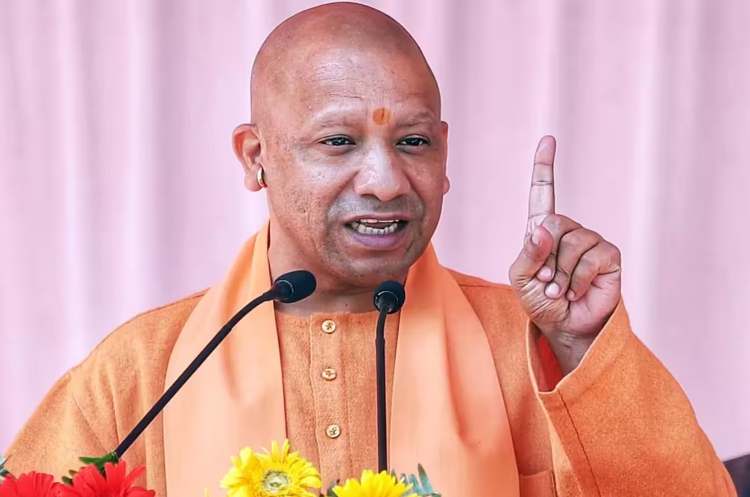
The BJP also retains advantages in public perceptions of law and order, infrastructure and welfare delivery. A News18-Pvalue Analytics survey conducted between 17 September and 2 October found that 77.1% of respondents were satisfied with the Yogi Adityanath government’s performance. Yet the survey also recorded employment concerns among younger, unemployed and economically vulnerable respondents.
This combination helps explain the difficulty facing the opposition. Dissatisfaction with employment opportunities may be widespread without becoming the deciding issue for voters who approve of other aspects of governance.
Dalit votes could change Uttar Pradesh contest
The interaction between caste and employment grievances may prove especially important.
Dalits account for roughly one-fifth of Uttar Pradesh’s population. The Samajwadi Party-Congress alliance made substantial inroads among Dalit voters in 2024, challenging the BJP while drawing support away from the Bahujan Samaj Party (BSP).
A shift of ten percentage points among voters representing 22% of the electorate would amount to 2.2 percentage points of the statewide vote. If those voters moved directly from the NDA to the opposition, the difference between the alliances would change by 4.4 points.
The calculation shows why even a relatively small movement within a large social group could overwhelm a narrow statewide lead.
The same arithmetic works against the opposition. Mayawati has indicated that the BSP will contest the election independently, while Chandrashekhar Azad’s Azad Samaj Party is attempting to establish a wider political presence. Both could attract voters otherwise available to the SP-Congress alliance.
For a young Dalit seeking a government job, caste representation, employment prospects and perceptions of the state government’s performance may influence the same voting decision. The relative weight of these considerations remains uncertain.
Opinion polls offer little certainty
Surveys released ahead of the Uttar Pradesh Assembly election provide widely divergent estimates of party support.
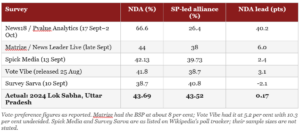
The smaller surveys cluster around an NDA advantage of two to six percentage points, with one placing the opposition ahead. Their agreement within a narrow range is insufficient to establish a reliable electoral baseline.
Past polling errors offer a further warning. In the 2024 Lok Sabha election, opinion and seat forecasts substantially overestimated the NDA’s performance in Uttar Pradesh. The alliance ultimately secured 36 seats, while the INDIA bloc won 43, despite the NDA retaining a narrow advantage in the aggregate popular vote.
The distinction between votes and seats is particularly important in Uttar Pradesh. A narrow statewide vote lead may produce a comfortable Assembly majority if support is distributed efficiently across constituencies. Conversely, an alliance can win more votes overall and still lose more seats.
The wide variation in current surveys makes a precise estimate of either alliance’s probability of victory indefensible. Nor can a three-point lead, even if accepted, be translated mechanically into a particular number of Assembly seats.
Much will depend on candidate selection, caste alliances, local contests and turnout. The strength of the BSP and other parties adds another uncertainty.
The opposition’s electoral-roll campaign may mobilise existing supporters and reinforce suspicions about electoral administration. The competition for government jobs offers a potentially broader source of discontent, particularly among younger voters. But the BJP’s advantages in leadership, organisation and welfare delivery remain substantial.
Whether the opposition can combine these grievances into a competitive electoral coalition will become clearer when credible surveys measure opinion after the October protests. Until then, the recruitment queue offers stronger evidence of social frustration than the rally crowd offers of electoral conversion.
Nihar Nalini Sarangi is a Cuttack-based commentator on political economy and public policy.