


India’s clean-cooking story is one of the country’s more significant social-policy gains, but it is also a reminder that access and use are different measures of success. When the Pradhan Mantri Ujjwala Yojana was launched in May 2016, its purpose was straightforward: give poor households access to LPG and reduce their dependence on firewood, dung cakes and crop residue. The scheme placed the LPG connection in the name of an adult woman, making gender part of the design rather than an afterthought.
The need was substantial. Household air pollution remains a major health risk. The World Health Organisation estimates that exposure to household air pollution caused 2.9 million premature deaths globally in 2021, including more than 309,000 deaths among children under five. Women in low- and middle-income countries carry a disproportionate share of the exposure because they spend more time near household cooking activities.
READ | LPG price shock is pushing migrants out of India’s cities
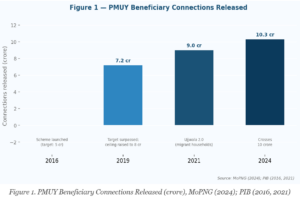
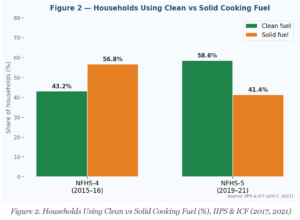
India has made considerable progress. The share of households using clean cooking fuel rose from 43.8% in NFHS-4 (2015–16) to 58.6% in NFHS-5 (2019–21). Ministry of Health and Family Welfare PMUY had released 10.33 crore connections by 2024, and the government subsequently approved another 25 lakh connections to close remaining gaps in access. Press Information Bureau
The policy achievement is real. The harder question is whether an LPG connection has become the household’s principal cooking fuel.

From a connection to a clean kitchen
The distinction matters because LPG adoption has never been determined by connection availability alone. The cost of refilling a cylinder, household income, the availability of biomass and the practicalities of obtaining a refill all influence what happens after the first cylinder is installed.
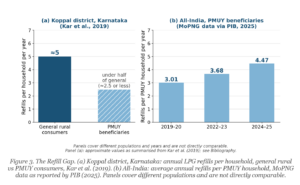
Early evidence from Ujjwala showed the problem clearly. Research based on distributor sales in Koppal district in Karnataka found that Ujjwala households purchased fewer refills than other rural LPG customers, who themselves averaged only about five cylinders a year. Subsequent national evidence also found extensive fuel stacking, with households using LPG alongside firewood and other solid fuels. CEEW’s 2020 analysis found that 38% of Indian households stacked LPG with solid fuels, while 14% of rural households relied entirely on biomass. CEEW
Government data show that usage has since improved. Average annual PMUY consumption rose from about three refills in 2019-20 to 3.68 in 2022-23 and 4.47 in FY2024-25. Press Information Bureau That is an important change and should be recognised. It also changes the policy question. The issue is no longer whether Ujjwala has increased LPG use. It has. The issue is whether the remaining gap between LPG access and regular, predominantly LPG-based cooking is now concentrated among the poorest and most vulnerable households.
That distinction is important for evaluating the scheme fairly. A household taking four or five cylinders a year may be using LPG for a substantial share of its cooking. But average refill numbers do not tell us how much cooking is still done with biomass, whether use changes during periods of high prices, or which households continue to depend most heavily on the chulha.
The health evidence provides the reason to close that gap. Household air pollution contributes to chronic obstructive pulmonary disease, stroke, ischaemic heart disease and lung cancer, while children exposed to household smoke face a higher risk of lower respiratory infections. World Health Organisation Research from Guatemala’s RESPIRE trial also showed that reducing household smoke exposure reduced severe forms of childhood pneumonia, although the intervention did not produce a statistically significant reduction in the primary outcome of physician-diagnosed pneumonia. PubMed
The lesson is straightforward: health gains depend on reducing exposure, not merely registering a household for a cleaner fuel.
READ | Fuel price shock tests India’s pricing policy
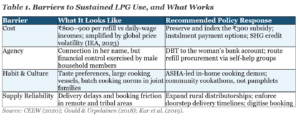
Affordability remains the central barrier
The government’s response has increasingly recognised this problem. Ujjwala 2.0 simplified eligibility and documentation and provided the first refill and stove without charge. The targeted LPG subsidy, introduced at ₹200 per 14.2 kg cylinder in 2022, was increased to ₹300 in October 2023. For 2025-26, the government approved continuation of the ₹300 subsidy for up to nine refills a year. Press Information Bureau

These measures have helped. Yet LPG remains an imported fuel and its international price is subject to global energy shocks. For poor households, even a subsidised cylinder can represent a substantial cash expense compared with biomass that can be collected at little or no monetary cost.
This is where fuel stacking needs to be understood as an economic response rather than simply a behavioural failure. A household may own an LPG stove and still collect firewood because the marginal cost of another cylinder is high. Women may then continue doing the work that the clean-cooking transition was supposed to reduce.
The burden is therefore measured in more than household expenditure. Time spent collecting fuel, preparing biomass and managing smoky fires reduces the time available for paid work, education and rest. The unpaid work involved in obtaining household energy has long been recognised as gendered labour. Ujjwala has reduced some of that burden, but a connection by itself cannot eliminate it.
There is also a question of household decision-making. Women may be the principal users of cooking fuel without controlling the household budget that determines when a cylinder is refilled. A woman-centred connection is therefore valuable, but ownership in her name does not automatically give her control over fuel expenditure.
Clean cooking should become a public-health measure
The next phase of Ujjwala should therefore be designed around sustained use rather than connections released.

One practical step would be to make cooking-fuel use part of routine maternal and community health work. ASHA workers and anganwadi staff already interact regularly with households on maternal and child health. During antenatal care, health workers could ask about the principal cooking fuel and exposure to household smoke, particularly for pregnant women and households with young children. The evidence linking household air pollution with adverse pregnancy outcomes is substantial enough to justify treating exposure as a health risk rather than merely an energy-access issue. PubMed
Monitoring should also improve. District-level LPG consumption data can identify areas where connections are high but refill rates remain persistently low. Such information should be used in aggregate, without tracking the individual purchasing behaviour of households. Districts with unusually low consumption could then investigate affordability, distribution problems, inactive connections and local dependence on biomass.
The subsidy architecture also needs greater predictability. The ₹300 subsidy has helped raise LPG consumption, but poor households remain vulnerable whenever international prices rise or fiscal support changes. A more durable system would link assistance more explicitly to household economic status and make the rules for subsidy revision predictable. Support should be designed around the cost of maintaining regular clean-fuel use, rather than the political cycle of periodic price shocks.
Electric cooking can form part of that transition, but it should complement rather than replace LPG prematurely. Induction cooking eliminates combustion inside the kitchen and can become increasingly attractive as electricity supply becomes more reliable and efficient appliances become cheaper. Yet the economics vary by household, and many rural consumers still face constraints related to appliance costs, power reliability and cooking practices.
Rooftop solar can help some households reduce electricity costs, but it should not be presented as a universal solution to clean cooking. The PM Surya Ghar scheme is primarily a rooftop solar programme, and a grid-connected solar system does not by itself provide backup electricity during a power outage. For poorer households, the upfront cost of an induction stove and solar system can also be prohibitive. The transition therefore needs to be based on what households can actually afford and use.
The broader objective should be technological choice backed by affordability. LPG will remain essential for many households. Electricity, induction and other clean technologies can expand the range of options as their costs and reliability improve.
READ | Energy access needs more than electrification
Ujjwala’s next test is sustained use
Ujjwala deserves credit for solving a problem that previous clean-cooking programmes had struggled to address at scale. More than 10 crore poor women now have LPG connections. Average PMUY consumption has risen substantially since the early years of the scheme. PMUY
But the next stage cannot be measured by another connection target.

The relevant policy indicators are whether households can afford their next refill, whether women have to return to collecting biomass when prices rise, how much cooking is still done on solid fuels, and whether household air-pollution exposure is falling. Those are harder outcomes to measure than connections issued, but they are much closer to the purpose for which Ujjwala was created.
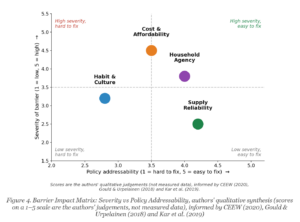

India has already moved a large part of the way from recognition to access. The remaining task is to make clean cooking the economically rational choice for the households that still find LPG too expensive to use consistently.
The constitutional promise of the right to life cannot be reduced to formal entitlement. In the case of clean cooking, it has a very concrete test: whether a woman can prepare a family’s meals without having to choose between the price of a cylinder and the smoke from a chulha.
Dr Salineeta Chaudhuri is Associate Professor, Department of Economics, CHRIST University. Dr Shalini Sharma is Professor, EGROW Foundation. Dr Vivek Kumar Shukla is Research Associate, CHRIST University.