


Kerala Chief Minister VD Satheesan will present his first Budget on June 19. He has already tabled a White Paper on the state’s finances. Prepared with a limited purpose and in some haste, the document largely does what it set out to do. It gives empirical backing to what was already known: The state’s public finances are in poor shape.
The White Paper does not offer many new insights beyond those available from NITI Aayog’s Fiscal Health Index. Kerala is ranked 15th among 18 major states in the 2026 edition of the index, in the aspirational category. Kerala’s fiscal weakness extends beyond the debt stock. The weakness lies in poor own-revenue mobilisation and in spending commitments that leave little room for productive expenditure.
READ | Migrant worker exodus exposes Kerala’s economic fault lines
The document is useful nevertheless. It exposes the accounting devices used by the previous LDF government to present a better picture of plan spending and revenue estimates. The committee had access to data not usually available in the public domain. That gives the White Paper some value as a diagnostic exercise.
It is less persuasive as a policy document. Its recommendations on loss-making public enterprises and asset monetisation are unlikely to be welcomed by Kerala’s political class. They will be even harder to sell to a society that remains suspicious of privatisation. Satheesan’s problem is therefore not the absence of evidence. It is the politics of acting on it.
Origins of Kerala’s fiscal crisis
Kerala’s fiscal stress has its origins in the mid-1980s, when the state began spending beyond the revenue base it was willing to build. Its central failure has been the inability to mobilise public resources in line with its income and consumption levels.
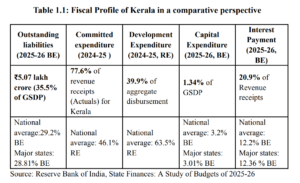

The state’s consumption profile changed sharply after the Gulf migration of the 1970s. Per capita consumer expenditure rose, and Kerala moved to the top of the large states by 1999-2000. It retained that position in the 2022-23 household consumption expenditure survey, the first large sample survey since 2011-12. This should have strengthened the state’s tax base. Consumption taxes remain the mainstay of state revenues.
That did not happen. In the first decade after Kerala’s formation, from 1957-58 to 1966-67, the state accounted for 4.45% of the own resources mobilised by all states and Union Territories. By 2025-26, its share had fallen to 3.71%. This happened even as Kerala’s fiscal potential rose substantially.
Coalition politics explains much of this failure. Both the Left and the Congress-led fronts avoided the harder task of mobilising own resources. They competed instead in exemptions, concessions and unfunded promises. Revenue expenditure was allowed to outrun revenue receipts. Borrowing filled the gap.
The White Paper now puts Kerala’s outstanding liabilities at ₹5.07 lakh crore. The figure would have been still larger but for the borrowing constraints imposed by fiscal responsibility legislation and Union oversight.
READ | Kerala remittances cannot replace jobs at home
Centre cannot be the excuse
Kerala governments have long blamed the Centre for the state’s fiscal squeeze. There is some basis for saying that central transfers have fallen. But this is not an argument Kerala can push too far.
In a federal system, poorer states will receive a larger weight in tax devolution and grants. Kerala has itself claimed, with some justification, that it matches developed economies on several social indicators. It cannot simultaneously claim the fiscal treatment due to poorer states.
The more serious problem lies at home. Kerala has not taxed its prosperity adequately. Nor has it charged enough for public services used by those who can afford to pay.
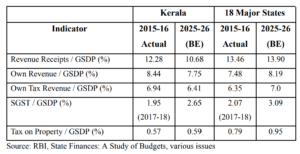
Revenue Performance Indicators: Kerala vs. Major States Average, 2015–16 and 2025–26 (% of GSDP)

Kerala’s regressive revenue base
Kerala’s revenue structure also raises a distributional question. Liquor, lottery, petrol and motor vehicles account for a large share of Kerala’s own resources. Liquor and lottery alone now contribute a far higher share than they did five decades ago.
This is not a healthy revenue structure. If the poor and lower-income households spend disproportionately on lottery and liquor, the tax burden has shifted in precisely the wrong direction. Kerala’s welfare state is being financed in part by those least able to bear the burden.
The state is now caught in a difficult cycle. To broaden its revenue base, it must increase purchasing power among those with a high propensity to consume. Social security payments, especially pensions for the poor, flow quickly into local markets. Yet fiscal pressure has slowed such spending.
At the same time, a large part of the state’s revenue is absorbed by salaries, pensions and interest. Government employees and pensioners form a small share of the population but command a disproportionate share of public spending. This leaves little room for welfare, infrastructure or productive investment.
READ | Kerala ageing population needs rights-based elder care
Own revenue is the answer
Kerala has little room left except to raise more of its own revenue. The political class is reluctant to say this openly. More worrying is the similar reluctance among parts of the bureaucracy and academia. The White Paper too does not state the case with enough force.
Satheesan has little choice. He must make resource mobilisation the core of his Budget. The target should be the middle class and the rich, who have benefited most from public spending and from Kerala’s social infrastructure.
Property tax offers the cleanest starting point for reform. The Constitution assigns this source to states. Kerala has assigned it to local bodies. But local bodies have neither the administrative strength nor the political insulation to tap its full potential. A study by the Gulati Institute of Finance and Taxation has pointed to these limitations.
The state can take back the function through a tax-rental arrangement, compensating local bodies for revenue foregone. With GIS-based assessment and regular updating of property records, collections can rise significantly. This is not an anti-local-body reform. It is an administrative correction.
User charges are the second source. Kerala spends heavily on health and education, but recovers very little through fees and charges. In 1972-73, the state recovered 5.55% of revenue expenditure through such charges. Between 2021-22 and 2025-26, the ratio fell to 1.35%. Tamil Nadu collects far more. Kerala need not copy Tamil Nadu blindly, but it cannot ignore the comparison.
The principle should be simple. Subsidies must be targeted. Those who can pay for public services should pay more. The poor should be protected explicitly, not through blanket under-pricing that benefits everyone.
Electricity duty is another option. A higher duty on larger consumers can raise revenue and curb wasteful consumption. The political resistance will be predictable. That is not a reason to avoid the issue.
Pension reform cannot wait
The White Paper makes several expenditure-side suggestions. It misses one important reform: pensions.
Kerala’s statutory pension system for government employees and aided educational institutions is a legacy arrangement. It was designed for a different demographic era. Life expectancy in India was about 32 years at the time of the 1951 Census. Pension from current revenue may have seemed manageable when retired employees were expected to live only a few years after retirement.
Kerala today has a life expectancy of about 76 years. It will rise further. This changes the arithmetic completely. Pension obligations will continue to swell. No feasible increase in taxation can permanently offset this if the present structure remains untouched.
The state must move towards a more defensible system. One proposal is a need-based universal pension, replacing the present fragmented and privileged pension architecture. Such a shift will be contested. Kerala will continue to borrow to meet commitments it cannot fund from current revenue.
Satheesan’s Budget test
Satheesan must resist the temptation to preserve the existing structure. Incrementalism will not work. Kerala’s fiscal problem is not a temporary cash-flow difficulty. It is a structural imbalance between what the state promises, what it taxes, and who bears the burden.
The June 19 Budget will indicate whether the government is prepared to tax prosperity and contain committed expenditure. Protecting entrenched interests will leave Satheesan managing the decline he has criticised. Reform will bring protests, but postponement will narrow the state’s choices further.
That is the nature of fiscal reform. Kerala has postponed it for too long. Satheesan’s day of reckoning has arrived.
Dr Jose Sebastian is former faculty member of Gulati Institute of Finance and Taxation, Thiruvananthapuram.